


And just like that, the first two months of the 2026-27 college golf season is in the books.
It seems like yesterday it was September and college golf teams were kicking off their seasons across the country. Now, outside of a couple of tournaments, the sport is going dormant for the next three months until the spring season arrives and teams begin a four-month sprint toward the NCAA Championship at Omni La Costa Resort & Spa in Carlsbad, California.
There was no shortage of action from the fall, whether it was school records going down or teams asserting their dominance heading into the holiday break.
Here are some of the biggest stories from men’s college golf this fall, including the biggest winners from the first two months of the season and
more.
Who are the contenders? Auburn, Oklahoma State and more

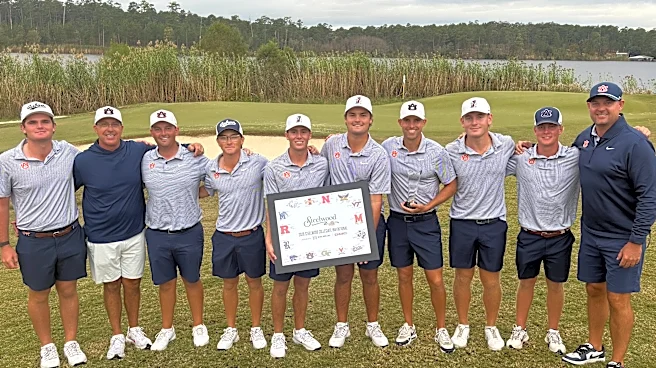
Some things change, and some things stay the same. Auburn and Oklahoma State have won the last three national championships, and they're arguably the two favorites to win again after the fall. Auburn, even after losing arguably the best amateur this century, has won three times and beaten Oklahoma State the same number of times this fall, including in stroke play and match play at the East Lake Cup. The Cowboys have all five starters back for the third straight year, including world No. 1 amateur Preston Stout, and are No. 1 in the NCAA golf rankings after the fall. We'll give Auburn the edge there based on head-to-head, but those two have separated near the top. Arkansas, Florida, Texas, Texas Tech and Tennessee also put together strong fall resumes.
Haskins favorites?
If the season ended today, my vote would be for New Mexico senior Johnnie Clark. He has three wins in four starts, all three of those coming in different countries. He also finished second in his only other stroke-play start, capping a dominating fall slate with more wins than any other Division I player in the country. Illinois' Max Herendeen, OSU's Stout and Texas' Daniel Bennett have also put together strong resumes. Washington's Finn Koelle had a walk-off ace for his first collegiate win and has carried that momentum throughout the year. Oklahoma's Ryder Cowan has also ridden the wave of his big summer into a strong fall with a dominant win at the 2nd Swing Gopher Invitational in Minnesota. The spring is where trophies are won, but if the Fred Haskins Award were given out now, my vote is for Clark.
Biggest surprise thus far?

There are two teams that come to mind. First is Washington with first-year coach Thomas Sutton, who has the Huskies sitting 18th in the country after the fall. Washington has finished below .500 for two straight seasons. Enter Sutton, and the Huskies finished third at the home Sahalee Players and closed the fall with a win at the Saint Mary's Invitational. Second would be Texas, but you can't be surprised that John Fields has guided this team to success. Even after losing Tommy Morrison and Christiaan Maas, Daniel Bennett has stepped up with a pair of wins and has Texas ranked fifth after the fall. Never count out the Longhorns.
Shoutout to the mid-majors
One scroll through the NCAA golf rankings will reveal numerous mid-majors who are making their mark early in the season. Perhaps the roster limits have spread the wealth a little bit in college golf or the overall depth of the sport is shining brighter than it ever has, but seeing numerous mid-majors high in the rankings is awesome to see. New Mexico paces the pack, ranked 11th, but East Tennessee State (No. 20), Santa Clara (No. 22), Liberty (No. 28), UNLV (No. 32), Toledo (No. 33), Pepperdine (No. 34), San Diego State (No. 35) and UNCG (No. 36) are all
Chase for PGA Tour card
One of the biggest competitions each year is for the PGA Tour card via PGA Tour University. Stout has a big advantage after the fall, almost a 200-point advantage over Ryder Cowan. It's not an insurmountable lead, but Stout needs to continue playing like he has to reach No. 1 in the world, and the card is his. Meanwhile, for PGA Tour U Accelerated, Kihei Akina has made massive strides this fall. The sophomore at BYU is up to 12 Accelerated points. When the year began, he had none. He needs 20 to earn his card. He recently made consecutive cuts on the PGA Tour to earn more points.
Cameron Jourdan is an assistant editor of Golfweek, covering college and amateur golf, the PGA Tour and plenty more. Follow Cameron on X/Twitter (@Cam_Jourdan) or Instagram (@GolfweekJourdan).
This article originally appeared on Golfweek: 5 biggest stories from men's college golf this fall. Who are the championship contenders?