




The voice in the back of Patience Rhodes’ head screamed at her. Something was wrong. She didn’t want to believe it.
The pain told her otherwise.
Rhodes, from England and on holiday in Australia with her family in January, was on a boat for a day of snorkeling and fun. As she stepped out of the water and hurried inside the boat, Rhodes slipped on the wet deck. Her foot caught the door frame, sending her tumbling. She twisted her left ankle and her full weight came down awkwardly on the leg while she tried to catch herself.
Her mother thought it was just a sprain. Rhodes wished for the best, but when she woke up the following morning, the pain had gotten worse. A trip to the emergency room confirmed the voice in Rhodes’ head: she had fractured her fibula
and torn five ligaments in her foot and ankle.

“The first thing I thought about was Augusta,” Rhodes said of the Augusta National Womens Amateur. “That’s the main goal every year. I was really worried about not being able to play in that event. It was stressful and traumatizing.”
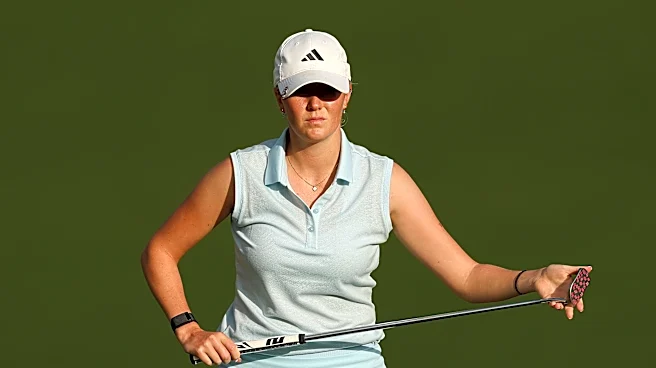
Just months ago, Rhodes was wondering whether she'd ever feel like herself again. A traumatic lower-leg injury halted the best stretch of golf in her amateur career and sent her into a grueling recovery that challenged her physically and mentally.
Now healthy and entering her final season at Arizona State, Rhodes hopes the experience that nearly broke her will help fuel the strongest chapter of her college career.

She and the Sun Devils begin their season Friday at the Mason Rudolph Championship in Franklin, Tennessee, but Rhodes’ journey to this moment began months ago with her left foot in a boot and crutches under her shoulders. Just how difficult the recovery would be became clear when she returned to Arizona.
“When she got off the plane from Australia, I was like, ‘Holy crap, this is going to be a long journey,’” said ASU coach Missy Farr-Kaye.
For the first six weeks of Rhodes’ recovery, she couldn’t put any weight on her left foot. That provided challenges as soon as she walked out of her apartment building, which didn’t have an elevator and required her to go up and down a flight of stairs every time she came and went. Tasks she once took for granted, from taking out the trash to getting in and out of the shower, were suddenly far more difficult.
She went to rehab every day, which was a mental challenge of its own. Rhodes experienced excruciating pain as physical therapists started to move her ankle around and begin the process of simply walking again. The pain never subsided, leading Rhodes' mind to wander as she pondered whether something else was wrong.
She filled her time with research on recovery, drinking gallons of milk to strengthen her bones, and working out where she could, hoping to stay in shape and not lose her touch on the course. In the fall campaign before her injury, Rhodes finished inside the top 13 of all four events and was one of college golf’s top players.
Now, she questioned whether the injury would set her back, a mental battle that was just as tough, if not more, than the physical one. She wanted to be involved with her teammates every day at Papago Golf Course, where the ASU women's and men's teams have a huge practice facility and clubhouse, but once at the course, there was only so much she could do since she couldn’t put any weight on her foot.
“All I wanted to do was get out on the golf course,” Rhodes said. “I was there a couple times watching my teammates play, and I think that's probably the worst thing to do. It just made me way more upset about the situation. It makes you really jealous.”
By early March, a month before Augusta, Rhodes was finally able to put weight on her left foot. Yet her body was not cooperating. She walked with a limp because of the pain, her brain not trusting that the leg could handle weight. The X-rays were clean and the doctors had cleared Rhodes to begin putting weight on her leg, but going so long without walking had conditioned her brain to avoid anything uncomfortable.
It was another mental hurdle Rhodes had to clear.
Farr-Kaye has a whiteboard in her office where she wrote down a plan for Rhodes to return to play. The goal was Augusta, with Farr-Kaye not going to push her to return for the Sun Devils until Rhodes was ready. The plan started with a handful of wedge shots, then gradually increased the number of swings and clubs each day.
In addition to trusting her body through the pain of walking again, she also had to trust turning on her left leg and putting all her weight on it in a golf swing.
“There was just a lot of self-doubt on whether I'd be able to swing the club the same way again,” Rhodes said. “I left my game in such a good place, and just trying to get that back, like just trying to figure it out for three months without being able to play golf was probably the toughest part.”
Farr-Kaye preached that Rhodes had to swing normally. If she tried to alter it to avoid being uncomfortable or wouldn’t swing at 100 percent, Farr-Kaye knew she would build bad habits. Rhodes had to trust her leg.

She didn’t hit a driver until about a week before the ANWA. Rhodes gradually increased her walking to rebuild her endurance, knowing the hills of Augusta National would be challenging.
And they were. There was pain with almost every step. Even with tempered expectations and having gone nearly 5 months without playing competitively, Rhodes somehow made the cut at ANWA and went on to finish T-31.
“I definitely did surprise myself,” Rhodes said. “I just wanted to go out and enjoy myself playing golf again, and not have to worry about the cut or scores and just trying to get a feel for the game again. I think taking the focus off of it a bit made me play better and relax a bit more.”
A week later, Rhodes led the Big 12 Championship with 18 holes to play. She woke up for the final round battling back spasms and lingering pain while walking, yet still finished fourth. Mentally, the back spasms felt minor compared to everything she had already overcome with her leg, and that perspective helped power her through.
At NCAA Regionals, she tied for sixth. Rhodes played at NCAAs, too, feeling like herself more and more with each round.
Then came the Curtis Cup, which included two 36-hole days at the hilly Bel-Air in Los Angeles. Rhodes went 4-1 for the Great Britian & Ireland side, playing every session and proving to herself she could handle the stress. The pain was slowly disappearing. Her game never did.
“I think what's really cool is that I think she's proven to herself that she's tougher than she thought she was, and she's more resilient than she thought she was,” Farr-Kaye said. “I've always seen that in her. I've always seen a lot of talent in her, but to see her dig deep in a way that I'm not sure she knew she had, and now she knows she has it, it's really cool to see because that's going to serve her really well.”
Heading into this week's Mason Rudolph, Rhodes is one of the best players in the country. But after spending months wondering whether she'd walk normally, let alone compete again, pressure on the golf course no longer feels quite the same.
“My first round back, I was just so excited,” Rhodes said. “I felt like I was 10 again at my first golf event, just playing a game instead of being so stressed out about other people's perspectives of you and playing and scores and outcomes and all of this. I was just honestly enjoying the whole process of it, getting back to where I could play and enjoy what I love doing the most.”
Those voices in the back of Rhodes’ head are gone, and so is her pain. The focus is just on golf, which could be bad news for the rest of the country.
Cameron Jourdan is an assistant editor of Golfweek, covering college and amateur golf, the PGA Tour and plenty more. Follow Cameron on X/Twitter (@Cam_Jourdan) or Instagram (@GolfweekJourdan).
This article originally appeared on Golfweek: The injury that nearly broke Arizona State's Patience Rhodes may define her best season yet