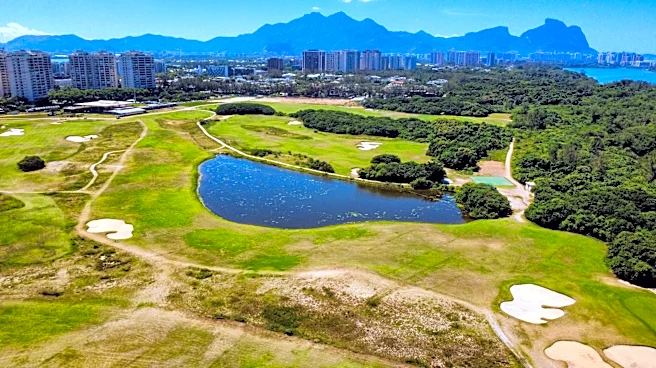




RIO DE JANEIRO, Brazil — The phrase “grow the game” has been repeated so relentlessly in golf circles that it's drifted from mission statement to punchline. Once a rallying cry for expanding the sport’s reach, it now often draws smirks and eye-rolls from those who have heard it deployed far too many times.
Yet on the fairways of Rio’s Olympic Golf Course, the phrase still carries genuine meaning.
The Gil Hanse-designed layout, created specifically for golf’s return to the Olympic Games, remains one of the sport’s most visible legacies from Rio 2016. Spend a day walking the property and the mantra surfaces repeatedly — spoken in both Portuguese and English — by players, caddies and local officials who still believe the Olympic venue can serve as
a catalyst for the game’s growth in Brazil.

Aug. 21 marks the 10th anniversary of the Rio Games' closing ceremony, a milestone that invites reflection on an event widely criticized for cost and extravagance. Much of the infrastructure built for those Olympics has struggled to justify its existence in the decade since. The golf course, remarkably, remains standing, making it one of the few enduring sporting venues from the Games.
But survival is not the same as success.
The Olympic Golf Course, which was built at a cost of roughly $19 million, finds itself in need of significant investment and attention. That reality is striking given its unique place in the city. It is Rio de Janeiro’s only public 18-hole golf course, a remarkable distinction in a metropolitan area of 13.9 million people, a population about one million residents larger than that of greater Los Angeles.
The question facing the facility a decade later is the same one that hovered over the project from the moment the first shovel hit the ground: Can the course become the spark for a lasting golf culture in a country where the sport has traditionally occupied only a small corner of the athletic landscape?
Native Brazilian Adilson da Silva hit the first ceremonial tee shot at those 2016 Games, and the hope was that a nation would follow his lead. It hasn't happened yet, but if the Olympic Golf Course can somehow ignite that transformation, its legacy may ultimately be measured not by the medals won there in 2016, but by the generations of golfers it can inspire long after the torch has faded.
2016 men's Olympics: Justin Rose aces golf's return

Justin Rose arrived in Brazil as an established major champion and left as something no golfer had been in more than a century: an Olympic gold medalist. Along the way, he also recorded another piece of history — making the first hole-in-one in Olympic golf competition during the opening round.
But it was what happened four days later that secured his place in Olympic lore.
On a sun-drenched Sunday at the Olympic Golf Course, Rose outlasted Sweden’s Henrik Stenson in a heavyweight duel between neighbors, major champions and European Ryder Cup teammates. The pair traded punches throughout the final round before arriving at the par-5 18th hole tied for the lead.
What followed became one of the signature moments of the Rio Games.
After reaching the edge of the green, Rose clipped a delicate chip from roughly 25 yards to tap-in range. Stenson, meanwhile, three-putted for bogey. Moments later, Rose rolled in the short birdie putt that secured the gold medal and a two-shot victory.
“It feels absolutely incredible,” Rose said afterward. “I've been so focused, really, to be honest with you. I've been so into it. I've been so up for it. I've been just so determined, I suppose, to represent Team GB as best as I could, and it was just the most magical week, it really was.”

Rose closed with a 4-under 67 to finish at 16 under par, matching the winning score later posted by Inbee Park in the women’s competition. Stenson shot 68 and finished runner-up at 14 under, while American Matt Kuchar surged into contention with a course record-tying 63 to claim the bronze medal at 13 under.
For much of the day, the tournament felt more like a two-man match than a 72-hole event. Rose and Stenson separated themselves from the field early and carried their rivalry into the back nine. Rose briefly surrendered the lead with a bogey at the 13th, only to save par from 20 feet on the next hole while Stenson dropped a shot. Rose moved ahead with a birdie at the 15th, but Stenson answered at the 16th to pull even once again.
Both parred the 17th.
“And then it was game on,” Stenson said.
Few players entered Rio in better form than the Swede. Ranked fifth in the world, he had won the BMW International Open in June before delivering one of the greatest major performances ever at Royal Troon, where he outdueled Phil Mickelson to capture the Open Championship. He followed that with a top-10 finish at the PGA Championship and arrived at the Olympics as arguably the hottest player in golf.
Yet the player who survived the “Duel at Troon” came up short in what many later called the “Rumble in Rio.”
“Of course, when you're in good position to try and win, you always kind of feel a little disappointed afterwards,” Stenson said. “But at the same time, we said that all along in the Olympics, you've got some pretty good consolation prizes. ... No one was giving anything away. It came down to the last hole and I didn’t hit my best pitch and Justin hit a great shot.”
A decade later, the image endures: Rose standing atop the podium, gold medal around his neck, listening to "God Save the Queen" as golf celebrated its first Olympic champion since 1904. At a time when questions surrounded the sport's return to the Games, Rose delivered the kind of dramatic finish the Olympics could only have hoped for, a moment that helped legitimize golf's place in the modern Olympic movement.
2016 women's Olympics: Inbee Park captures gold

When Inbee Park arrived in Rio, her place in golf history was already secure. A seven-time major champion and former world No. 1, the South Korean star had accomplished nearly everything the sport could offer. What remained absent from her decorated resume was Olympic gold, a reflection of circumstance rather than achievement, given golf’s 112-year absence from the Games.
Park left Brazil with that, too, becoming the first golfer since American Margaret Abbott in 1900 to stand atop an Olympic podium and claim gold.
“This is definitely one of the special moments in my golfing career and in my whole life,” Park said afterward. “It feels great. Obviously winning the gold, representing your country, it's so special. It's just really all I've wanted.”
Then 28 years old, Park delivered a masterclass under some of the most challenging circumstances of her career. Her victory was never seriously threatened, finishing at 16 under. Park opened with back-to-back rounds of 66, added a third-round 70, then closed with another flawless 5-under 66 to cruise to a five-shot victory over New Zealand's Lydia Ko. China's Shanshan Feng claimed bronze at 10 under.
The key, Park said, was impossible to miss.
“Obviously, my putter just worked so well this week,” she said. “That was really the key to the gold medal.”
The triumph carried added weight because Park had spent much of the summer wondering whether she would even make it to Rio. A debilitating thumb injury to her left hand had sidelined her for most of the season and threatened both her career and her Olympic dream. She had not competed on the LPGA Tour since missing the cut at the KPMG Women's PGA Championship in June. A planned appearance at the UL International Crown was scrapped because of the injury, and her lone tune-up before Rio, a Korean LPGA event two weeks before the Olympics, also ended with a missed cut.
The uncertainty became so severe that Park considered relinquishing her Olympic spot altogether.

Instead, she persevered, arriving in Rio with little competitive form but a determination that never wavered.
“I fought through injury, and so I'm proud of myself,” Park said. “This is something I've really been dreaming about. Representing your country in the Olympic Games and getting a medal, it's such a special feeling.”
The galleries only made the moment more meaningful. Korean fans packed the ropes throughout the week, transforming parts of Olympic Golf Course into a home-away-from-home for one of the nation's sporting icons.
“There were so many Korean people out here supporting me,” Park said. “It almost felt like we were in Korea. Seeing how much support I had this week, I'm just happy that I finished well. This is definitely a big relief.”
Ten years later, Park's victory remains one of the signature moments of golf's Olympic revival, a reminder that even for a player whose resume was already overflowing with accomplishments, an Olympic gold medal represented something entirely different.
What's next for Rio's golf course?
History aside, golf is at a crossroads in Brazil, a place where the game has lagged far behind many other places in the world.
The course is still very playable and somewhat reasonably priced, but a decade after hosting the Games, Brazil is still a study in contrasts. Latin America’s largest economy has shown resilience, posting steady if unspectacular growth while inflation has cooled from the spikes that plagued much of the post-pandemic era. Yet the country's progress remains tempered by familiar challenges, including steep borrowing costs, massive inequality and persistent fiscal pressures.
Brazil remains an economic heavyweight on the global stage, with a gross domestic product exceeding $2.2 trillion, supported by a diverse mix of agriculture, natural resources, manufacturing and services. Growth has settled into a modest range of roughly 2 to 2.4 percent annually, offering stability but underscoring the difficulty of generating the kind of sustained expansion needed to address the country's deeper structural issues.
For a country still balancing immense potential with equally significant challenges, the economic story a decade after Rio 2016 is one of progress, but also unfinished business.
Golf has largely remained a game concentrated within Brazil’s wealthiest circles, a reality that surprises few who have followed the sport’s trajectory in the country. If anything, it reflects the skepticism that surrounded golf’s Olympic return from the very beginning.

Back in 2016, then-Golfweek architecture editor Brad Klein cautioned against expecting a transformative boom from the visibility generated by the Rio Games. The notion that a two-week Olympic spotlight would suddenly propel golf into Brazil’s sporting mainstream, he argued, was always a long shot.
A decade later, that assessment appears spot-on. While the Olympics delivered unforgettable moments and left Rio with a world-class public golf course, the dramatic surge in participation that some envisioned never materialized.
From Klein's story:
... the long-term legacy of golf at the 2016 Rio Games remains very much uncertain. Surely a stirring week of women’s play ... will help generate more fan attention worldwide. But if one of the goals of getting golf into the Olympic Games was to help grow the game in countries where golf has yet to take a foothold, these matches are likely to have no impact.
There’s no evidence in the developing world that exposure to competitive golf develops mass popularity and participation. An aspiring country such as China might seek world-class status through training elite athletes to compete on a global stage. But that doesn’t translate into mass participation without an entirely different, populist emphasis, one based on getting youth from the peasantry and middle classes out to play.
Absent that effort, golf is likely to remain a game of the elite in developing nations. And it’s likely to remain closed off from the concerns of everyday life and recreation. Evidence for that can be seen in Rio itself, where a virtual police-state presence has kept an uneasy peace in the city’s impoverished urban ghetto favelas during these games.
It remains to be seen if and to what extent the Olympic Golf Course will be open to public play – and at what cost. Day-to-day management is due to turn over soon to the Brazilian Golf Federation, though the group has been curiously quiet about its plans for operation of the golf course and whether everyday citizens will be able to afford to play golf there.
Given the recession ravaging Brazil and the political paralysis of the country’s government, there’s little reason to believe that the fate of the entire Olympic infrastructure – venues, roads, housing - will be much different than the fate of other Olympic facilities in other economically stressed places such as Sarajevo and Athens.
Klein's warning looks remarkably prophetic a decade later. The Olympic spotlight came and went, but the surge in participation many hoped for never arrived. Golf remains a niche pursuit in Brazil, and even the country's most visible golf venue has struggled to generate sustained momentum.
The Olympic Golf Course has evolved in small ways since 2016. A bar and children's play area have been added to broaden its appeal, and the facility now boasts one of the few traditional golf shops in the country, where much of the retail market relies on vending machines rather than fully stocked pro shops.
Yet, for all the course's pedigree, the reality is that Brazil's golf population remains relatively small.
When a recent group of Golfweek course raters visited the property in April, local officials brought out one of their most influential ambassadors. Humberto Martins is among Brazil’s most recognizable actors, a household name whose impact extends beyond television screens and into fairways.

An avid golfer, Martins has spent years championing the sport in a country where it remains far from mainstream. He has helped introduce golf to Brazilian audiences by weaving it into the fabric of popular culture, even persuading TV writers to make the game part of his characters’ lives in telenovelas. He is also a regular fixture at charity tournaments and golf-related events, using his celebrity to expose new audiences to the sport.
Few people have worked harder to expand golf’s reach in Brazil.
Martins is also a frequent presence at the Olympic Golf Course, a facility he views as one of the sport’s greatest opportunities in the country. Like many of the game’s most passionate advocates, he remains hopeful that the course can eventually become more than a relic of Rio 2016 and instead serve as the foundation for a broader golf movement in Brazil.
"I think golf strengthens the family, this bond that we need so much," he told Golfweek. "It's a sport of respect, it's a sport of gentlemen where there is no dispute between one and another, the treatment is cordial. Everyone is a friend. We compete against the field and against ourselves.
"I started playing this sport about 30 years ago. And we are enchanted. And this, this is within nature, right? So you have this beautiful view there, of the Atlantic forest and all this. The sea right there in front, right? It's wonderful."
South America's upside is enormous
The game has gained some visibility, new facilities and a handful of passionate ambassadors like Martins, but it remains a niche pursuit concentrated among the country's wealthier communities. Brazil's golf story has been gradual at best, with advocates still searching for a breakthrough that could carry the game into the mainstream.
Yet if golf ever truly gains a foothold in South America, the upside could be enormous. The region remains one of the sport’s great untapped frontiers. According to The R&A’s Global Golf Participation Report, Central and South America trails even Africa in the number of 9- and 18-hole golfers, underscoring just how small golf’s footprint remains across the continent.
That reality also highlights the opportunity. South America is home to roughly 440 million people, meaning that even a modest increase in participation could translate into hundreds of thousands of new golfers. For equipment manufacturers, course developers, event organizers and broadcasters, the potential market is far larger than current participation figures suggest.
That's why advocates continue to view facilities such as the Olympic Course as more than local projects. If they can help introduce the game to a broader audience, the long-term implications could extend well beyond Brazil, opening the door to one of golf’s most significant growth opportunities anywhere in the world.
Change in 9- and 18-hole golfers
One of the country's emerging young talents, Paco Casini spends his days as a caddie at the Olympic Course while chasing a dream that stretches far beyond its fairways. Casini recently celebrated his 18th birthday and finished third in the Aberto do Campo Olimpico de Golfe, earning himself a place in the World Amateur Golf Ranking. But with limited opportunities to compete internationally, he remains buried deep in the standings at No. 1,242.
That reality means there are few shortcuts.
Casini hustles for every opportunity, carrying clubs while squeezing in practice whenever he can. He knows the options for working on his game are slim.
"There's not much, because here, it's a really expensive sport to golf. To (play) a public course, you need money and most players don't have money, so they don't play golf. And the players that have money prefer to play in private clubs. It's not a great deal, you know," he said. "So, that's why there are more private clubs than public."
So how important is the Olympic course?
"It's really important," Casini said. "It's the only public course in Rio, and I think one of four in Brazil. So, yeah, it's really important here."
Tim Schmitt is the managing editor of Golfweek.
This article originally appeared on Golfweek: A decade later, Rio's Olympic Golf Course might house the world's most important 18 holes