


The morning sun was just beginning to stretch across the Atlantic when our threesome arrived at the first tee of Great Dunes Golf Course on Jekyll Island. The air was salty, the breeze gentle and the course looked as though it had stepped straight from a Roaring Twenties postcard.
A silver-haired starter greeted us with a smile.
"Do you fellas know who Mae West is?"
My two older playing partners exchanged knowing glances: the blonde bombshell who starred in films such as I'm No Angel nearly a century ago. Yours truly was about to get a history lesson.
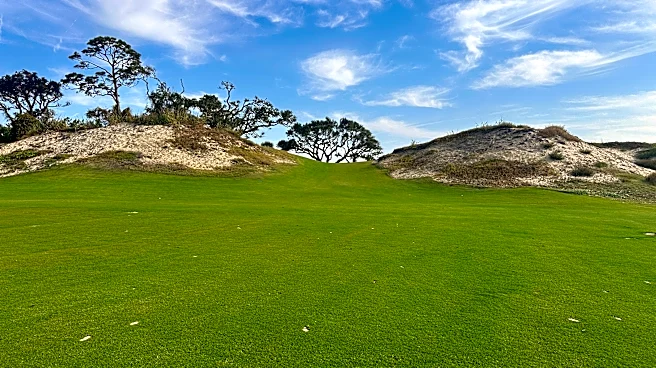
"We call the fourth hole here our Mae West hole," the starter explained. "Two big mounds guard a hidden elevated green."
He paused for effect.
"Sometimes we call it the Dolly Parton hole, too."
Laughter
erupted.
My cart mate leaned toward me.
"Maybe they ought to update the name and call it the Sydney Sweeney hole."
The starter slapped his knee.
And so began our round at Great Dunes, where golf, history and a little harmless male mischief intersect over 18 memorable holes.

Great Dunes isn't technically a new golf course. It's a classic reborn.
Walter Travis, a three-time U.S. Amateur champion and the first American to win the British Amateur, designed the course as a retreat for members of the Jekyll Island Club, whose ranks included the Vanderbilts and Rockefellers. It was his final design, opening in 1927 shortly after his death.
Great Dunes is one of only three Travis designs open to the public in the United States, according to golf course architects Brian Ross and Jeffrey Stein. A storm in 1947 damaged the back nine of the original layout, and erosion and redevelopment eventually claimed those holes altogether. The State of Georgia acquired the property and operated the remaining course as a public facility.
Using archival photographs and historical research, Ross and Stein reimagined the property by combining the surviving nine-hole Travis layout with portions of Dick Wilson's neighboring 18-hole Oleander Course. The original Travis holes now comprise Nos. 4 through 12.
The result is a course that honors its roots while offering a fresh identity of its own.
Ross and Stein deserve credit for threading the surviving Wilson holes through forested wetlands while preserving the strategic character and aesthetic principles of Travis' Golden Age design. The unused Oleander holes were converted to conservation land, creating an environmentally sensitive project.
When I visited a year ago and about a month after the reopening, some growing pains remained. The greens were still maturing, and a few turf areas needed additional time to fill in. Yet it was already easy to see the course's potential.
In fact, Great Dunes seemed destined to become the most popular course on Jekyll Island, giving sister layouts Pine Lakes and Indian Mound serious competition.
The case for that distinction began early in the round.
Then came the fourth, the Mae West hole and the star attraction.
At 533 yards from the back tees, the par 5 isn't especially long by modern standards. What makes it unforgettable is the design.
The fairway rises steadily toward a green hidden behind two massive sandy dunes, twin peaks to continue the metaphor of our starter. They look innocent enough from a distance but an approach from the fairway is a blind shot and the carry required can be deceptive. Long hitters may be tempted to attack in two, but missing left or right can leave a ball swallowed by dune sand, beach grass, wildflowers and native coastal vegetation. It’s arguably the most interesting risk-reward shot of the round.
The climb itself to the green is worth it.
Cresting the hill reveals one of the course's finest surprises. Beyond the green, the Atlantic Ocean stretches toward the horizon just beyond North Beach Road. It's the kind of moment that briefly makes players forget about their score and appreciate where they are.
The seventh hole delivers a different sort of challenge. Measuring 228 yards from the back tees, the par 3 demands both length and precision, with two imposing bunkers guarding the front of the green.
"I should hit driver here," my playing partner said, "but I'm just too proud."
The eighth, another par 5, offers its own memorable features, including a pronounced ridgeline crossing the fairway near the green and a wooden archway built into a mound along the right side. Just the sort of quirky design feature you don’t see enough of these days.
The back nine winds through forested wetlands and continues the course's theme of strategic options and visual interest. Elevation changes create thoughtful decisions throughout the round, while the sandy coastal landscape gives Great Dunes a distinct sense of place.
Another noticeable change to those who have played here before extends beyond the golf itself. With the old Oleander Course having been merged into the new Great Dunes routing, it now shares a clubhouse with Indian Mound and Pine Lakes, while its former check-in hut has been repurposed as a halfway house behind the eighth green. It's a fitting transformation for a property that has managed to preserve its history while embracing something new.
By the time we finished, I was convinced the fourth hole deserved its reputation. It was challenging, funny, beautiful and just a little dangerous. It demanded respect, rewarded good decisions and had enough personality to keep golfers talking long after the final putt.
In many ways, the hole mirrors Great Dunes itself.
Ross and Stein didn't simply restore a Golden Age design principles into affordable public golf near the ocean. That alone would have been an achievement but they gave the final design of Travis a new identity, preserving its past while injecting it with fresh energy, character and just enough swagger to keep golfers coming back for another look.
Adam Schupak is a senior writer for Golfweek, covering the PGA Tour.
This article originally appeared on Golfweek: Great Dunes rises again: How two designers brought Walter Travis' final design back to life