

The question sounded simple.
As Adam Hadwin picked apart Colonial Country Club — hitting its first 13 fairways in regulation during the second round of the 2015 Crowne Plaza Invitational in Fort Worth, Texas — Golf Channel analyst Brandel Chambleewondered when the last time was that anyone had hit every fairway and every green on the course known as “Hogan’s Alley.”
But Chamblee didn’t search out the answer himself. Instead, he turned to researcher Justin Ray, who delivered the answer within five minutes. He would’ve reported back sooner if he hadn’t been determining simultaneously that the only two players who had accomplished this feat in the last 30 years were Fulton Allem in 1992 and Tim Clark in 2007.
“He’ll find stuff nobody can find and
he’ll think of things nobody will think of,” Chamblee said.

For years, Ray, 41, has been quietly building a reputation as one of golf’s most remarkable statistical minds. To many fans, he became the person behind the numbers — the guy who could answer the question nobody else had thought to ask. For the third straight Solheim Cup, he’ll attempt to give the U.S. side a slight edge by crunching the numbers to its benefit. And it all started when he was a kid.
“I was the kid who kept his Little League stats in Microsoft Excel,” Ray said.
Perhaps it was inevitable that he’d find his way in golf. His father, Mike Ray, was the longtime executive director of the Southern Texas PGA section before later becoming an executive with the PGA of America. His uncle worked in the golf business, and his brother played college golf. Golf was everywhere around Justin.
But when he arrived at the University of Missouri School of Journalism, he wasn't dreaming about becoming a statistician. He had a different hero.
“I wanted to be Dan Patrick,” he says.
That ambition led him to ESPN in 2007. What began as an internship turned into a seven-year journey at the worldwide leader in sports. Ray worked his way up, eventually becoming a researcher for The Scott Van Pelt Show. He also worked behind the scenes during ESPN's coverage of the Masters and the U.S. and British Opens. In those days, he described himself simply as a “professional sports nerd.”
But there was something different about Ray's nerdiness. He didn't just know statistics. He knew how to find stories inside them.
Ray built an enormous database covering every major championship in men's golf history, dating back to 1860. He created another database containing every round ever played at the Masters. Ask him how much better Tiger Woods was than everyone else during the majors from 1997 through 2008, and he can give you the answer almost instantly. Woods finished that span 126 under par. The rest of the field? For those scoring at home, players who competed in at least 40 rounds were collectively 189 shots worse.
Those are the kinds of numbers Ray loves. Numbers that make people stop scrolling. Numbers that make people say, Wait. What? And social media gave him the perfect platform. Ray's statistical discoveries began spreading online, turning him from a behind-the-scenes researcher into one of golf's most recognizable statistics experts.
But Ray believed golf was only beginning to understand what data could do. As sports gambling expanded across the United States and professional teams became increasingly sophisticated in their use of analytics, statistics were no longer merely trivia. They could influence strategy, preparation and even the outcome of competitions. Ray's expertise eventually took him far beyond television research. For several years, he was head of content for Twenty First Group, a data-analytics company that helped Team Europe regain the Ryder Cup in 2018, and recently started his own company, Justin Ray Sports.

He’s worked with the DP World Tour and LPGA extensively on their stats programs, and he handled data analytics for U.S. Solheim Cup Captain Stacy Lewis in 2023 when the match ended in a tie and in victory in 2024. For the U.S. team, statistics weren't simply something interesting to discuss after a round. They became part of the decision-making process. Working with Lewis and KPMG Performance Insights, Ray and the analytics team could examine details that traditional statistics often missed.
In 2023, those numbers told Ray something particularly important about Lexi Thompson. Traditional results suggested Thompson was struggling. She had missed five of her previous six cuts heading into the competition. But beneath those results, the statistics told a different story. Thompson's underlying performance suggested she was playing better than the results indicated. Lewis trusted the data. She also trusted what she was seeing during practice. So Thompson was placed in the opening pairing with Megan Khang. It was a bold decision. Even Lewis wasn't completely certain she had made the right call. The night before the matches, she couldn't sleep.
“Was this the right move? Did we dive too much into the stats? Am I trusting this too much?” Lewis later recalled to Golf Digest.
Thompson and Kang rolled to victory and Thompson would go on to win three of her four matches overall, her best Solheim Cup since 2017.
The statistics had seen something before the scoreboard did. The stats spit out from his spreadsheets could help a captain make a difficult decision when instinct and conventional statistics pointed in different directions.
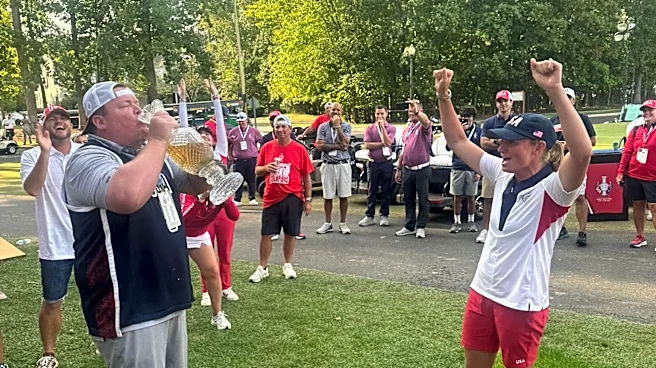
Ray returned to the U.S. team in 2024, playing a role in a winning Solheim Cup campaign. And because Ray apparently wasn't satisfied with simply helping the team win, he had made a promise. If the United States won, he would get a tattoo. They won. Ray kept his word. Then came the celebration. At the team's victory party, Ray posted a message still pinned to the top of his X feed that perfectly captured the unusual journey of a man who had spent his career buried in spreadsheets and databases:
“Just karaoke-rapped Hypnotize by Biggie in the US team room, dreams do come true.”

He’s dreaming of being part of another victory party if the U.S. side can retain the Solheim Cup this week. It would be a perfect ending for the boy who wanted to be the next Dan Patrick, but he’s already on to his next chapter.
Ray's reputation has grown to the point where U.S. Ryder Cup captain Jim Furyk brought him onto the American team for the 2027 matches at Adare Manor in Ireland. Ray is teaming with Hunter Stewart in crunching the numbers for the Stars and Stripes and locking horns with Edoardo Molinari, Team Europe’s data analytics wizard, in hopes of ending America’s winless drought on foreign soil dating to 1993. Furyk had a simple description for Ray.
“Justin is our big picture guy,” he said.
The golf world sees the leaderboard; Ray sees everything underneath. Somewhere inside all those numbers is a story waiting to be found. Ray's job is to find it before anyone else does.
Adam Schupak is a senior writer at Golfweek.
This article originally appeared on Golfweek: Meet the man crunching the numbers for the U.S. Solheim Cup team