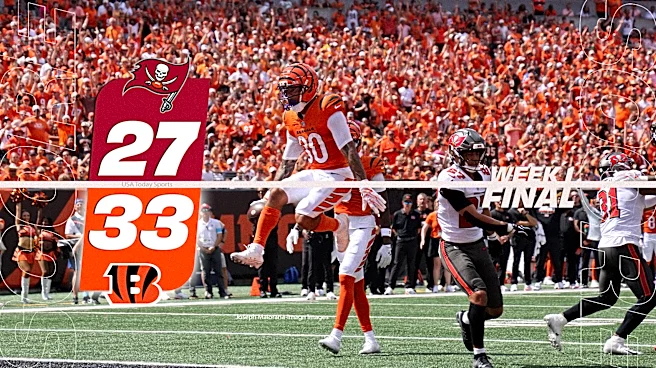



The Tampa Bay Buccaneers opened the 2026 season with plenty of flashes against the Cincinnati Bengals, but four turnovers were too much to overcome in a 33-27 loss at Paycor Stadium. Tampa Bay actually moved the ball fairly well for much of the afternoon, but the offense repeatedly gave Cincinnati extra possessions and short fields while the Bucs were trying to climb back into the game.
If there was one player who encapsulated the afternoon, and it was Baker Mayfield. Tampa Bay’s quarterback made some outstanding plays, extended drives with his legs and helped keep the Bucs alive late, but his inability to protect the football was also at the center of the loss. Mayfield finished 23-of-28 for 216 yards with no interceptions and a 98.8 passer
rating while adding 30 yards and a touchdown on five carries, but he fumbled three times and lost all three.
Bucky Irving added another lost fumble, giving Tampa Bay four turnovers without throwing a single interception. The Bengals did not turn the ball over until Josiah Trotter’s pick-six late in the third quarter, and that turnover differential allowed Cincinnati to build a lead even though the Bucs continued moving the football. Tampa Bay finished with 282 total yards, 19 first downs and converted five of 10 third downs, while Cincinnati totaled 351 yards, 26 first downs and converted eight of 14 third downs.
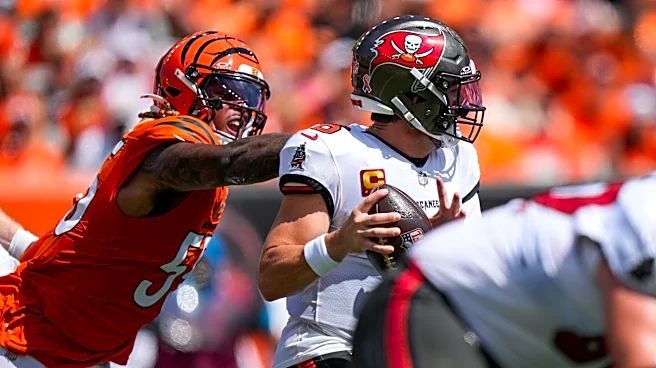
The first turnover immediately changed the tone of the game. With Tampa Bay leading 3-0, Mayfield was stripped by Myles Murphy on third down, and Demetrius Knight returned the loose ball 27 yards for a touchdown. On Tampa Bay’s next possession, Irving lost the football after catching a seven-yard checkdown on third-and-14, and Cincinnati turned that short field into a Joe Burrow touchdown pass to Mike Gesicki.
The mistakes continued in the second quarter. Mayfield escaped pressure and turned what looked like a broken play into an eight-yard scramble toward the Cincinnati goal line, but instead of going down, he tried to make one more defender miss and fumbled through the end zone for a touchback. The Bucs had now lost fumbles on three consecutive possessions, and Cincinnati eventually stretched its lead to 21-3.
The opening offensive drive covered 56 yards on 11 plays and ended with a 34-yard Chase McLaughlin field goal, and the defense followed that up by forcing Cincinnati into a three-and-out. From there, the Bucs went from looking in control to turning the football over on three straight offensive possessions, including one that immediately became a Bengals touchdown.
Tampa Bay finally settled down late in the second quarter, as Mayfield connected with Emeka Egbuka for 11 yards, Chris Godwin for 30 and Egbuka again for 13 before finding Cade Otton for another 10 yards. Irving finished the 75-yard drive by bouncing a run outside and scoring from 10 yards out, cutting the deficit to 21-10 before Cincinnati added a field goal just before halftime.
Irving remained one of Tampa Bay’s most dangerous players despite his fumble. He finished with 45 rushing yards and a touchdown on eight carries, averaging 5.6 yards per attempt, and added seven receptions for 48 yards on seven targets. His vision stood out early, particularly when he was forced to cut runs back across the formation after the original lane disappeared.
Egbuka also quietly put together a productive opener, catching five of six targets for a team-high 63 receiving yards. Godwin caught all four of his targets for 40 yards, including the 30-yard reception that helped spark Tampa Bay’s first touchdown drive, while Otton finished with three catches for 26 yards.
The biggest bright spot of the afternoon, however, belonged to rookie linebacker Josiah Trotter. The second-round pick recorded 10 combined tackles, a sack and an interception in his NFL debut, and his impact went well beyond the box score because he was consistently flying downhill and arriving at the football with force.
Trotter recorded his first NFL sack in the third quarter when he shot through the interior of Cincinnati’s offensive line and brought Burrow down for a nine-yard loss. Cincinnati still managed to hit a 55-yard field goal on the possession, but Trotter’s ability to generate pressure from inside was one of the most encouraging defensive developments of the game.
His biggest moment came with 2:24 remaining in the third quarter. Trotter showed pressure at the line before dropping into the middle of the field, undercut Burrow’s throw intended for Andrei Iosivas, and returned the interception 38 yards for a touchdown. The play gave Trotter his first NFL interception and touchdown in the same quarter as his first sack, and it suddenly cut Cincinnati’s lead to 27-20.
The secondary had its moments of greatness as well. Zyon McCollum helped force Cincinnati’s opening three-and-out by breaking up a third-down throw intended for Ja’Marr Chase, while Benjamin Morrison stepped into a larger role after Jacob Parrish left with an injury. Morrison finished with four tackles and a pass defense, and he was repeatedly around the football after entering the game.
Todd Bowles also won his first challenge of the season after Tee Higgins was initially credited with a 33-yard reception late in the third quarter. Replay overturned the ruling and changed the play to an incompletion, and Morrison followed shortly after by breaking up another pass intended for Higgins.
Even with the good there were still plenty of problems defensively. Cincinnati repeatedly found openings underneath and, in the flats, particularly with its tight ends and running backs, while Tampa Bay struggled at times to finish tackles in space. Gesicki finished with five catches for 78 yards and a touchdown, and Drew Sample added three catches for 19 yards as Cincinnati continued attacking the middle and underneath areas of Tampa Bay’s zone coverage.
The Bucs also struggled to consistently affect Burrow despite showing pressure from different looks. Burrow finished 25-of-35 for 254 yards with one touchdown and one interception, while Tampa Bay recorded only one sack for nine yards. Cincinnati averaged 5.6 yards per offensive play and held the football for 31:25 compared to Tampa Bay’s 28:35.
Tampa Bay’s defense was also hurt by poor footing throughout the afternoon. Multiple defenders slipped while trying to change direction or close on ball carriers, and those missed opportunities stood out when Cincinnati attacked the flats. Whether it was the surface, cleat choice, or simply bad footing, it repeatedly put Tampa Bay defenders in poor position to finish plays.
The Bucs did continue fighting as the game continued onward. After McLaughlin hit a 51-yard field goal to make it 27-13, Trotter’s pick-six brought Tampa Bay within seven, but Cincinnati answered with a 58-yard Evan McPherson field goal early in the fourth quarter. Tampa Bay then appeared to be building another promising drive before Mayfield was stripped by Boye Mafe following a delay-of-game penalty, giving Cincinnati its fourth takeaway of the afternoon.
Even after the fourth turnover, Tampa Bay still made things interesting. Rookie Ted Hurst became a major part of the final touchdown drive, catching three consecutive passes for 16, eight and 12 yards. Hurst finished with three receptions for 36 yards on three targets, and all three catches came during a two-minute, 51-yard touchdown drive in the fourth quarter.
Mayfield eventually finished that possession himself, scrambling nine yards up the middle for a touchdown that made it 33-27 with 3:19 remaining. The Bucs still had all three timeouts at that point, but Cincinnati never gave the football back after Burrow completed passes for 18 yards to Denzel Mims, 14 yards to Samaje Perine and 18 yards to Higgins on the final possession.
The Buccaneers special team's unit also had a few positives. Josh Williams had a 47-yard kickoff return late in the fourth quarter, while Tampa Bay averaged 29.4 yards across seven kickoff returns. David Walker also showed up around the football in coverage and was credited with a special team's tackle.
McLaughlin did his part as well, connecting from 34 and 51 yards while making all three of his extra points. Tampa Bay scored on five offensive possessions and never punted, which made the four turnovers even more frustrating because the offense moved the ball when it kept possession.
The final numbers show just how costly those mistakes were for Tampa Bay. Tampa Bay lost four fumbles in a six-point game, committed eight penalties for 39 yards, and finished just 2-for-4 in the red zone. Cincinnati did not dominate statistically, but the Bengals protected the football outside of Trotter’s interception and repeatedly took advantage when Tampa Bay handed them extra opportunities.
There is plenty Tampa Bay can build on after Week 1. Trotter looked like an immediate difference-maker, Irving remained dangerous with the ball in his hands, Hurst showed something when his number was finally called, and Mayfield proved again that he can keep plays alive when everything around him starts breaking down. The problem is that Mayfield’s game was also a microcosm of Tampa Bay’s afternoon, because every impressive flash seemed to come with a mistake waiting around the corner.
The Bucs were down 21-3 in the second quarter and still managed to turn the game into a six-point finish. That fight at the end of the game is what you want to see as a Bucs fan, but Tampa Bay also put itself in that hole with three consecutive lost fumbles and eventually finished the afternoon with four. In a 33-27 loss, the biggest things the Bucs have to clean up before Week 2 are consistency and turnovers.
The Bucs were down 21-3 in the second quarter and still managed to turn the game into a six-point finish. That fight matters, but Tampa Bay also put itself in that hole with three consecutive lost fumbles and eventually finished the afternoon with four. In a game that ended 33-27, that is going to be the biggest thing the Bucs have to clean up before Week 2.
This article originally appeared on Bucs Wire: Four turnovers sink Bucs in Week 1 loss to Bengals