

The Baltimore Ravens released their first unofficial depth chart ahead of Sunday’s season opener against the Indianapolis Colts.
On offense, the Ravens list Zay Flowers and Rashod Bateman as the starting wide receivers, with Mark Andrews and Durham Smythe occupying two starting tight end positions. Lamar Jackson, Derrick Henry, Ronnie Stanley and Roger Rosengarten fill their expected roles. The defensive front consists of Nnamdi Madubuike, Travis Jones and Calais Campbell, with Trey Hendrickson listed as the starting rush linebacker. Roquan Smith and Trenton Simpson are the first-team inside linebackers, although Simpson shares his position with Teddye Buchanan.
Anthony Weaver's defense has Marlon Humphrey and Nate Wiggins starting at cornerback.
Kyle Hamilton is classified simply as a defensive back, with Jaylinn Hawkins and Malaki Starks starting at strong and free safety, respectively.
Here are 10 takeaways from the Ravens’ initial depth chart of the 2026 regular season.
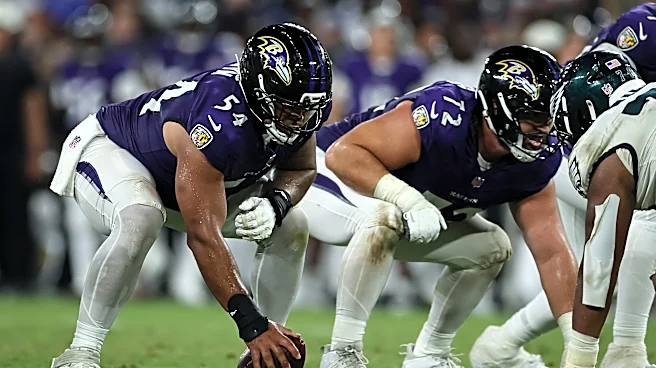
Jovaughn Gwyn is the starting center.
Minter removed the suspense before the depth chart was released, confirming Gwyn would start against Indianapolis.
The chart reinforces that decision, listing Gwyn ahead of veteran Ethan Pocic. Gwyn has appeared in 19 games over three seasons but has never started an NFL game.
His responsibilities will include delivering clean snaps, identifying pressure and communicating protection adjustments with Lamar Jackson. The Colts’ interior front, led by DeForest Buckner and Grover Stewart, will provide an immediate challenge.
Rookie Vega Ioane starts at right guard
Baltimore’s first-round pick will begin his career in the starting lineup.
Ioane is listed at right guard, with Emery Jones Jr. behind him. The rookie’s size and power should complement the physical identity Baltimore wants to maintain with Derrick Henry.
Ioane also received work at center during training camp, but the depth chart confirms that right guard will be his primary assignment entering the season.
Baltimore lists two starting tight ends.
Mark Andrews and Durham Smythe are both listed as starters, while Baltimore does not include a fullback position.
That structure provides an early indication of how Declan Doyle could arrange his offense. Andrews remains one of Jackson’s leading receiving options, while Smythe offers experience and value as an in-line blocker.
Rookies Josh Cuevas and Matt Hibner are the second-team options.
Ja’Kobi Lane begins behind Rashod Bateman
Lane will not immediately displace one of Baltimore’s established starting receivers.
Zay Flowers and Bateman occupy the two starting positions. Devontez Walker is listed behind Flowers, while Lane will open behind Bateman.
The big-bodied rookie should still have opportunities in red-zone packages and situations where Baltimore wants additional size on the perimeter.
Calais Campbell is a starting defensive end.
Campbell returned to Baltimore for what he has said will be his final NFL season, and the 40-year-old is not listed as a ceremonial veteran.
He will start at defensive end alongside Nnamdi Madubuike and Travis Jones. Aeneas Peebles is listed behind Campbell.
The Ravens can manage Campbell’s snaps throughout the game, but his first-team designation reflects the important role he will play against Jonathan Taylor and Indianapolis’ rushing attack.
Trey Hendrickson leads the pass-rush rotation.
Baltimore’s biggest defensive addition is listed as the starting rush linebacker.
Second-year edge defender Mike Green will back up Hendrickson. That arrangement gives Anthony Weaver an established pass rusher and a young player positioned for a breakout season.
Hendrickson’s presence should also create more favorable matchups for Green, Madubuike and Baltimore’s other defensive linemen.
One starting competition remains unresolved.
Trenton Simpson and Teddye Buchanan are separated by an “or” at weakside linebacker.
It is the only first-team position on the depth chart that contains that designation. Simpson has more experience, but Buchanan has continued pushing for a larger role after a promising rookie season.
Baltimore could rotate both players depending on personnel, matchups, and game situations.
Kyle Hamilton is a Swiss Army Knife
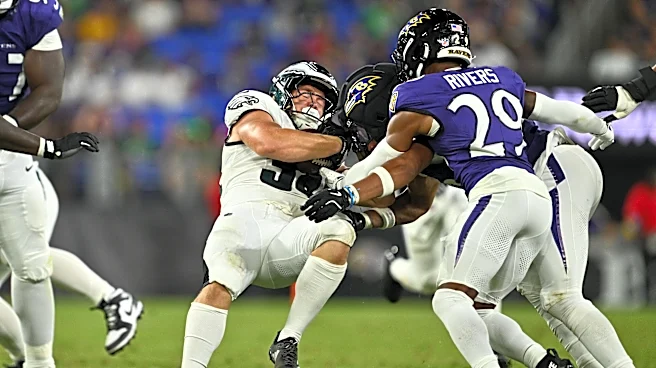
The Ravens did not confine Hamilton to a traditional safety designation. He is listed simply as a defensive back, with Keyon Martin and rookie Chandler Rivers behind him.
That classification reflects Hamilton’s versatility. He can operate as a deep safety, cover the slot, play near the line of scrimmage, and pressure quarterbacks.
His designation should allow Weaver to build packages around Hamilton without attaching him to one position.
Jaylinn Hawkins joins Hamilton and Malaki Starks.
Hawkins is listed as the starting strong safety, while Starks occupies the free safety position.
With Hamilton classified separately as a defensive back, the Ravens effectively list three safeties among their defensive starters. That alignment could become Baltimore’s preferred answer against offenses using multiple receivers and versatile tight ends.
Keondre Jackson is listed behind Hawkins and Starks.
Two young players hold the kicking jobs.
Second-year kicker Tyler Loop and rookie punter Ryan Eckley will handle two of Baltimore’s most scrutinized roles.
Eckley is also the holder, while Nick Moore remains the long snapper. Jake Moody is not included because he is on the practice squad.
This article originally appeared on Ravens Wire: Ten takeaways from the Ravens’ first depth chart of 2026