


The Baltimore Ravens enter training camp with established starters at most offensive positions and several competitions for backup roles.
That creates difficult roster math for undrafted rookies and developmental players. Strong practices will help, but players near the bottom of the depth chart must also contribute on special teams and demonstrate enough versatility to become viable game-day options.
Here is one player at each offensive position facing a particularly difficult path to Baltimore’s initial 53-man roster.
Quarterback: Joe Fagnano
Fagnano’s chances improved when Baltimore waived fellow undrafted rookie Diego Pavia before training camp. His path remains difficult because the Ravens already have three quarterbacks with NFL experience.
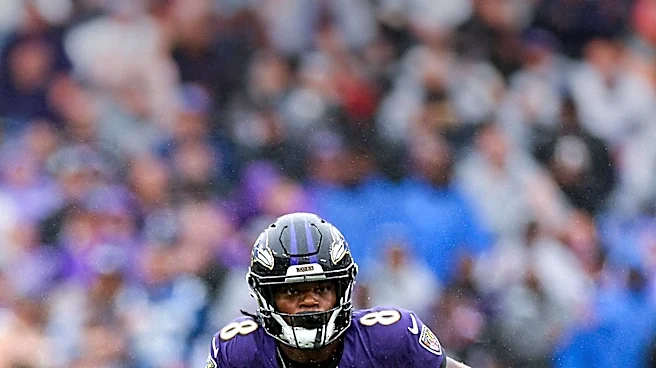
Lamar Jackson and Tyler
Huntley are secure atop the depth chart. Skylar Thompson emerged from spring practices as the favorite for the third position, leaving Fagnano as the only rookie in the competition.
Baltimore could keep only Jackson and Huntley on the active roster, further reducing Fagnano’s chances. He must outperform Thompson during the preseason to force the Ravens to carry three quarterbacks. Otherwise, the former Connecticut starter is a logical practice-squad candidate.
Running back: Elijah Tau-Tolliver
Derrick Henry and Justice Hill have secure roles, while Rasheen Ali and fifth-round pick Adam Randall are competing to become Baltimore’s third running back.
That leaves Tau-Tolliver battling Dontae McMillan for opportunities at the bottom of the depth chart. Both arrived as undrafted rookies and must distinguish themselves with limited practice and preseason touches.
Tau-Tolliver needs to demonstrate value beyond rushing production. Pass protection, receiving ability and special teams performance will determine whether he can close the gap. The Ravens may only keep three running backs, leaving even Ali or Randall vulnerable to difficult roster math.
Wide receiver: Xavier Guillory
Baltimore’s offseason investment at wide receiver created one of the roster’s most crowded competitions.
Zay Flowers and Rashod Bateman are established starters. Devontez Walker enters his third season after averaging 22.7 yards per reception and scoring three touchdowns in 2025. The Ravens also drafted Ja’Kobi Lane and Elijah Sarratt, giving both rookies significant advantages.
LaJohntay Wester provides return value, and the addition of veteran Chris Moore adds another experienced special-teams contributor. Guillory must also compete with Dayton Wade, Cornelius Johnson, Cortez Braham Jr. and Octavian Smith Jr.
Guillory spent last season developing but did not appear in a regular-season game. With Baltimore likely to keep five or six receivers, he needs a series of explosive preseason performances to climb the depth chart.
Tight end: Ty Pezza
Pezza is an intriguing developmental player because he began his career at Brown as a wide receiver. He recorded 87 receptions for 959 yards and nine touchdowns across 38 college games while adding 24 special teams tackles.
That combination gives him a chance to contribute in multiple roles, but the tight end depth chart contains several players with significant advantages.
Mark Andrews remains the starter, while veteran Durham Smythe provides proven blocking ability. Baltimore used fourth- and fifth-round selections on Matthew Hibner and Josh Cuevas, creating an expectation that both rookies will receive time to develop.
The Ravens would have to keep five tight ends for Pezza to avoid displacing one of those four. He may need to convince the coaching staff that his receiving and special teams abilities are unique enough to warrant an additional position.
Fullback: Lucas Scott
Scott is Baltimore’s only listed fullback, but that does not make his roster spot secure.
The former Army offensive lineman spent the 2025 season on the Ravens’ practice squad while transitioning to a 290-pound fullback. He can provide lead blocking, short-yardage power and additional protection in the backfield.
The larger question is whether offensive coordinator Declan Doyle wants to dedicate a roster spot to a fullback. Baltimore can use Smythe, Hibner or another tight end as a motion blocker without keeping a specialist.
Scott must show that his presence changes the running game while contributing on special teams. Otherwise, the Ravens could return him to the practice squad and elevate him when a particular game plan calls for a fullback.
Center: Nick Dawkins
The late addition of Ethan Pocic changed Baltimore’s center competition. Pocic brings 69 career starts and enters camp as the likely favorite to handle the position.
Danny Pinter, Jovaughn Gwyn and Corey Bullock can also play center. Their experience at guard gives them additional value when the Ravens determine which backup linemen to carry.
Dawkins must prove that his developmental upside outweighs the versatility and experience ahead of him. Baltimore does not need to keep a center who cannot contribute elsewhere, particularly if Pocic remains healthy.
An impressive preseason could secure Dawkins a practice-squad position, where he could continue developing without occupying a spot on the 53-man roster.
Guard: Evan Beerntsen
First-round pick Olaivavega Ioane and veteran John Simpson are the projected starters at guard. The competition behind them contains several players with NFL experience or recent draft investment.
Andrew Vorhees is attempting to regain a role after previously starting for Baltimore. Emery Jones Jr. can play guard and tackle, while Bullock, Gwyn and Pinter offer center flexibility. Hakeem Adeniji has made NFL starts at both guard and tackle.
Beerntsen enters that competition as an undrafted rookie from Northwestern. He needs to show that his power and technique can translate immediately against NFL defensive linemen.
Baltimore will likely prioritize linemen capable of backing up multiple positions. Unless Beerntsen demonstrates similar versatility, his most realistic opportunity may come on the practice squad.
Offensive tackle: Diego Pounds
Ronnie Stanley and Roger Rosengarten are secure as Baltimore’s starting tackles. The battle behind them includes several players capable of filling multiple roles.
Carson Vinson returns after making the roster as a rookie, while Jones can serve as a swing tackle. Adeniji has started on both sides of an NFL offensive line, and Gerad Lichtenhan spent last season developing on Baltimore’s practice squad.
Pounds enters as an undrafted rookie from Mississippi. At 6-foot-6 and 330 pounds, he possesses the size teams seek at tackle, but he must demonstrate that he can handle NFL speed rushers and contribute on either side of the formation.
The Ravens may keep only three or four true tackles. Pounds likely needs to move ahead of Lichtenhan while convincing the coaches that he offers more long-term upside than the experienced Adeniji.
Difficult roster math awaits Baltimore.
Fagnano, Tau-Tolliver, Guillory, Pezza, Scott, Dawkins, Beerntsen and Pounds enter camp with different skill sets and levels of experience. They share the challenge of competing against players with clearer roles or greater organizational investment.
Preseason injuries can change the depth chart quickly. So can a series of strong practices or special teams plays.
Without that separation, several members of this group could land on Baltimore’s practice squad. Others may need to continue their careers with another organization after final cuts.
This article originally appeared on Ravens Wire: One player on the Ravens' roster bubble at each offensive position