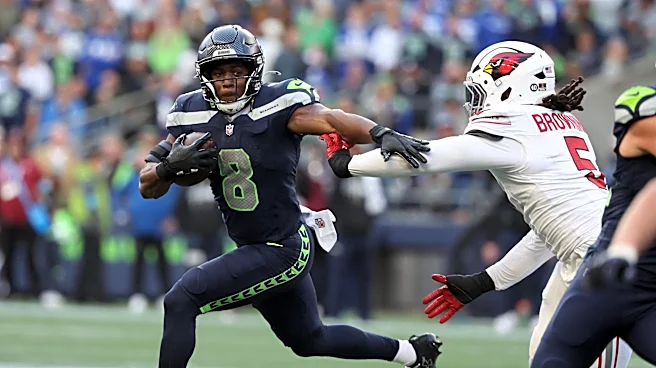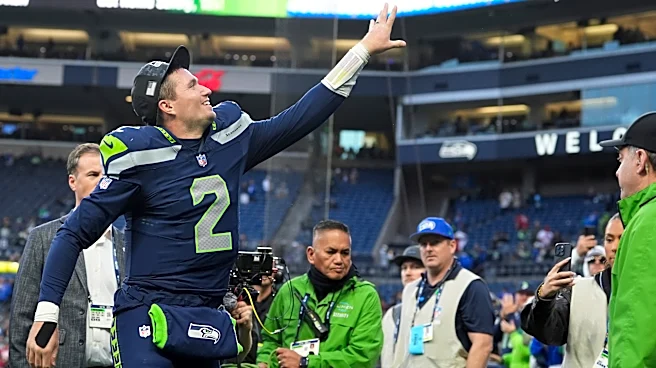

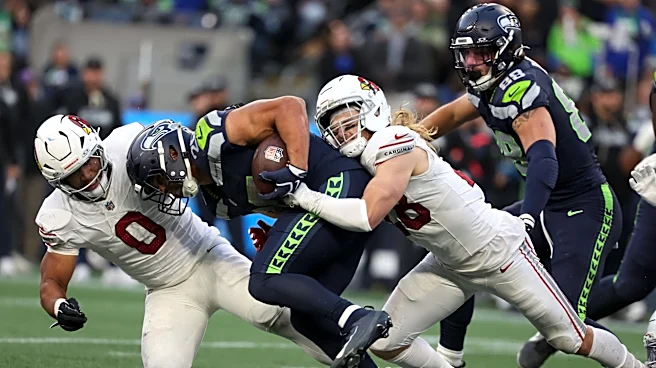
I asked Seattle Seahawks safety Julian Love about the diversity in tackles across the entire team’s defense after their 17-3 win over the Arizona Cardinals in Week 9. The video is available on Seahawks Press Pass’ YouTube channel. Skip to timestamp 6:57 to hear the full question and response.
Q: “Julian, when you talk about imposing the will, there was a time in the third quarter when no one on the defense had more than three tackles. How does that speak to your gang tackling?”
Love: “That’s a good— that’s kind of crazy, that’s crazy. I don’t know, no one ever kind of, thinks that way. We kind of move as a wave. We’re kind of a swarmy style of defense. I think that’s what makes us fun, and I think that’s what makes offenses really not like playing
us because, like, we have some talented players, of course, but we’re going to get to the ball. We have each other’s backs. People are going to miss, sometimes, but you’re going to have 2-3 more Seahawks hats to the ball. So, kind of crazy, pretty cool.”
His response made me ponder football terminology on the drive home. The next day, I came away pinpointing the collective human effort that makes the Seahawks “Dark Side” defense special. Credit to Love for an incredibly insightful answer.
Football terminology is a learned language
I came away with two pieces to this story. The first is how different terminology is passed around football coaches, players, and pipelines across the country. The football jargon, so to speak, is confusing in the same way localized slang words are. For example, Cover 6 meant something completely different in a Nick Saban defense than it did when many other coaches taught it. This makes it near-impossible for someone who doesn’t know the lingo to pick up on it — especially when in most cases, they didn’t even consider the possibility they could be wrong. They learned it one way. This also shows why Love is one of the smarter players in the entire NFL.
Three examples of this level of “hats to the ball” mentality, as Love calls it, that have taught me most about it are my high school football team as a sophomore, the Jimmy Rogers-led Washington State University Cougars of 2025, and the Mike Macdonald-led Seahawks of 2025-26. You learn football at a young age. You continue to learn at an old age. The first of these three used certain language to refer to it, which, at that time of my life, was how I became acquainted with this idea of how a team should play football. This represents the whole language model of learning communication, which believes language is taught and learned effectively through life experiences where the application of the word naturally pops up, as opposed to the more traditional phonics-based approach.
That’s how drilling football terms works in practice. You can’t assume your knowledge of words will translate seamlessly across different teams and schemes.
How communication shapes the Dark Side defense
The second piece is about the Seahawks’ universal language of physicality. The idea of playing proper football translates. I used the term “gang tackling” while Love used the saying “hats to the ball.” The latter is the more modern and descriptive term. Scouts like Daniel Jeremiah frequently use it, too. He especially emphasized this term the last time the Seahawks and Cardinals played in Week 2, tweeting out this picture and citing the term as a reason why Seattle’s defense hit the ground running in their title defense. He used the adjectives “faster” and “more connected,” which define this concept eloquently.
When I rewatched Love’s response after asking it, I found it interesting that Love hadn’t heard the term I’d used for half my life. I learned the term “gang tackle” as soon as I started playing high school football. Although Love didn’t know the specific one I used, he understood what I meant, and graciously responded with a description of his perspective.
How we see it on Sundays
While “gang tackling” might elicit a reckless idea, the term is one of many that struggle to properly convey the coordinated, physical, human effort the Seahawks’ defense conveys on a weekly basis. Love is the embodiment of it. His ability to figure out what concepts and words mean is a great representation of what makes him one of the more cerebral safeties in the NFL today. He studies and recognizes offensive patterns quickly with his eyes, communicates them to his teammates with words and signals, and uses his athleticism with optimal timing to achieve results. It helps the team continuously appear as one of the most physical in the NFL, no matter which players are forced to leave the lineup.
Seattle didn’t earn the “Dark Side” nickname on a whim. It’s apparent when they play that they are willing and able to rise to a different level of controlled, violent physicality than any offense they face. When you watch them play, players like cornerback Devon Witherspoon and linebacker Drake Thomas II are some of the most obviously physical players in the NFL. However, Love’s physicality doesn’t always appear as obvious.
Love most often aligns as a high-safety, which usually puts him outside the broadcast camera angle’s focus during the confines of the play. The viewer at home might not see him, but the quarterback’s reading the high-safety’s eyes constantly, trying to prevent the high-safety from becoming their passing game’s worst nightmare. However, Los Angeles Rams wide receiver Puka Nacua specifically referred to Love as his “No. 1 guy” on the Seahawks he has vitriol for because of “a couple shots” Love’s taken at him. Love’s physicality is just underrated to the average viewer on television. The broadcast camera’s angle being the reason for that is understandable.
After studying Love’s All-22 film this season and watching the Seahawks’ past two games in person, I’ve come to appreciate how underrated Love’s ability to be physical is. When he does fly downhill in the run game, he can generate just as much thump as Witherspoon or Thomas do closer to the line of scrimmage.
The way this story was represented in Sunday’s game wasn’t just about the stats, the physicality, or the terminology — it was about the language the Seahawks speak with their football. They’re a process-oriented team. In this sport, you don’t win by reverse engineering the route to a “safe” victory. You go to war, physically, with communication techniques that you’ll drill into your routine as you prepare. That’s why the aesthetics of an individual play can leave a bigger impression than the amalgamation of all 143 of them.
As terminology goes, “gang tackling” has become outdated. “Hats to the ball” seems like the most modern one. This exchange has come to make me appreciate its specificity. I, like Love and Jeremiah, will use this literal term to describe the concept in my work in the future. I want this to be understood by more people. It represents one of the most special parts of the Seahawks “Dark Side” defense. As Love said, he thinks it’s “what makes [them] fun.”
The hats to the ball mindset represents Love’s intensity. It appears as pure violence, but carries the principles of any terrific workplace environment. It’s forged through clear communication. They get on the same page. They move as a wave, like Love said. Then, as Jeremiah said, they play faster and more connected. That’s what’s special about how the Seahawks play defense.
Follow seahawkswire.usatoday.com and @TheSeahawksWire on X for human analysis of all things Seahawks.
This article originally appeared on Seahawks Wire: I asked Julian Love about tackling. It taught me football terminology.