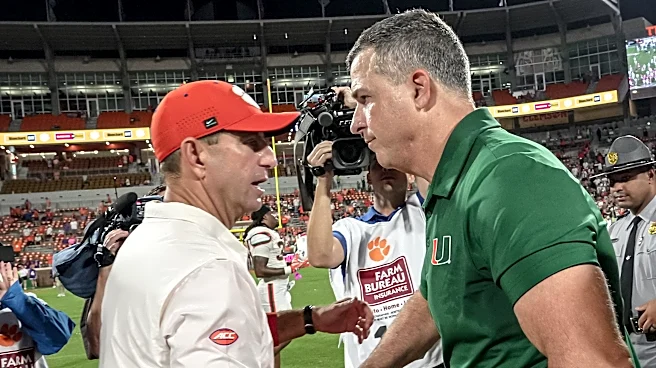

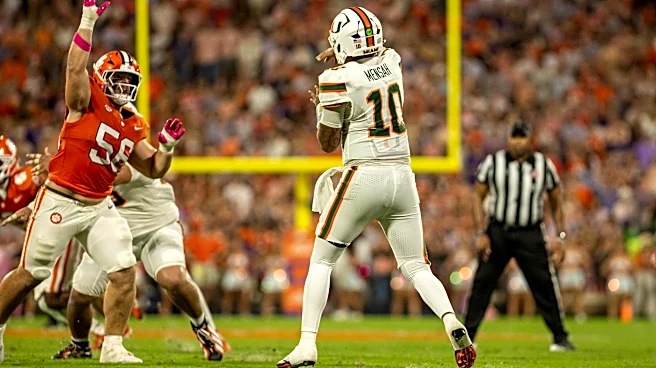
Clemson got beat again against a ranked team, and like last time, it was ugly.
Here are three things we learned from Clemson’s second ranked loss of the season.
1. Clemson’s pass protection is a serious problem
Miami entered the game with one of the best defensive fronts in college football. That explains some of what happened Saturday night, but it does not excuse another absolutely woeful performance from Clemson’s offensive line.
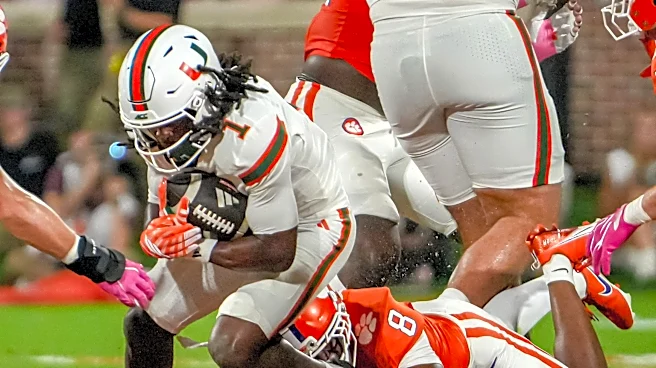
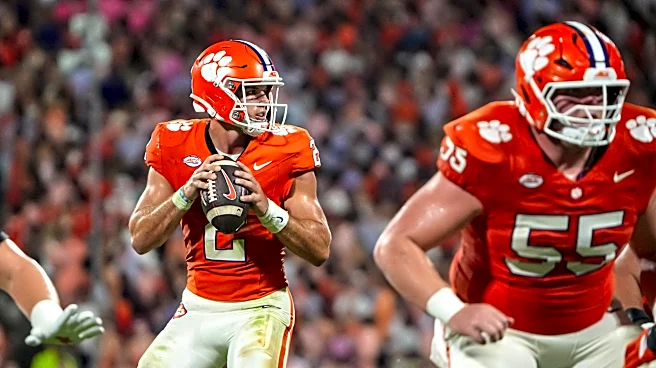
The Hurricanes sacked Reynolds six times, including five times in the first half, and recorded nine tackles for loss. Clemson has now allowed 17 sacks through five games, five more than any other ACC team that has played at least five games.
Clemson’s linemen were consistently violated in isolated matchups after the snap. On one rep, Miami defensive tackle Ahmad Moten
used a swim move to beat Ronan O’Connell to get a half-sack on 3rd down. On another, Marquise Lightfoot powered through freshman Grant Wise’s block for a sack. Lightfoot later came through untouched when Wise and right tackle Collin Sadler appeared to expect the other to block him, allowing a clean hit on Reynolds as he completed the pass. The right side specifically stunk all four quarters, whether through individual losses or breakdowns in protection responsibilities. Damon Wilson II created additional problems off the edge and finished with 2.5 sacks.
The right side of Clemson’s OL rode the struggle bus last night.
— Grayson Mann (@gray_mann21) October 4, 2026
Pretty sure both Sadler and Wise assumed #8 was the other’s assignment, and he gets a clean hit on Reynolds, who completes the pass. pic.twitter.com/jeSZYtUpcu
Clemson badly struggled to anchor against Miami’s power inside, redirect its speed rushers off the edge, or keep the depth of the pocket intact. Reynolds frequently reached the top of his drop with defenders already closing around him.
The official rushing numbers were also ugly. Clemson entered halftime with exactly zero net rushing yards and finished with 55 yards on 31 attempts, an average of 1.8 yards per carry.
However, those numbers require some context because college ball counts sack yardage against the team’s rushing total. Reynolds finished with minus-22 rushing yards after losing 37 yards, primarily on sacks. Clemson’s other ball carriers combined for 77 yards on 17 attempts, averaging roughly 4.5 yards per carry.
That means Clemson’s traditional run blocking was not quite as disastrous as the final total suggests. Chris Johnson Jr. averaged 6.4 yards per carry, Jarvis Green averaged 4.7 and Gideon Davidson finished with 25 yards and a touchdown.
The larger failure was Clemson’s inability to protect Reynolds in obvious passing situations. Sacks repeatedly knocked the Tigers behind the chains or ended promising possessions. On Clemson’s final drive before halftime, the offense reached Miami’s four-yard line before a false start and sack forced it to settle for a field goal.
Miami’s defensive line is elite. It will make far better offensive lines look uncomfortable this season. But Clemson also allowed four sacks and 11 tackles for loss against LSU and has surrendered 17 sacks overall. This is no longer a one-game matchup problem it's something offensive line coach Matt Luke has to figure out.
2. Tait Reynolds continues to grow under pressure
Reynolds did not play a perfect game, but he looked far better than the 66th-best quarterback in the Power Four, where ESPN ranked him.
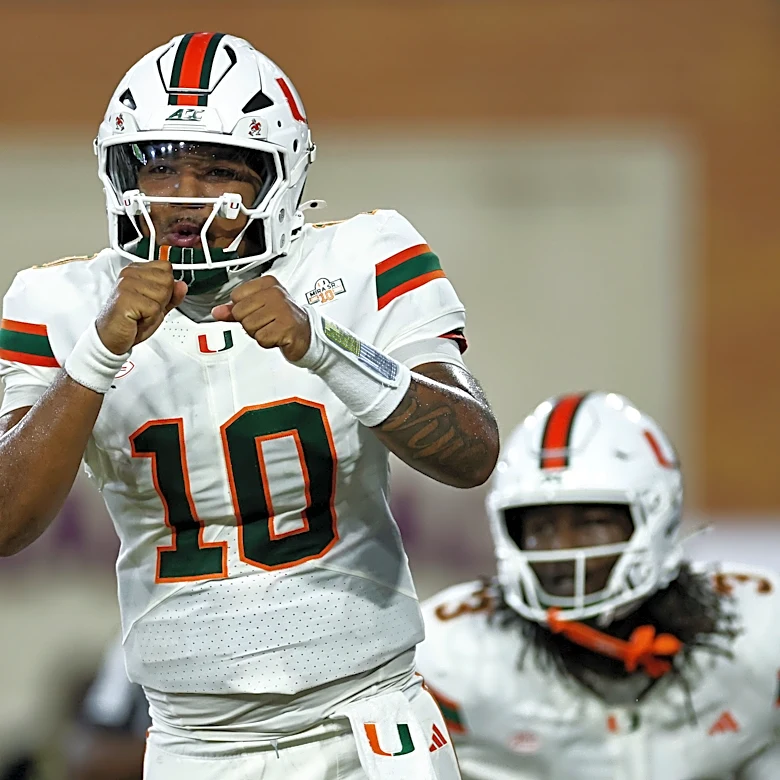
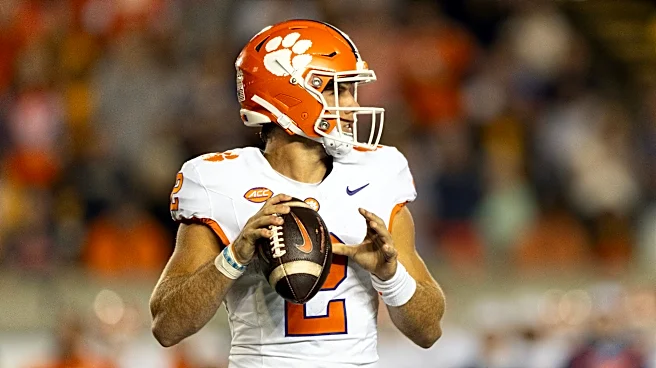
The freshman completed 29 of 44 passes for 295 yards, setting career highs in all three categories. He finished with more passing yards than Miami quarterback Darian Mensah, whom I expect to win the Heisman Trophy. Mensah threw for 227 yards and a touchdown.
To add some context, Miami took its foot off the gas through the air after building its lead and leaned on a running game that accumulated 192 yards and three touchdowns. Mensah was not asked to throw 44 times or carry his offense from behind.
Still, that statistic alone deserves a shoutout. Reynolds did some of his best work after the original structure of the play broke down, using his mobility to evade pressure, extend plays and give his receivers additional time to uncover. His improvisational ability helped Clemson cross midfield on seven possessions despite Miami consistently collapsing the pocket. Justin Dottavio of State of the U, SB Nation’s Miami site, noted that Reynolds made several clutch plays to extend drives “when all seemed lost.”
One sequence late in the second quarter demonstrated his development. After Miami dropped him for a six-yard sack, Reynolds responded on third-and-16 by finding Bryant Wesco Jr. for 21 yards. He later converted a fourth-and-2 with a seven-yard completion to T.J. Moore as Clemson completed a 16-play, 75-yard drive.
Clemson picks up a third and 16 -- once again, QB Tait Reynolds scrambles, buys time and finds WR Bryant Wesco Jr. on a comeback route. Reynolds is taking a beating tonight, though. Just got hit hard on his next attempt
— Chapel Fowler (@chapelfowler) October 4, 2026
That possession only produced a field goal, but Reynolds displayed command of the offense, operated against the clock, and repeatedly delivered on passing downs despite already taking a beating.
His lone interception also requires context. It came on a garbage time desperate fourth-and-7 throw with 1:49 on the clock and with Clemson already trailing 34-13. JJ Dunnigan returned it 39 yards for a touchdown. Reynolds also lost a third-quarter fumble, so he was not blameless, but neither turnover changes the overall evaluation of his night.
The wheels are falling off for Clemson.
— Underdog CFB (@UnderdogCFB) October 4, 2026
Miami's JJ Dunnigan intercepts Tait Reynolds and goes for a touchdown to make it 41-13. pic.twitter.com/7N45mBFczL
Reynolds still needs to improve his internal clock. Some sacks were the result of immediate protection losses, while others came when he held the ball hoping a route would develop. Knowing when to escape, check the ball down or throw it away is part of growing into the position.
The encouraging part is that Reynolds appears more comfortable every week that goes by. His processing is becoming quicker, his pocket movement is improving and he looks increasingly dangerous when forced to operate outside the original play design.
He is not Trevor Lawrence or Deshaun Watson, and Clemson should not place that type of expectation on him. But Reynolds faced a top-five opponent, absorbed six sacks, and continued attacking. Clemson got blown out by 28, but its freshman quarterback grew up during the process.
3. Ashton Hampton looked like a first-round NFL talent
Malachi Toney entered Death Valley as the player Clemson could not allow to control the game. He barely had a sniff.
Miami targeted Toney 10 times, but he finished with only five receptions for 40 yards, no touchdowns, and a longest catch of 17 yards. He added 19 yards on one rushing attempt, but Clemson prevented him from producing the game-changing receiving plays that have made him one of the country’s most dangerous offensive weapons.
The junior cornerback finished with five tackles and two pass breakups. His biggest play came on Miami’s opening possession of the second half. On fourth down, Hampton stayed connected to Toney through the route and knocked away Mensah’s pass to give Clemson possession near midfield.
Clemson CB Ashton Hampton locks up Malachi Toney AGAIN for a fourth-down stop. pic.twitter.com/vlcYOeVEOD
— Underdog CFB (@UnderdogCFB) October 4, 2026
Clemson did not leave Hampton alone with Toney on every snap. The Tigers bracketed Toney at times and rolled additional coverage toward him, which created opportunities elsewhere. Cooper Barkate took advantage with five receptions for 98 yards, including a 61-yard screen touchdown on Miami’s opening possession.
Still, Hampton won his share of the matchup when Clemson placed him across from Toney. He remained patient at the line of scrimmage, stayed in phase downfield and played through the receiver’s hands at the catch point.
Few cornerbacks in college football will hold up that well against Toney. Hampton did it while recording two pass breakups and preventing Miami’s top receiver from reaching the end zone.
The final score will dominate the conversation surrounding Clemson’s loss, and understandably so. But Hampton’s performance showed that the Tigers have a corner capable of surviving against elite receivers without forcing the entire defensive structure to protect him.
Photos: Clemson takes on Miami in college football Week 5
— Clemson Wire (@Clemson_Wire) October 4, 2026
📸 Ken Ruinard / USA Today Network , USA TODAY Network via Reuters Co https://t.co/Br8DJlJx1Y pic.twitter.com/WEhrWmkgVj
Clemson has major problems to solve during the bye week, particularly in pass protection. It also has two studs in the making in Reynolds and Hampton who looked like legitimate building blocks against one of the country’s best teams.
Contact us at @Clemson_Wire on X (formerly Twitter) and like our page on Facebook for ongoing coverage of Clemson Tigers news, notes and opinions.
This article originally appeared on Clemson Wire: Three things we learned from Clemson’s loss to Miami