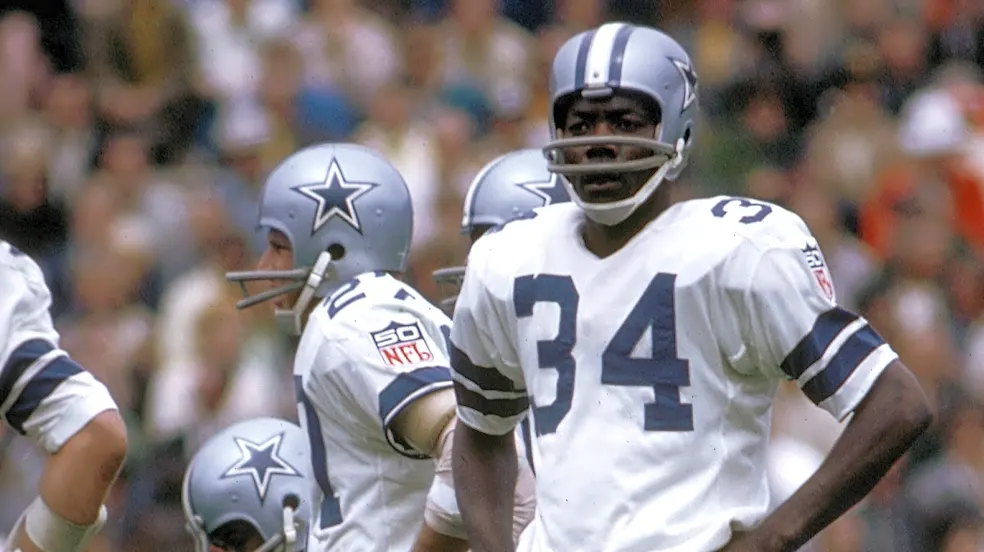


The Cowboys have lost one of their earliest stars, whose improbable path to the NFL-and groundbreaking strides once he arrived- helped pave the way for countless others.
Cornell Green, a key member of the Doomsday Defense's first iteration, passed away Wednesday at the age of 86.
Green earned five Pro Bowl trips during his career at two different positions- cornerback and safety- and never missed a single game in 13 seasons with the Cowboys, a span which included a streak of 145 consecutive starts over his final 11 years. He played for the first Cowboys squad to go to the Super Bowl, helped the franchise bring home its first Lombardi Trophy, was a Pro Football Hall of Fame nominee for the Senior class of 2026, had his name put forth as a Cowboys Ring
of Honor enshrinee as recently as this past spring, and is still- a over a half-century after his retirement- the all-time Cowboys leader in blocked kicks and in the top five in interceptions.
Not bad for a kid who never even played college football.
Green, born in Oklahoma and raised in northern California, was actually a basketball standout at Utah State and then drafted in 1962 by the NBA's Chicago Zephyrs (who would later become the Washington Bullets and then the Wizards). But it was a time when Cowboys personnel guru Gil Brandt was starting to look to other sports for potential talent to add to the still-fledgling franchise, and he spotted in the 6-foot-4-inch Green a rebounding machine who, as a fifth-round pick, might not make it in the NBA... but could be turned into a football player.
Green accepted Brandt's invitation to Cowboys training camp, solely for the $1,000 bonus, fully expecting to get cut in short order and pocket the cash on his way back to Chicago. The Cowboys were originally unsure whether to try to make Green a wide receiver or a defensive back, or maybe even both. He played his first three preseason games mistakenly wearing his hip pads backward but made the roster, as a cornerback who wasn't even sure how to put his uniform on.
As it turns out, his inexperience with the sport may be what allowed him- and the Cowboys- to tap into his pure athletic ability.
"When I started with the Cowboys in '62," Green once told author Peter Golenbock for his book Cowboys Have Always been My Heroes, "Tom Landry was teaching the Flex to the defensive players. You had to read 'keys' and take the key to where you were supposed to go. A lot of the older vets didn't want to do it, because they were used to playing a certain way. But to the younger guys ... it didn't matter, because hell, we had never played any other way at all, so it wasn't that big a thing."
But Green turned out to be a very big thing for 13 seasons in Dallas. He made the NFL's All-Rookie team in 1962. The following year, he led the Cowboys in interceptions- a feat he would repeat in 1965, 1966, and 1967. He earned three first-team Al-Pro nods. Went to two Super Bowls, earned one ring. And along the way, he shut down some of the most legendary receivers the game has ever seen.
"Cornell Green shut out [the Dolphins' Paul] Warfield," franchise legend Calvin Hill once said, per the team website. "Warfield was like a mega-bomb, and the fact that we were able to prevent him from being who he was – in my mind, the greatest receiver I've ever seen – was remarkable."
— Dallas Cowboys (@dallascowboys) October 21, 2026
Green still stands tied for fifth in the Cowboys' all-time record books in interceptions. His seamless transition from the basketball court to gridiron glory helped usher in a slew of signings of other sports' stars, both by the Cowboys and across the NFL landscape.
But he acquitted himself well off the field, too, in an era when the Deep South wasn't always a friendly place for a Black man to live, even if he played for the Dallas Cowboys. Green was universally loved and respected by his teammates, though he had to make certain concessions in his personal life. He did not live in the Dallas area during the offseason, for example, and needed a two-month head start on finding a new place to live each fall in neighborhoods where Blacks could reside.
"I was from California, and I had never seen a system where people had to live in only a certain section." Green said in Golenbock's book.
"In our own way we came down here fighting the system."
Green retired following the 1974 season. He went on to a career outside of football but returned in 1987 as a scout for the Denver Broncos, picking back up a talent he had started to develop over his final years with the Cowboys. Green was with the Broncos organization until 2015, a remarkable 28-year second career in a sport he never even meant to play.
Green died this week after a long battle with dementia. Though he is in neither the Pro Football Hall of Fame nor the Cowboys Ring of Honor, many who recall his prowess on the field believe he should be.
John Wooten, a two-time Super Bowl champ and former Cowboys scout who went on to chair the Frtiz Pollard Alliance advocacy group, has lobbied the Cowboys to add Green's name to the facade at AT&T Stadium.
And though several of his Doomsday teammates- Bob Lilly, Mel Renfro, Chuck Howley, and Cliff Harris among them- have bronze busts in Canton, Green may never get there, perhaps the victim of being just a mere superstar on a team filled with larger-than-life icons.
Green snagged 34 interceptions in his career, in a day when passing was far less popular than it is now. Brandt once theorized that if Green had better hands, he'd have ended his career with three times as many. How could his college's all-time recordholder in rebounding not be better at snatching a football out of the air? Green was once asked.
His answer: "A football is not a basketball."
A generation of Cowboys fans can be glad of that, for that simple fact gave us the one-of-a kind career of Cornell Green.
Todd is on X at @ToddBrock24f7. Also, follow Cowboys Wire on Facebook to join in on the conversation with fellow fans!
This article originally appeared on Cowboys Wire: Remembering the unlikely NFL journey of Cowboys legend Cornell Green