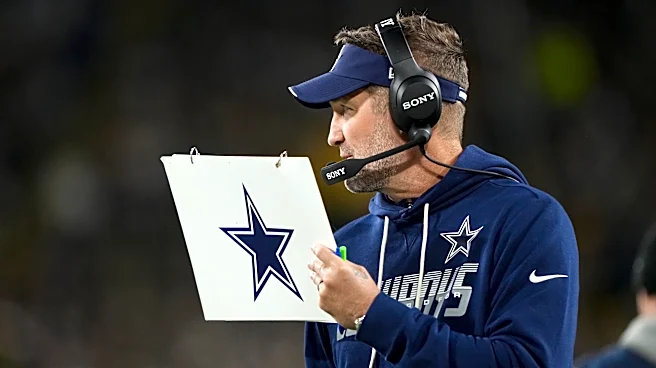




Going into Week 7 tied for the sixth-worst record in the NFL, it’s understandable that HC Brian Schottenheimer finds himself on the hot seat. The Dallas Cowboys entered the 2026 season with playoff aspirations. Instead, they already find themselves in a do-or-die situation by the last week of October.
With the defense struggling all year and the offense now uncharacteristically slumping themselves, there’s plenty of blame to go around. Players are not performing up to standards with mental and technical mistakes stretching across all corners.
Given the all-encompassing blame, it’s easy to question how much actually falls on the shoulders of the offensive play-caller and head coach. After all, a horse can be led to water, but they can’t be made
to drink. Luckily there’s a way to sift through the noise and get a good look at what exactly the second-year head coach is doing to contribute to the current state of affairs.
Steven Patton at Patton Analytics focuses on this very thing through his substack. He looks at things like personnel, predictability, volatility, pass rate over expected, motion and play-action, and then grades coaches accordingly. Head coaches can’t complete a pass, break a tackle, or perfectly block a play, but they can control factors such as those.
Cowboys’ personnel diversification
Employing different personnel groups is important to keep defenses on their toes. Rolling out exclusively 11 personnel, opposing teams can prepare and strategize for heavy use of their own nickel defense. Just like playing a ton of 12, 13, and 21 personnel will cause defenses to focus on strategies with their own base defense more.
But beyond simple diversification, is predictability. If a team alternates personnel frequently, but always flips to heavy looks like 13 and 21 in short yardage on late downs, they are still being predictable and easy to scheme against.
So, the fact the Cowboys play 73.07 percent of their plays in 11 personnel (3rd most in NFL per Sumer Sports), isn’t great but the bigger problem is they use it predictably in game situations. Just like they use their bigger personnel predictably and play certain down and distances predictably, per Patton.
Cowboys’ play sequencing
Patton Analytics also looked at play sequencing. Always passing on first down is problem. Just like always running after an incomplete first down pass is problem. The Cowboys run the ball at an abnormal rate on 2nd-and-short and love to pass the ball at an abnormal rate on 3rd-and-short. It’s something that’s been dangerously predictable and easy for defense to prepare for.
At the end of the day, calling plays that work is what’s most important and unpredictability for the sake of unpredictability is bad. But avoiding tendencies is a good way to keep defenses honest and should pay dividends down the road.
Asked Brian Schottenheimer about the lack of motion. He pointed to the fact they trail often. But why does that matter?
— Joseph Hoyt (@JoeJHoyt) October 19, 2026
"You're trying to go fast. You're trying to keep the defense on their heels. You're trying to extend the game for as long as you can and get as many ops as… https://t.co/NQn8T6O6Bu
Motion
There are two types of motion to consider: motion before the snap and motion at the snap. Motion before the snap is useful in diagnosing coverage while motion at the snap is good in gaining leverage on routes and in run blocking.
Both types of motion are traditionally helpful in increasing EPA/play but motion at the snap has been consistently more fruitful over the years. For an experienced quarterback like Dak Prescott, motion before the snap might be a little overrated but there’s no excuse not to use motion at the snap for an offense struggling to establish the run.
The Cowboys have gone from league leaders in motion last season to laggards this season. It’s a wrinkle that can be worked into nearly every offense and one that’s had proven results in Dallas. This is a clear mark against Schottenheimer in 2026.
Play-action and RPO
Play-action doesn’t require a strong running game to be effective. A good running game helps, but it’s far from a requirement. Using play-action, particularly from under center, is another cheat code to improve EPA/play. It’s not a miracle elixir but does boost efficiency numbers because second level defenders instinctively bite.
Run-pass options are a little gimmicky in nature, but they have proven results. A hand-off motion is used to read the defense. If the conflict defender bites, the quarterback pulls the ball back and delivers a pass to the vacated space. If the conflict defender doesn’t bite, it becomes a handoff. It’s a pick-your-poison play that can produce results even when traditional attacks do not. Patton Analytics calls these “easy button” plays and punishes the Cowboys appropriately.
A great chart from @PattonAnalytics showing who’s using the tricks of the trade and who’s leaving meat on the bone. To no surprise Schotty is in the sad quadrant pic.twitter.com/RLfWoQKncS
— Reid D Hanson (@ReidDHanson) October 24, 2026
Cowboys’ PROE
Pass rate over expected is a good way to gauge strong passing attacks. Since the best offenses are traditionally passer led, having a positive PROE is seen as a good thing, within reason of course. It may feel like the Cowboys are operating in territory outside of reason, but the reality is Dallas is only passing at a rate of 2.4 percent over expected.
It’s for this “reason” the Cowboys look good in the PROE department and why their current run-pass splits are somewhat (somewhat!) excusable.
Pace and tempo
The Cowboys run a fast-paced offense and because they’ve been efficient most of this year, it’s allowed them to have sustained drives. With an average drive of 3:01, they are fourth in the league in average drive time, even if the time between snaps is extremely quick.
Schottenheimer is using pace and tempo as an excuse as to why he’s not using motion, play-action, runs, or under center plays as much as last year, but let’s face it: it’s just an excuse.
After you cut through the fat and grade coaches and play-callers on what they actually control, you can see Brian Schottenheimer is adding very little to this Cowboys team (graphic credit: @PattonAnalytics ) pic.twitter.com/h63L5rOBXG
— Reid D Hanson (@ReidDHanson) October 24, 2026
Cowboys’ verdict: Schotty deserves the criticism
Finishing near the bottom of the NFL in play-caller tendencies, there were more than a few coaches who graded better than Schottenheimer while simultaneously fielding worse offenses. The goal of this breakdown was to cut out the noise like player talent and execution, and get down to grading what a play-caller actually contributes. Last season Schottenheimer contributed plenty. This season? Not so much.
With roughly two-thirds of the 2026 season ahead, there’s time for Schottenheimer to fix things on his end. The fact he once displayed decent play-caller tendencies and unpredictability, has to be seen as a good thing this season. It’s on him to be better.
The talent on the Cowboys offense means there’s no excuse in not being top three in the NFL. It’s a team built to win now and a team relying on its offense to carry them. Schottenheimer is getting all the criticism he deserves and the numbers prove it. It’s time for him to fix what he can control so he can maximize the Cowboys offense down the stretch.
You can follow Reid on X @ReidDHanson and be sure to follow Cowboys Wire on Facebook to join in on the conversation with fellow fans!
This article originally appeared on Cowboys Wire: Here's why Cowboys’ play-calling, coaching deserve both criticism, blame