
It was Jon Kunneman's 11th birthday.
Like many kids, he was looking forward to the presents, the appreciation, and the cake and ice cream. Kunneman got some combination of those things, but eating sweets would come with the same peace of mind after an unexpected "gift" he received.
"My parents thought I was just growing, getting ready to hit a growth phase," Kunneman recently told MMA Junkie. "I started getting weak. My body – I was peeing literally every 10 minutes. I would drink like two or three gallons of water a day and still be thirsty. ... I remember one day we were at the College World Series. We were in line. It was a hot day, and I passed out in the line. They had to bring EMTs, and they found out my blood sugar was low, but they just thought it was because
of the heat.
"Then the next day, my mom had smelled my breath, and she's like, 'Your breath smells fruity. It doesn't smell right. Something's not right with you. Let's just go to the hospital and see what's going on.'"
Kunneman's blood sugar was 576 mg/DL. The normal range is 70-99 mg/DL. That day, his 11th birthday, Kunneman was diagnosed with type 1 diabetes.
"Happy birthday, right?" Kunneman said.
Unlike type 2 diabetes, which is often caused by poor diet and lack of exercise, type 1 diabetes is a chronic autoimmune disorder where the body attacks its own insulin-producing cells in the pancreas. The diagnosis came with restrictions, confusion, and fear. It would be a difficult adjustment for anyone, never mind an 11-year-old kid.
"I had people laugh in school when I would take insulin shots," Kunneman said. "People would look at me like I was this weird kid who has to pull his insulin out and take a shot in class, lift his shirt up at 10 years old, and people looking at you take an insulin shot in class, or people would look at you weird in a restaurant when you gotta take a shot. ... A lot of times as a kid people would ask, 'Oh, do you eat too much sugar? How'd you get diabetes?' and people just don't understand that has nothing to do with it."
For years, Kunneman struggled to navigate not only the physical toll but the social one as well. He did everything he could to pretend to be the average teen with a normal blood sugar, living a normal life. But it just wasn't sustainable. He hit a point where he was done hiding – and the mental rain clouds cleared.
"For a lot of years I didn't talk about it," Kunneman said. "I tried to hide it and make it invisible. That's the hard part with it as a kid: it's an invisible disease, and people don't know how brutal it literally is until you've been around someone who has type 1 diabetes. When your blood sugar is high, your head hurts. Your kidneys hurt. You can literally feel your blood in your body, and it feels like glass sometimes. I've been in training camps where I've had high blood sugar, and I'm just rocking myself back and forth in the fetal position because it's so uncomfortable, and there's no way out of it until insulin kicks in. You take your shot, but it takes 45 minutes or an hour to kick in, and it's honestly miserable, and it's the rest of your life. At this point, I've taken conservatively like 30,000 to 35,000 shots, but probably closer to 40,000 or 45,000 shots in my life to stay alive. As a kid, that's a very daunting thing."
Kunneman's fear was more deeply ingrained from watching his grandfather deteriorate from diabetes firsthand. It was a bit traumatic, seeing what his own fate could be if he didn't keep his condition under control.
"He had a whole medical ordeal where he almost died," Kunneman said. "His colon was leaking feces into his body, and he came out of it with type 2 diabetes. But he didn't take care of himself, and I watched him slowly (fail). His legs stopped working. I literally watched him wither away, and to see that could be me when I'm older. To face that as a kid is super scary. Then they tell you all about, 'If you don't manage your blood sugar, don't check your blood sugar, don't take insulin at the right time, this is what you're gonna look like, or this is what's gonna happen to you.' That's such a daunting thing for not even a teenage kid to be thrown at in life. So that definitely was tough, for sure. It still is tough to this day."
The regimen hasn't gotten any easier as the years have passed, but how Kunneman deals with it mentally certainly has. He's grown as a person from the experience, learning valuable life lessons that have expanded into other aspects of his life.
"I found that you can't necessarily control what happens in life," Kunneman said. "You can't control the outcomes, like in a fight, right? I can't control everything that happens, but what I can do is make the most of the time I have, or what I have in front of me. I can control what I can control. I found at a young age that doing very difficult things, hard things, gave me something to chase, something I could focus on and get better at. For me, it was training, boxing, wrestling, and then I got real big into lifting weights in high school, chasing the next squat max, the next bench max or deadlift, whatever – chasing that next fight, or just getting better at fighting.
"As a kid I always felt like, with diabetes, that I stuck out, because you're a kid taking insulin shots. People think you're just like a diseased kid. It sounds a little dramatic, but that's how you feel when you're that age. I wanted to do hard things, so people could look at my life and be like, 'Man, he's the kid who gets back up when life knocks him down. He keeps going no matter how hard or how crazy life gets for him, no matter how big the adversity or the obstacle may appear. He keeps fighting and keeps going despite having horrible circumstances.' That mindset of chasing things that make you uncomfortable in the moment but give you reward and satisfaction in the long term, that's what literally saved my life as a kid."
Using "knocked down" as a metaphor wasn't enough. Kunneman found that fighting was a way to stay in shape, but it also aligned the physical with the mental. It amplified the underdog story exponentially. Kunneman was long a fight fan. He started working with UFC alumni Ryan Jensen, Jake and Joe Ellenberger, and Jason Brilz.
His journey then brought him to Albuquerque, N.M., where he trained at JacksonWink, getting rounds with all-time UFC great Jon Jones, as well as various big bodies like Juan Adams and Devin Clark. When Jones and the gym went their separate ways, Kunneman was attracted to Denver, its MMA gym scene, and of course its mountains, which he frequently hikes with friend and fellow 2026 Dana White's Contender Series fighter Logan Paxton.
"Climbing mountains is the best base for MMA," Kunneman laughed. "That's gonna be the new thing."
Throughout his winding journey across the United States, Kunneman racked up experience. He learned not only how to be a fighter, but also a whole new tier of diabetic management. Training, fighting, weight cutting – everything needed its fine-tuning.
"Everything is so much harder," Kunneman said. "People don't think that I cut weight with diabetes, but I still cut a fair bit of weight. ... The thing is, everything is harder with diabetes. For example, when my blood sugar is high, I take insulin; when it's low, I gotta drink juice or sugar. So if you imagine you're in your weight cut, a couple of days out from weigh-ins, and your blood sugar goes low, I have to literally drink or eat sugar, candy, juice, things you would not want to eat right when you're getting ready to cut weight and make weight. If your blood sugar goes low in the middle of a training session, you've got to step off the mats and deal with it.
"You can research the symptoms of a severe low blood sugar or a severe high blood sugar, and I've literally trained through it because I knew how important it was to get my rounds in. One time I was sparring Neil Magny this camp, and I felt my sugar go low. We're doing rounds, and I'm like, 'You know what, I got five minutes, one more round, I'm gonna get through the round and deal with my blood sugar after.' I don't advise that, 100% do not advise that, because that can be really dangerous. I'm a bit of a veteran with diabetes, so I know when it's urgent, like I'm gonna literally pass out and have to go off the mats, or I can make it through five minutes."
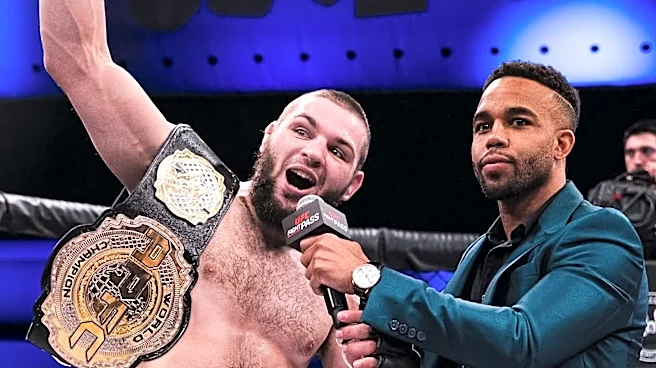
Kunneman, 27, won his first 10 professional fights and an Anthony Pettis FC title. He will compete Aug. 11 on Dana White's Contender Series vs. LFA middleweight champion Joe Kropschot (8-3) and hopes to earn a UFC contract.
To call himself a UFC fighter would be a huge accomplishment, but that's only one layer of his motivation. He wants to serve as an example for a middle school kid out there who was just told on his 11th birthday that he'd be diabetic for the rest of his life. That is his championship.
"I didn't have a person to look up to, to say, 'Hey, you can go chase your dreams, or go climb dangerous mountains, or fight in a cage with this condition,'" Kunneman said. "I never thought any of that would be possible. So if my story can inspire people living with my condition, or any other adversity in their life that they feel hopeless with, that's what it's all about for me."
This article originally appeared on MMA Junkie: Type 1 fighter: Jon Kunneman aims to show diabetics can do anything – even make it to the UFC