
It has been said that lightning doesn't strike in the same place twice, but for Miami and Notre Dame, it did. In South Bend, Indiana, in both 1988 and in 2026, we saw remarkably similar games with remarkably similar controversies, 38 years apart. It's uncanny that two schools could basically replay one game in the same stadium 38 years after the original, only with one noticeable twist: The rules surrounding legal pass catches in football have changed. Let's walk you through this story and its context, which is layered and involves several details:
2026 Miami-Notre Dame non-touchdown
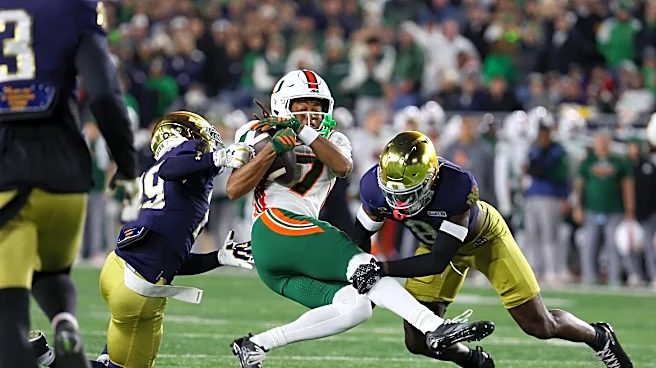
Here's the video of the Miami touchdown catch which wasn't. Miami was not awarded a touchdown for this play, even though we can all see the Miami receiver had firm possession of the ball in the end
zone and then stepped out of bounds:
TRUE OR FALSE: THIS WAS A TOUCHDOWN CATCH BY MIAMI AGAINST NOTRE DAME…?
— MLFootball (@MLFootball) November 8, 2026
😳😳😳
WOW: pic.twitter.com/6fbZhC4USy
Cleveland Gary in 1988 Miami-Notre Dame
In 2026, Miami thought it scored a tying touchdown against Notre Dame with the score 31-24 in favor of the Fighting Irish. In 1988, Miami also thought it scored a tying touchdown against Notre Dame in South Bend with the score being the exact same: 31-24 for the Fighting Irish. Here's the play in which officials ruled that Miami's Cleveland Gary fumbled at the 1-yard line, when you can see the ball came loose only after Gary reached the ball to the goal line and actually scored. The officials missed the call:
“If you go to Notre Dame, you can’t leave it in the officials’ hands.”
— David Furones (@DavidFurones_) November 8, 2026
From Cleveland Gary and Jimmy Johnson in 1988 to Elija Lofton and Mario Cristobal in 2026.
(🎥 ESPN 30 for 30 “The U,” directed by @BillyCorben) https://t.co/9Q5mTCDTbk pic.twitter.com/FNin16xc24
1988 Miami-Notre Dame catch would not have stood under 2026 rules
In 2026, the Miami-Notre Dame catch shown earlier in this article was ruled a non-catch and a non-touchdown. In 1988, this play involving Miami receiver Andre Brown was actually ruled a catch. We'll have more to say about this play after we show you the video. Just see for yourself, and notice the officials on each side of the play:
I mean this was a touchdown in 1988 pic.twitter.com/B9byi6fZCC
— RJT (@86rjt) November 8, 2026
1988 was a completely different time for football officiating
We told you to watch the two officials on that 1988 play (which, again, came with Notre Dame leading Miami 31-24, the same score at the end of the 2026 game in the same stadium in South Bend, Indiana).
Notice how those two officials instantly raised their arms to signal touchdown back in 1988. Back then, legal pass catches in the end zone were not viewed as plays which required a three- or four-step process. In 1988, the act of catching the ball was viewed as something which happened instantly. It was not the way it is today, in 2026, with a receiver needing to continue to retain possession in the midst of efforts by the defender to rake the ball out. The 2026 Miami play was not a touchdown because the Notre Dame defender raked the ball out of the Miami receiver's hands well after the initial physical act of catching the ball was made. In 1988, that standard clearly did not apply.
The most famous example of a catch being instant but not prolonged
In the history of football, the most famous example of a legal catch being very quick but not prolonged came in Super Bowl XII between the Dallas Cowboys and Denver Broncos. Dallas receiver Butch Johnson very, very briefly held the ball in the end zone:
Roger Staubach ➡️ Butch Johnson for a 47-yard touchdown.
— NFL (@NFL) May 11, 2020
Watch the @dallascowboys Super Bowl XII victory for FREE on https://t.co/TAuzHhPGvH: https://t.co/03g5AKmZhK pic.twitter.com/fRv2mATBnK
Key point about Butch Johnson 1978 Super Bowl catch
From the video above, notice that the CBS Sports announcers, Pat Summerall and especially color commentator Tom Brookshier, did not argue with the touchdown call. In the football rules and points of emphasis of 1978, when that play occurred, possession of the football in the end zone was something which did not have to exist for a long period of time, the way it needed to for the Miami receiver in 2026 this past weekend. In 1978, possession of the football just had to exist, period, even if it was only for a split-second. Having the ball in the end zone means having the ball. How long the possession lasts is irrelevant and immaterial. That was how legal pass catches in football were interpreted in 1978.
Infamous modern-day examples of "catches" which weren't ruled as catches
In the 21st century, plays which easily would have been ruled legal catches in 1978 or 1988 were no longer ruled legal catches.
Here's one infamous example:
Still can't believe they called this Calvin Johnson catch incomplete! pic.twitter.com/TdwVtHaMB3
— TG Casino (@TGCasino_) November 19, 2025
Dez Bryant, Dallas Cowboys versus Green Bay Packers
Here's another infamous example underscoring the point that football catch rules dramatically changed from the late 20th century to the early 21st century:
January 11, 2015: Dez did not catch it (according to referee Gene Steratore). The Packers would beat Cowboys 26-21 in the NFC Divisional Round. pic.twitter.com/wVHuPyyqY1
— This Day In Sports Clips (@TDISportsClips) January 11, 2021
So, when did the rules change? It had to happen at some point
As you can clearly see, the rules regarding legal pass catches in the sport of football underwent a very big change as the century turned. There had to have been a moment which inspired that huge change.
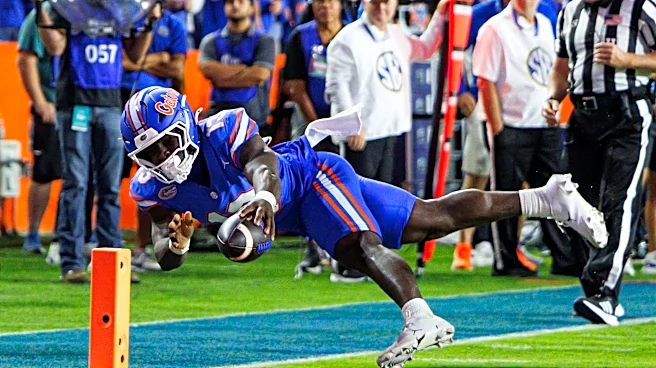
Here is that moment: Jabar Gaffney of Florida, in September of 2000 against rival Tennessee, caught a pass in the end zone but held the ball for just a split second before it was knocked out. The play was ruled a catch and a touchdown for Florida. For some reason, all the previous instances of a player holding a ball for a very brief period of time in the end zone did not inspire rule changes. This was the one which did, and football hasn't been the same since:
September 16, 2000: Florida’s Jabar Gaffney “catches” the @JessePalmerTV pass for the game-winning TD and UF beats Tennessee 27-23 pic.twitter.com/1lhVp6377x
— Bad Sports Refs (@BadSportsRefs) September 16, 2020
The bottom line
Fair or foul, good or bad, it's simply a fact that football's rules for legal catches changed a lot. The Jabar Gaffney play against Tennessee in the year 2000 was the play which ushered in that new era, and the new set of rules which denied Miami a touchdown in 2026. In 1988, the 2026 Miami play would have been ruled a touchdown. In 2026, the 1988 Miami catch would have been ruled an incomplete pass and no touchdown. Two games, played 38 years apart in the same stadium, highlighted how different football's rules have become, and (correspondingly) how different they used to be.
Postscript
Every football fan will have his or her own view of what a "catch" is or should be. Our view is this: Catching a ball (or any object) is not a prolonged act. When my two hands grab a football or my one gloved hand grabs a baseball, the act of catching that object is not "more" complete because I held the ball for two, or three, or five, or 10, seconds. As soon as my hand or hands clasp the ball, that's it. I have in fact caught the ball. If the ball is knocked away from me by my brother, my mom, by an opposing player, by my teacher, by my professor, by the policeman, by the janitor, anyone, that doesn't mean I didn't first catch the ball. I caught it and then it was knocked away. That's completely different from a ball being thrown in my direction and someone knocking the ball away before I have a chance to catch it.
The ball being knocked away before it gets to my hands is not the same thing as the ball being knocked out of my hands. If the ball is knocked out of my hands, that means it was in my hands first! That, logically, means I first caught the ball before it was jarred loose. Our view is that 1988 (and 1978) rules - basically 20th-century football rules - were better and more enlightened than the complicated rules of modern times in the 2010s and 2020s.
38 years after the 1988 Miami-Notre Dame game, the 2026 game between the same teams in the same stadium shows that the debate over football's rules is still as fierce as ever ... because the sport of football decided to significantly change its rules when it never needed to do so.
Contact/Follow @College_Wire on X and @College_Wires on Threads. Like our page onFacebook to follow ongoing coverage of college sportsnews, notes, and opinions.
This article originally appeared on College Sports Wire: 1988 Miami catch vs. Notre Dame wouldn't have stood under 2026 rules