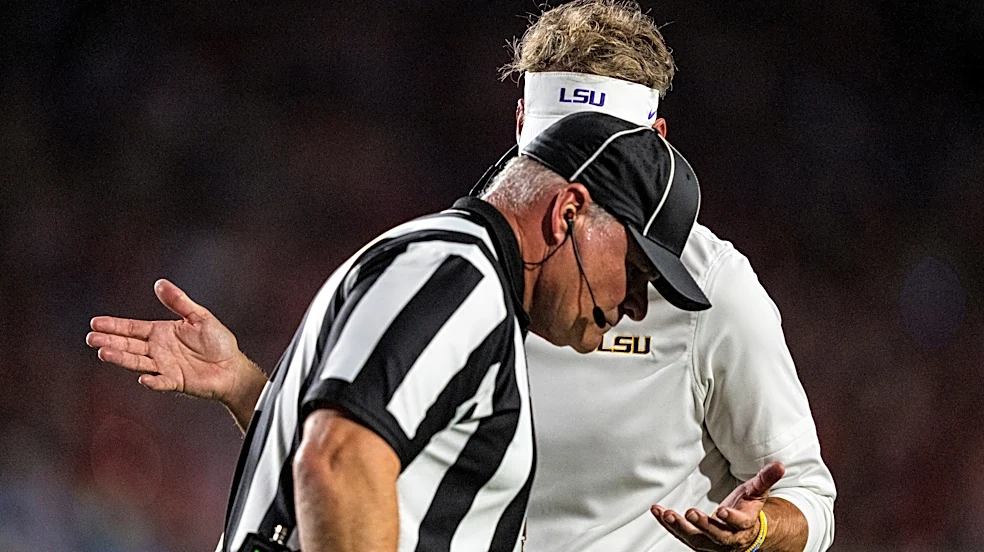



One of the big talking points in college football right now is the 24-team College Football Playoff. Another hot topic is the incredible drama of a stunning Saturday which produced chaos in the top 10 of the national rankings. As though we didn't already have enough juicy subjects to discuss in college football, we also have to deal with the sorry state of college football officiating, both in real time and on replay. There's a lot to go over after the weekend's controversies.
The current reality
The current reality of college football replay review is shaped by the procedural bias toward upholding the call on the field. Whatever the on-field call is, the current policy requires that indisputable evidence must exist to overturn the call. This makes it very hard
to overturn calls that are anything less than 100-percent certain, and it forms the starting point for our discussion.
Bud Elliott of the Cover3 college football podcast
Bud Elliott, a very astute college football analyst and one of the sport's best thinkers, pointed to a replay solution when he said that "It’s time for a new replay procedure.Given the amount of deference that is given to the on-field call and the standard of indisputable evidence to overturn, we need to have an option for refs to no call and go straight to replay if they truly were not able to see what happened."
We will explain why this makes so much sense.
Not all calls are the same
I have officiated sports myself. Whether we are officiating the game ourselves or are looking at a replay monitor, human beings know that not all calls are the same. Some calls are really clear-cut. Other calls are much closer to 50-50, and it might be the case that a certain play just isn't easy to make a ruling on. A play could come very close to the dividing line between one outcome or another. I have made calls I knew were right, and I have made calls I knew were 50-50, and I could have been wrong. Officiating generally and replay specifically need to honor the reality that not all calls are either 100-percent clear or soaked in 50-50 uncertainty. Procedures need to adjust accordingly.
Important plays
We all know what an "important play" is in football. Everything matters, but some things matter more: touchdowns and takeaways (changes of possession). It is logical to establish the principle that if a play is going to be ruled a touchdown or a takeaway (turnover), which is an extremely important part of a game, the evidence for the touchdown or turnover should be airtight, or close to it. Phrased differently, we should have clear evidence that a touchdown was scored. If there isn't clear evidence (the foot might not have touched down in bounds, the ball didn't reach the goal line, etc.), there's no touchdown. This is different from "whatever the on-field ruling is, there must be airtight evidence to overturn it." It's a very different point of emphasis ... but it's a fair one. Everyone in the stadium or watching on television should know that a given play was a touchdown.
Nebraska-Oregon
Nebraska was awarded a touchdown just before halftime against Oregon on the basis of "the on-field ruling" and the need for indisputable evidence to overturn the call. Yet, it seemed far from clear that the Nebraska receiver's toe hit the ground in bounds. It certainly came very close, but the foot swung through the air without seemingly slowing down in a manner which would have suggested the toe hit the ground or dragged itself briefly along the turf.
It was highly uncertain that Nebraska scored, but the "on-field ruling" principle made it far easier for the referees, following the current set of procedures and policies, to award a touchdown rather than rescind it.
Some might say there's absolutely nothing wrong with following the on-field ruling, but we have to then ask ourselves, "What happens when the on-field ruling is really bad?" Later in Nebraska-Oregon, an Oregon receiver clearly bobbled the ball well out of the end zone but was rewarded a touchdown. It was beyond obvious it wasn't a catch, but it raises the point that just because a ruling is made on the field, that doesn't make it inherently better, wiser, or more enlightened. It doesn't deserve that level of deference or primacy. Getting the call right, not "upholding or overturning" the on-field ruling, should be the point here. As an addendum on the Oregon TD which was very clearly not a TD, this is why replay is still needed. Sometimes the on-field calls are so awful that replay has to be a backstop.
Florida State-Miami
Florida State-Miami involved a thorny kind of play: simultaneous possession. The rule still stands that simultaneous possession means the offense gets the benefit of the doubt and is awarded a catch. The defense has to have full possession before or when two bodies hit the ground (a dead-ball position). The absence of full defensive possession is enough to indicate partial possession by the offense, which satisfies the requirement for simultaneous possession between offense and defense.
In other words, there must be airtight evidence of the defense having full possession. The camera angles in FSU-Miami didn't offer that airtight evidence, but in a context of "the on-field ruling" needing to be overturned with indisputable evidence, the bias went toward the on-field call, not to the need to require the defense to have absolute possession.
The simultaneous possession rule is a tricky one, in that one team gets the ball (or touchdown, or catch) if there is uncertainty about who has the ball. This is different from a lot of other rules in the rule book. The point, however, is that it's a rule in which total certainty is required to give the ball to one team (the defense). Absence of clarity is, in its own real way, clarity. That's where the replay process should focus. The tension between certainty and uncertainty is what we really need to get at, and this is where Bud Elliott's point becomes so smart and such a solution to this larger problem.
The no-call option
Instead of the refs needing to have an on-field ruling which is often hard to overturn, Bud Elliott's recommendation that refs be allowed to have an official "no call" designation on a highly uncertain or ambiguous play frees them and the replay booth from having to overturn an on-field call which might be highly suspect and, ultimately, wrong. We should be able to see that allowing a "no call" designation liberates officials to just get at the right call instead of having to operate under the added burden of overturning the on-field ruling. It's such a cleaner, less cluttered, less complicated way of resolving tough calls.
One added point
Let's add this into the mix: Referees have the option of making a "clear call" or allowing a "no call" designation to exist. The "no call" designation removes the on-field ruling from an official's or a replay booth's plate. There is no burden of having to overturn a ruling. If the refs want to make a "clear call" as their on-field ruling, the opposing head coach can get two challenges per game in which said coach (team) can turn a clear call into a no call for purposes of replay review. If the challenge is unsuccessful, the team loses a timeout and is assessed a 15-yard penalty.
Evaluating officials
Why care about a no call designation versus a clear call designation? Here's how: Having these two separate categories can give officiating supervisors more information on which they can evaluate both officials and replay booths. Any "clear call" plays which turn out to be errors will lead to downgrades of officiating crews and replay booths, which means that if they work in the SEC or ACC in a given season, they will not be allowed to work in those power conferences the next year and will be relegated to the Sun Belt or Mountain West (etc.). Crews in the lower conferences which grade out well will be allowed to be promoted to the SEC or the other power conferences for the next year. This will create a healthier culture of officiating by providing better performance evaluation.
Conclusion
Shrugging your shoulders, saying "close enough, we'll stick with the on-field ruling," and ultimately making a call which is not fully supported by the camera angles provided by television is a pretty bad way to go about replay review. Yet, that's where college football is. The idea of shifting scrutiny to "did he really score?" or "getting the call right instead of using the on-field ruling as a crutch" should be the dominant, prevailing idea which guides officiating and replay processes. It shouldn't even be a debate.
That much is clear about college football officiating. Bud Elliott would agree.
Contact/Follow @College_Wire on X and @College_Wires on Threads. Like our page onFacebook to follow ongoing coverage of college sportsnews, notes, and opinions.
This article originally appeared on College Sports Wire: One simple fix will dramatically improve college football officiating