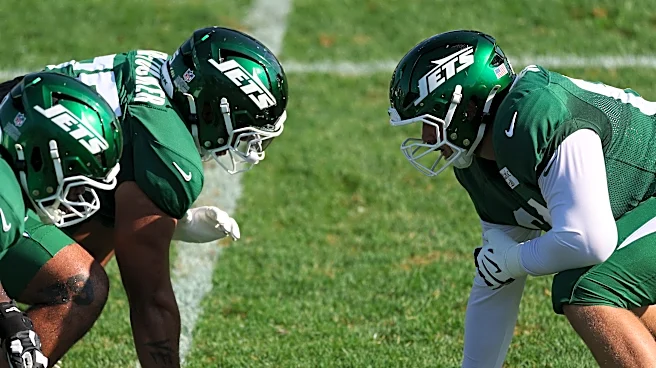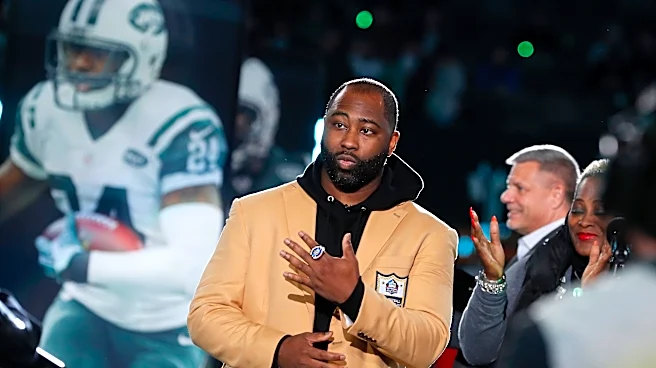





New York Jets offensive coordinator was hired to maximize a unit that already possesses several intriguing pieces, even if the production didn't consistently reflect that potential in 2025.
While the Jets struggled to generate points through the air and finished near the bottom of the league in several offensive categories, they also established trends worth preserving.
Reich now has an opportunity to build around those strengthswhile implementing an offense designed to create greater balance and efficiency.
Here are Jets Wire's four trends on offense the team can build on in 2026:
Breece Hall provides a proven foundation
Every successful offense benefits from a dependable running game, and the Jets already have one of the league's more talented backs. Hall rushed for 1,065 yards while
averaging an impressive 4.6 yards per carry in 2025, recording the first 1,000-yard rushing season of his career despite playing in an offense that rarely found consistent rhythm.
Even more encouraging, Hall has surpassed 875 rushing yards in each of the past three seasons, demonstrating the type of consistency Reich has traditionally valued throughout his coaching career.
Reich has long preferred offenses that establish the run before using play-action to attack defenses downfield. Hall's vision, burst and ability to contribute as both a runner and receiver give the coordinator a versatile centerpiece capable of making that philosophy work.
Garrett Wilson remains the passing game's centerpiece
Few receivers have produced as consistently under difficult circumstances as Garrett Wilson. Although injuries and inconsistency at quarterback limited his production during a shortened season, Wilson still finished as the offense's primary receiving threat.
His route running, separation ability and reliability make him the obvious focal point of Reich's passing attack, particularly on quick-hitting concepts designed to get the ball into his hands early. Wilson's presence also benefits everyone around him. Defenses routinely dedicate extra attention to slowing him down, creating favorable matchups for complementary receivers, tight ends and running backs working underneath.
The tight end room suddenly offers exciting possibilities
The Jets have quietly assembled one of the NFL's more intriguing young tight end groups. Mason Taylor gave the organization a promising developmental piece before the front office doubled down by selecting Kenyon Sadiq in the first round a year later.
Both possess the athleticism to stretch defenses while creating mismatches against linebackers and safeties, giving Reich multiple options when designing personnel packages. Whether the Jets utilize one tight end or both simultaneously, the position should become a much larger part of the offense moving forward.
Three-receiver sets already fit Reich's philosophy
Personnel usage also gives Reich a head start. The Jets frequently relied on 11 personnel last season, deploying three wide receivers alongside one running back and one tight end. That's hardly unfamiliar territory for Reich, whose offenses have consistently featured heavy usage of that grouping throughout his coaching career.
Maintaining that approach allows the Jets to capitalize on their growing depth at wide receiver while creating favorable spacing for Hall, Wilson and the team's young tight ends to operate.
Reich inherits an offense that clearly needs improvement, but he also inherits legitimate building blocks. Hall has already proven he can shoulder the running game, Wilson remains one of the AFC's rising stars and the tight end room offers exciting long-term potential. If those strengths continue developing within Reich's system, the Jets may finally have the balanced offense they've spent years trying to establish.
This article originally appeared on Jets Wire: 4 trends on offense Jets OC Frank Reich can build on in 2026