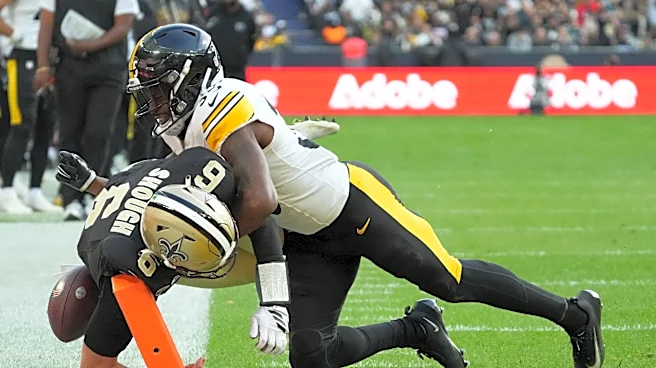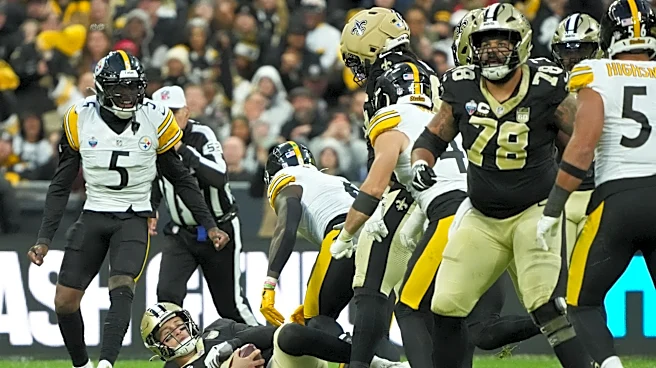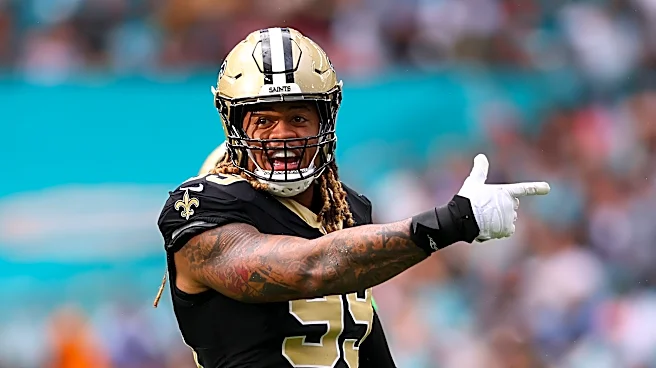




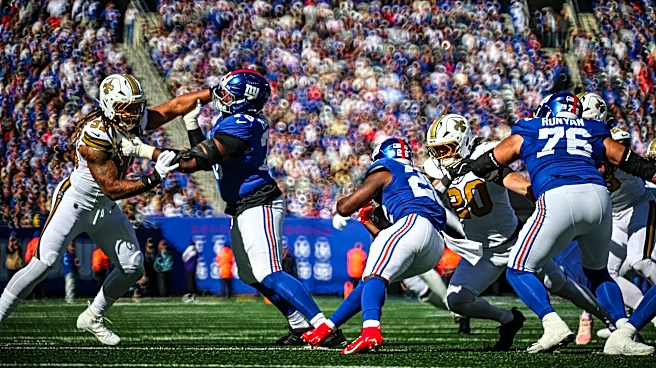

Chase Young has another year left on his contract, but if the New Orleans Saints are smart, they'll recognize he's earned a big extension and start working on a new deal with him now. He's got seven sacks in seven games (not including one taken from him by a bad officiating decision in Week 1) and 17 of them in his last 19 games with the Saints. All respect to Chris Olave and Erik McCoy, but Young has made a strong case that he's now the best player on the team. It won't be long until he's paid like it -- here in New Orleans, or somewhere else. What could an extension look like?
Right now, Young is due almost $26.4 million in 2027, with $18 million of it coming from his base salary. Then he'll be a free agent in 2028. We've seen the Saints take
a creative approach before to free up current-year salary cap space with a new deal. There isn't much to be done with his 2026 cap hit now that we're halfway through the season, so we're only focused on 2027 and beyond. By restructuring that $18 million base salary as part of a new deal, the Saints could actually save $10.3 million. Here's how.
Reducing that $18 million to the minimum ($1.3 million) and paying the difference in a $16.7 million signing bonus spreads the payments out over five years. Tacking on another $15.3 million to be paid in the same signing bonus would put the value at $32 million, averaging out to $6.4 million per year. Combine it with the league-minimum base salary and the remaining payments from his original signing bonus ($3.4 million) and subsequent restructure (just under $5 million) and you've got a 2027 salary cap hit of just $16,095,000. That's bringing in savings of $10.3 million next year, putting the Saints under the cap by roughly $37.7 million. But of course there's a cost. Let's get to it.
We looked at the extensions signed by Aidan Hutchinson and Will Anderson Jr. for guidance (which is where that very specific $32 million signing bonus came from). Paying Young in line with his peers would mean a 2028 base salary of $21.9 million, followed by $39.5 million in both 2029 and 2030, peaking at $41.5 million in 2031. Combine the new signing bonus proration with what's left behind from his previous deal and you've got the following cap hits:
- 2027: $16,095,000
- 2028: $36,695,000
- 2029: $52,023,000
- 2030: $48,623,000
- 2031: $41,500,000
That looks like a lot of money. And it is. But NFL contracts are unique from other major pro sports leagues because they rarely guarantee the whole contract. At this scale, only about half of the deal is guaranteed at signing. We're guaranteeing Young's base salary in 2027 (the minimum), 2028 and 2029, with just a small portion guaranteed in 2030 ($5.5 million), when he'll be 31 years old. Without any guarantees in 2031, we can look into another extension or consider going our separate ways.
What's unique about this structure is that it also gives us an off ramp in 2029 if the deal goes south; releasing him as a post-June 1 cut would spread out the damage, saving roughly $18.5 million against the salary cap that season and leaving behind $33.5 million in dead money the following year (which means saving something around $15 million). Ideally Young is continuing to play well and this isn't a consideration. But NFL teams, including the Saints, give themselves exit strategies all the time. You just hope you don't have to use it.
And it isn't the only quirk we're writing into the contract. This deal is set up for a restructure in 2028, which could free up more than $16.4 million under the salary cap. A $36.7 million cap hit is manageable if they don't want to do that, but a restructure would be necessary in 2029 even if the cap keeps rising by $25 million per year. Assuming Young is still playing well enough to stay. If the situation implodes and the Saints are willing to take the dead money hit, they can do so.
Here's the final tally: we're proposing a four-year extension starting in 2028, worth $175.7 million, with $98.9 million guaranteed at signing. While in reality it's a five-year contract running from 2027 to 2031 (owing to the restructure), for accounting purposes it's considered a four-year deal. That comes to an average of $43,925,000 per year and ranks among the league leaders at his position. Specifically it ranks fourth between Hutchinson ($45 million per year) and T.J. Watt ($41 million APY). Just three edge defenders have been guaranteed more than $100 million, so Young would be knocking on that door. And don't forget the levers we wrote into this. If things don't pan out, the Saints can exit after two years, but they'd obviously like that decision to wait until 2030.
You could argue about the value in extending Young or exploring a trade. It would be very, very difficult to turn down a blockbuster trade like the Dallas Cowboys got for Micah Parsons -- two draft picks in the first round and a quality starter. But you're hoping the rookies you draft with those picks eventually develop into someone as good as him. Take the known quantity at one of the game's most important positions. Lean on Young as Cameron Jordan's successor and splurge on a blue-chip talent while you've got Tyler Shough on an affordable rookie contract. And this deal is a good example of how they could get it done.
This article originally appeared on Saints Wire: Chase Young contract extension: What Saints' best player could earn