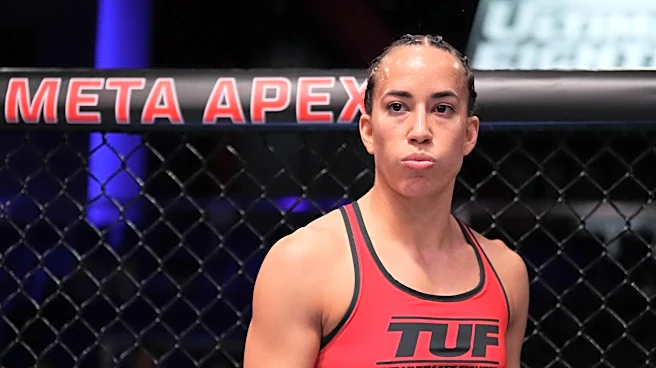




Melissa Amaya knew from a young age she was destined to be an athlete. She never expected she’d end up fighting for her life in and out of the cage.
Currently a cast member on The Ultimate Fighter 34, Amaya shined on the season premiere with a gritty first-round submission win over Team Michael Bisping’s No. 1 pick Anna Melisano. The 31-year-old was all smiles after moving one step closer to a UFC contract, and has stood out for her cheery attitude through the first two episodes that have aired so far.
Amaya is no stranger to dark times, though, having suffered a pair of severe knee injuries in her youth, once in high school, and again in college. Having dedicated much of her life to track and field as well as basketball, seeing those dreams cruelly cut short was difficult for Amaya, to say the least. In an interview with MMA Fighting, the TUF 34 strawweight contestant opened up about overcoming mental health challenges.
“It started when I was 16,” Amaya said. “I truly believe something—I don’t know if it was the anesthesia or just this huge change in, like, you know, you’re 16, your whole identity, at least for me, I was so obsessed about sports in general. Track and field, everything, my whole identity was wrapped around that and being a high performer. The second I couldn’t do that, that did something to my body and my brain and that was when I was 16 that’s when I started feeling what I call ‘the blues.’ It’s kind of like in Halloweentown when everything turns gray and just feeling sad, this weird feeling that just comes over you.
“It’s nothing that precipitates it, it’s just like, ‘OK, that’s weird.’ Because people are like, ‘Maybe there’s a trigger,’ and I’m like, no, it just happens. You could be in the middle of this crazy, happy party around your family and suddenly everything just kind of seems like, beeeeeeep, and you’re just like, ‘I don’t want to be here anymore.’”
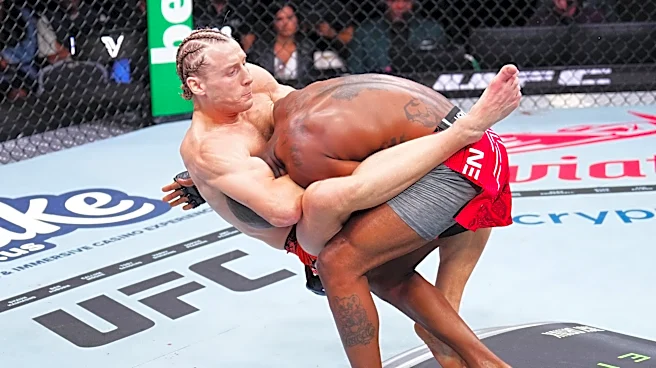
In the world of MMA, fighters who reveal they’re having issues with mental health often receive a mixed reaction. Current UFC stars like Paddy Pimblett, Joe Pyfer, and even two-time middleweight champion Sean Strickland have spoken openly about their mental health struggles, but such conversations can still be taboo in fighting and in the broader sports landscape, with many athletes being told from an early age not to discuss these topics publicly.
Amaya doesn’t subscribe to the notion that she should remain silent.
“It’s very interesting,” Amaya said. “Or when people are like, ‘Oh, you seem very comfortable talking about it.’ Am I supposed to shut up and be ashamed about it?
“That was my experience and there were times when I was crying in the bathroom before practice, because it was just coming out of my eyes. I call it ‘crying spells’ and I’m like, ‘What is going on? Why can’t I control this?’ I felt like I was losing my mind, but I still kept putting one foot in front of the other and I’m like, one day. Tough times don’t last, it’s going to be OK. Hopefully, it helps somebody else, that’s why I also speak about it because maybe I’ll say it in a way that it makes sense to somebody to get through to them.”
In the TUF 34 season premiere, Amaya was the third pick of Team Daniel Cormier and the sixth pick overall, just narrowly missing out on being left off of the show entirely with only eight of 10 strawweight contestants making the cut. She made Cormier look like a genius with her dominant win over Melisano.
Amaya trains with Team Sikjitsu in Spokane, Wash., and counts two-time UFC bantamweight champion Julianna Peña as one of her mentors. Peña is also someone Amaya trusts most when she needs to talk mental health.
“Julianna and I, we have very deep conversations about it,” Amaya said. “I feel like we both have had tough experiences and we’re pretty big supporters of each other, so when you feel a certain way and you communicate it to somebody that understands, instead of being like, ‘Oh my God, do I need to make sure you’re not going to kill yourself?’ No, they, like, maybe giggle, and be like, ‘Yeah, been there. You’re going to be OK. We got this.’ So it’s very nice.
“My coach, on the other hand doesn’t understand it, but he approaches it in more of a curiosity kind of way. He tries to get to know instead of being like, ‘That’s f*cking fake.’ You know what I mean?”
With Amaya and Melisano being the first fighters to compete on this season, they received plenty of camera time, which might not be the case in future with the focus typically being on the two fighters competing on a given episode. Asked what producers might have left out of her episode or what she wants viewers to know about her that might not make it out of the editing room, Amaya focused on communicating a broader, hopeful message.
“Maybe not so much about me in general, but there’s a lot of times people don’t put their name in the hat because everybody else is so much more confident and saying it to the world and they’re like, ‘OK, I don’t feel like that about myself or whatever so I don’t belong there,’” Amaya said. “You belong there. You’ve just got to put in the work and you can make your own style. You don’t have to fit everybody else’s style. You can be the first one of your own kind and that’s essentially what I want people to know about me. That’s what I’m trying to do, too, is just to pave your own way, so I hope everybody else can do that, too.”
If you or someone you know is dealing with mental health issues, please reach out.
In the U.S., the 988 Lifeline can be reached at 1-800-985-5990, or by text via 988 or at 988lifeline.org.