



Written By Former Sunderland Midfielder, Kieron Brady
The name Raich Carter is firmly embedded within the lore of Sunderland AFC and the hearts and minds of its followers.
A son of Hendon, he was the local lad come good – a one-goal-every-two-games inside-forward who would lead the club to league and cup glory in the late 1930s and who is still, to this day, one of the youngest-ever captains to lead a side to top-flight English success. Having led the club to the English First Division in 1936 – that is the Premier League in old money for the millennial
masses – he was then presented with the prospect of leading the side out at Wembley the following year in the FA Cup Final.
Millwall had been successfully overcome in the semi-final three weeks earlier, with Sunderland showing the resilience to come from behind. The final whistle at Leeds Road, Huddersfield, brought the typical emotions – the elation that comes with success in such settings and, of course, the anticipation of the weeks ahead and the looming date with destiny as Sunderland aspired to return to Wearside laden with silverware.
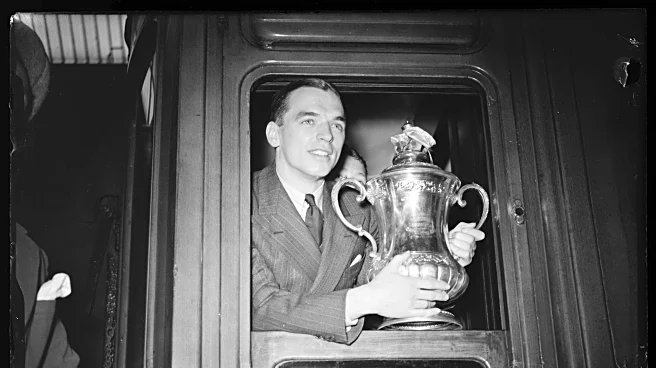
The fortitude shown to come from behind would again be evident during English football’s end-of-season showpiece on 1st May as Preston, ahead at half-time, succumbed to the Wearside warriors in the second half, with Raich Carter amongst the goalscorers.
But Sunderland had another captain in 1937 — every bit as much a hero as the man whose mural proudly looks down from the Blue House pub in his home town of Hendon. Arguably more so.

Captain Frederick Robinson would have celebrated each FA Cup tie being won as much as anyone, but by the time Sunderland headed to Yorkshire in the hope Wembley was soon to follow, the focus of Captain Robinson, bred in the Barnes area, was on an upcoming journey that had more than memories and medals at stake.
In an increasingly polarised continent, Europe was coming to terms with the political phenomenon of fascism. Whilst some of its ingredients were hardly novel, the idea of absolutism and othering communities had been adequately packaged and presented with its symbology a nod to Roman history.
The adherence to such ideology had found allure, with Germany, Italy, and Spain the notable victims as an antithesis to the democratic will of the people became evident. In the latter, Spain, the 1936 election won by the Popular Front was both disputed and dismissed by Franco and his sycophants.
A fascist disputing the electoral endorsement of the people. Wouldn’t happen now, eh…
The ensuing civil discord, carefully crafted by Franco, brought about the Spanish Civil War and, for the Spanish people, the demise of parliamentary democracy for four decades.
But some would not stand idly by. Not merely the Spanish people but ordinary decent people beyond Iberian borders.
One such individual was our very own Frederick Robinson. And by the time Sunderland and Preston were engaged in battle at Wembley he, with others from Sunderland, the wider North-East, and beyond, was the captain of the SS Knitsley as it made its way to Spain to bring aid to the beleaguered Basque people. Despite the trepidation of what lay ahead, on 1st May 1937 the crew of the ship had, temporarily, other matters to focus on.
Sunderland, their home-town club, were at Wembley, and for several hours these local heroes, part of what we know now as the International Brigade, were able to use the ship’s radio to keep abreast of how events were unfolding in London.

They celebrated. Briefly. Before long emotions were balanced and the precarious nature of their mission realised.
Some made it to Spain. Some did not. Some took down aid whilst others took up arms. All to fight on behalf of the poor and disenfranchised. Their humanity and heroism is not diluted by the outcome of the conflict; it lies in their willingness to confront evil and the preparedness to make the final sacrifice if needed.
They are memorialised across modern Spain, from street name to statue, from plaque to plaza.
There is, however, no fitting memory or memorial to Captain Robinson and others from Sunderland within Wearside.
Incredibly, if you want to see the inscribed names of those from Sunderland who fought Franco and fascism you have to go to the garden and grounds of Newcastle Civic Centre.
That, however, is about to change. With the assistance of the community that reared such heroes.
Solidarity Sunderland are in the process of trying to ensure that those who, as the oft-espoused football chant says, were “one of our own” can have their voices heard and story told through a public memorial that accurately reflects their demonstrable opposition to the social disharmony and destruction of political poison.
If every second Saturday you go to the Stadium of Light to support a footballing International Brigade – all colours, creeds, and nationalities – then surely we can honour the local volunteers who were part of one that had so much more to lose than a football match.
Get involved – your time and input can prove as invaluable as any financial contribution.
Find out more at https://solidaritypark.com/solidarity-sunderland/
Please contact – solidaritysunderland@gmail.com