


The late season decline of the Los Angeles Rams can be primarily explained by two recent developments:
- The defense went from one of the best tackling units in the NFL to among the worst
- Matthew Stafford started the season on a tear but has since come back down to earth
If you want to read more about the Rams’ tackling woes, I’ve written about it often and you can find it here, here, and here.
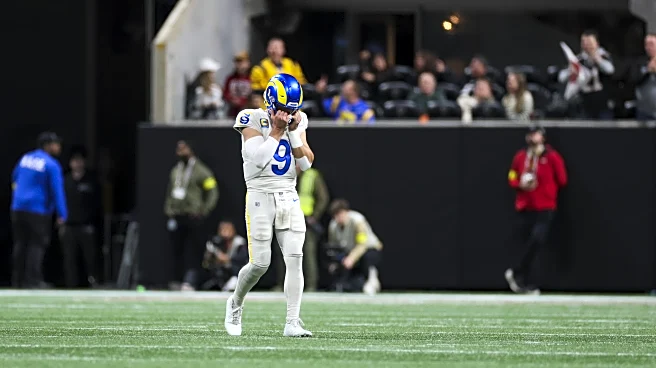
The aspect of the Rams’ decline that I haven’t talked about enough recently is the statistical regression of Stafford. The veteran’s start to the season defied all odds. He’s now into his late 30’s and missed all of training camp and the preseason with a back injury. The team
itself wasn’t even sure he’d be able to suit up in time for the season. In the face of adversity, Stafford emerged on the other side playing the best football of his entire career.
But we should have known it wouldn’t last, or at least we should have been much more cautiously optimistic.
When a player performs better than he has at any points over the last 17 years, the smart bet is against the trend continuing. Stafford is an aggressive quarterback. He started the season on a historic TD-INT ratio (a bad measure of passing performance but still impressive nonetheless) despite putting the ball in harm’s way at a relatively high clip over the rest of his career.
Diving deeper into the turnover regression
Stafford’s season-high mark for Pro Football Focus (PFF)‘s turnover-worthy plays is three. He’s hit that threshold in two games, both of which came late in the season in Week 17 (Falcons) and Week 15 (Lions). We don’t usually think of the Detroit game as a bad performance for Stafford as he threw only one interception. The box score can lie to us. In both games Stafford finished with a turnover-worthy play rate of 6.8%.
On a percentage basis, there are two more games in the same ballpark in terms of potential turnovers. In both Week 13 against the Panthers and Week 6 versus the Ravens, the quarterback had a TWP rate of 6.7%. While Stafford only had two TWP’s in each of these games, he dropped back to pass at least 10 less plays compared to the two games where he had three.
In other words, three of the worst games for Stafford putting the ball in harm’s way came in recent weeks. Since the Week 13 loss to Carolina (the start of this stretch), the Rams have a measly 2-3 record.
As I mentioned before, I am not saying the recent change in win/loss record is entirely on Stafford. The defense has also taken a step back and this is another key driver in the team’s decline. However, the oldest adage in football is that the turnover battle decides outcomes. The Rams aren’t winning this game within a game of late.
This development might be the single-most important factor for the Rams heading into the postseason.
This could all explode in extraordinary fashion
After a Week 12 rout of the Buccaneers, the Rams were the predominant favorite to win the Super Bowl and Stafford was far and away the leader for the league’s MVP award. It was difficult to imagine anyone other than Stafford taking snaps under center in 2026, all in spite of his offseason trade rumors and his mysterious back injury.
If Los Angeles limps into the playoffs and get booted in the early rounds, I don’t think we can rule out a change at quarterback. The Rams already explored trading Stafford this offseason, and there are obvious limitations to his game into his late 30’s—like the fact the quarterback has a negative rushing total on the season.
You can call me crazy. But if the Rams don’t win the championship this season, continuing with Stafford is only detrimental to the team’s long-term success. It doesn’t matter what condition the roster is in or what draft picks you hit. If you can’t thread the needle from Stafford to the next franchise quarterback, it’s all for naught.
Let’s be honest. Nearly every premier quarterback in the NFL would enjoy career seasons under Sean McVay. We shouldn’t pretend that the Rams’ only option is an age 38 player who can be incredibly inconsistent.
The 2010’s called and want their signal caller back.
The next evolution of the Rams offense should be centered around a mobile threat at quarterback. Stafford leaves a lot of meat on the bone in terms of rushing for first downs and touchdowns. Drake Maye, now the MVP front runner, has gained 34 first downs and four touchdowns with his legs this season. Those are usually moments where the defense does everything right—cover up receivers and pressure the quarterback—and he still escapes and beats you in another way.
These aren’t even knocks on Stafford individually. Los Angeles is playing offense with one hand tied behind it’s back. They were able to partially mitigate this problem by signing Davante Adams and growing more potent in the red zone. This is only a temporary fix and a dual threat quarterback would be more sustainable in the long run.
A late regular season collapse and an early exit from the playoffs could force the Rams to go back to the drawing board this offseason. That could mean moving on from Stafford in a year where he was once the favorite to win MVP.