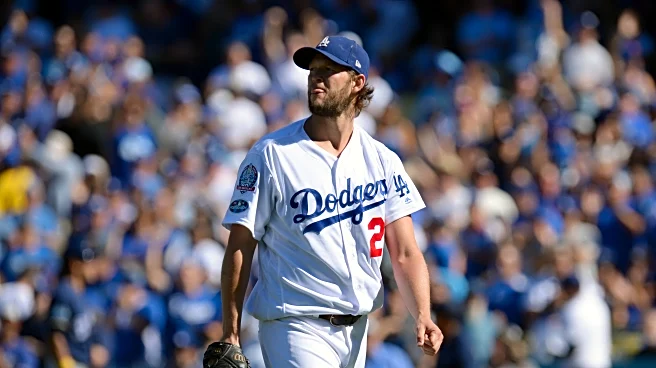

Clayton Kershaw, like the Dodgers team as a whole, took a step back in 2018, although they were both still good enough to accomplish similar goals. Kershaw delivered another sub-3.00 ERA, and the Dodgers saw
their most difficult division title of this whole Andrew Friedman era come to pass, needing a Game 163 at home to beat out the Colorado Rockies for the NL West crown. A team that severely underperformed its pythagorean win-loss record, winning only 92 games when it indicated it should’ve crossed the 100-win threshold, the Dodgers entered the playoffs without the gravitas of the previous campaign but were still seen as a top candidate to reach the Fall Classic.
The year 2018 marked the first time Kershaw could legitimately be seen as no longer the top option in the Dodgers rotation. Walker Buehler was beyond magnificent in his rookie campaign, starting that decisive Game 163 in a win over Colorado, and it was Hyun Jin-Ryu taking the ball in Game 1 of the NLDS against the Braves after a 1.97 ERA in 15 starts.
As if to have his Michael Jordan’s “and then it became personal to me” moment, Kershaw started game 2 of that NLDS against Atlanta with a vengeance, delivering one of the most efficient postseason outings in the 21st century, covering eight scoreless frames while needing a mere 85 pitches to do so, largely explained by his standard no walks and a surprising only three strikeouts. Still, the Dodgers already led that series 1-0, and for as great as Kershaw was, this wasn’t his most memorable outing during that World Series run.
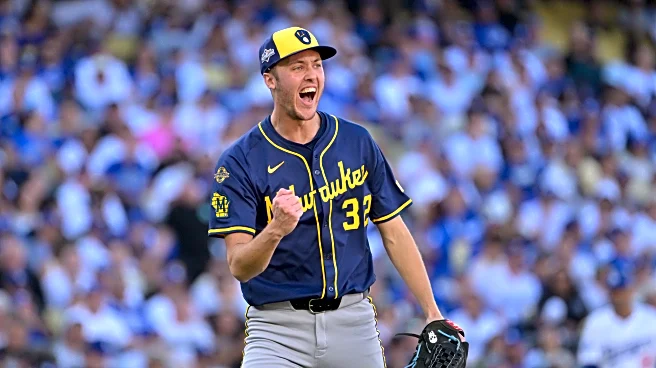
Quick, if someone tells you to think of the first thing that comes to your mind when hearing the mention of Kershaw against the Brewers in the postseason? You, like me and so many others, might’ve thought about pitcher Brandon Woodruff taking him yard with a home run in Milwaukee, worthy of the game’s premier left-handed sluggers. While the rarity of that moment holds merit, when you assess Kershaw’s track record against the Brewers in the playoffs, there’s a rather transparent argument that it stands out due to the narrative around Kershaw in the playoffs in our subconscious — a narrative built largely on undeniable facts, but one that, at the very least, glosses over the entire story by skipping a few chapters in a quite rude manner. Although not as dominant as in his Wild Card performance in 2020, Kershaw’s most important postseason performance against the Brewers came in Game 5 of the NLCS in 2018.
I had the idea to do a series along these lines for quite a while, and when going back to check Kershaw’s postseason record, none of the previous games we’ve covered stood out as much as this one. For whatever the case, I remembered Kershaw doing well in that Game 5, but not as well as he actually did in what was a pivotal win in a series then tied 2-2 and headed to Milwaukee with someone owning a match point.
The script had been written, the stage was set, and even the “villain” had been properly introduced shortly into the proceedings with a change of starters. Craig Counsell quickly revealed Wade Miley was simply a decoy and threw Woodruff in to cover the bulk of innings one out into the start of the game for the Dodger hitters—the same Woodruff who had homered off Kershaw as the Brew Crew hit around the three-time Cy Young winner in Game 1 of that series.
For those paying attention, there is a consistency from the start of this series of articles: thin margins for Kershaw in each one of these great postseason performances. A large part of why I’m so dismissive of the idea of any logical explanation behind the general struggles of Kershaw in the playoffs is that, on the times he was at his best, of which there were plenty, as we’ve seen, those games were some of the more tightly contested the Dodgers have played, upping the pressure to the nth degree.
Milwaukee scored first in Game 5, once again propelled by a positive at-bat from the hitting pitcher Woodruff, whose one-out walk helped pass the baton to Lorenzo Cain, driving in one on a double — a hit that generated a two-on, one-out situation for Kershaw to navigate through against the heart of the order for Milwaukee. The rally knocked on the door of the future Hall of Famer, and he shut it down with a couple of strikeouts against Christian Yelich and Jesús Aguilar in the middle of a Ryan Braun walk to end the threat.
Out of every one of his nine strikeouts in that game, those two were by far the biggest.
Speaking of pressure, that one run meant the Dodgers trailed in this game until the bottom of the fifth, when finally the bats came alive, but still, throughout his entire seven innings of work, the Dodgers never led by more than two runs., Los Angeles eventually added a couple of insurance runs to help protect his outstanding performance.
Lost in the story of that game, Kershaw played a key part in the Dodgers’ scoring and did so after his outing was finished. The Dodgers’ starter came out to hit in the eighth inning, when the Dodgers led 3-1, and he drew a walk in what ultimately became a two-run frame, upping the Dodgers’ lead to 5-1. With a more comfortable advantage, Dave Roberts went to Pedro Báez and subsequently Kenley Jansen to close the game.
It’s purely speculative, but one might be justified in pondering if a bit more tired Kershaw, having thrown eight and not seven innings, could’ve struggled to secure the final outs he was brought in to do in Game 7. We’ll never know.