




After seven games into the 2026 season, Mizzou has reached its bye week. It’s not necessarily the halfway point of the regular season- a little over- but it’s a great time to reflect on what has happened up to this point in the regular season with the Tigers not in action.
Before the season, we examined each positional group, observing the roster in every aspect. Throughout the season, we’ve also explained some stock risers and fallers, whether it be individual players or positional groups.
Now, with
seven complete games, let’s look at which players and positional groups have seen significant changes within the preseason expectations and if their stock has risen or fallen.
Stock Up
Austin Simmons

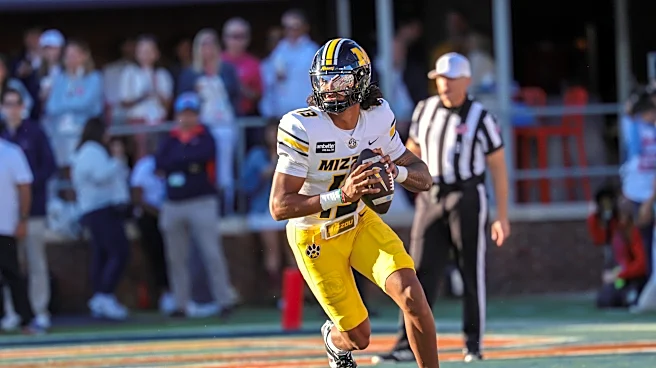
Austin Simmons has been everything that Mizzou’s offense has needed in 2026. Coming into the year, he was more of a projection than anything. He arrived at MU with just 118 collegiate dropbacks, but there was no denying the arm talent that was briefly displayed at Mississippi, with Drinkwitz crowning his skillset as the best he’s seen in Columbia.
That arm has helped transform the Tigers’ offense, which is what the idea of pairing him and Lindsey has brought. Per PFF, his 14 completions of 20-plus yards match the total the Tigers’ quarterback room had all of 2025, while his average depth of target of 11.5 is higher than both Beau Pribula (7.5) and Matt Zollers (6.7) from last year.
While just being a one-year starter, he’s risen up into NFL draft first-round conversations. His ability to layer the ball all over the field is outright impressive and fun to watch. Even in a bad loss, like against Mississippi, when the Rebels took away Cayden Lee, he turned to his other receivers, including Donovan Olugbode (127 yards), Jude James (57 yards), and Naeshaun Montgomery (45 yards and a dropped touchdown).
There’s plenty of improvement still for Simmons. Per PFF, his adjusted completion percentage dips from 73.3 to 57.1 when kept clean vs. under pressure. While he’s thrown just two interceptions, he’s been credited with eight turnover-worthy plays. But Mizzou has a quarterback, and it’s been fun to watch. While the passing attack has dipped a bit the past couple of weeks, it will be interesting to see how it performs after the Bye Week.
Jamal Roberts

Now, let’s talk about the three AP mid-season All-Americans. Starting in the backfield with Jamal Roberts.
Before the season, we knew that Roberts was one of the best complementary running backs in college football. Much of the preseason conversations, and into the regular season has been centered on Ahmad Hardy’s potential return and whether Roberts could handle the workload.
Well, Roberts is one of the most productive running backs in the nation, which is definitely a Curtis Luper stat, but also shows the Something To Prove mentality that he can be a 1A in the toughest conference.
Heading into Saturday, Roberts leads the FBS with 867 rushing yards (Coming after a 29-yard performance against Mississippi), while his 167 attempts are the second-most. His 20 runs of 10-plus yards are sixth among Power Four running backs, while his 346 breakaway yards are fourth. At his current rate, he’s on track to provide Missouri with back-to-back 1,400-yard rushers.
When discussing some of the most important decisions made in the 2026 offseason, when we look back, retaining Roberts might be the second-most important one, alongside grabbing Austin Simmons in the transfer portal. He’s a player who has stuck around since being a freshman in 2023, and in a world where players can easily transfer, it’s paid off for him staying.
Daeden Hopkins

For being a second-year player, there hasn’t been a player who’s taken a bigger leap than Daeden Hopkins and has helped supplement a defensive line that experienced turnover and injuries in 2026.
Zion Young and Damon Wilson II departed. Through seven games, both Darris Smith and Langden Kitchen have missed time with injury.
Being the next man up is a cliché in the sport, but Hopkins has risen to the occasion. His 24 pressures rank 11th among Power Four edge rushers, while seven sacks lead the team. Down the stretch, a deep pass rush arsenal is going to be needed against the opponents and quarterbacks this team will face. While in a loss, Hopkins was awesome against Mississippi State, constantly causing pressure on Kamario Taylor, while he contributed to the havoc caused against Kansas.
It’s a promising trend through seven weeks as he’s exceeded the external expectations in this edge rush room.
Nicholas Rodriguez

Mizzou lost three linebackers to NFL rosters last spring, picked up a star out of the transfer portal (Robert Woodyard Jr.), but the math there doesn’t add up positively for the Tigers. Another player from the previous year’s depth was going to have to fill in and be an every-down contributor in a big way.
Rodriguez was the most experienced of the returners and has been the Tigers’ leading tackler (77 total tackles), including 4.5 for a loss and 1.5 sacks. Like Roberts and Hopkins, he is a mid-season All-American.
But a case can be made that Rodriguez and the rest of the Tigers’ defense improved after a rough performance in Starkville to end September. PFF grades don’t tell the full story, but prior to Week 5, Rodriguez had tackling grades all below 60. Since the Mississippi State game, he hasn’t had a tackling grade below 65, and this comes against Jadan Baugh and Kewan Lacy, two projected early-round picks.
Donta Simpson
While Mizzou lost Wilson to Miami-FL, it was in a way balanced with the arrival of Donta Simpson. As a true sophomore, he came from South Beach with just 105 career snaps. Now, he has carved out a significant role within the interior of the defensive line.
Simpson ranks fifth in snaps on the unit, behind Jason Dowell and Jalen Marshall as well as Marquis Gracial and Sterling Webb. But Simpson ranks second on the team with 19 pressures, while being second with 5.0 sacks. While this Tigers defense has a plethora of talent, it’s exciting to know that both Simpson and Hopkins are still relatively young, but have stepped in to be major impact contributors through seven weeks.
Stock Down
The offensive line efficiency in the run game
There’s a paradox within Mizzou’s rushing attack. Despite Roberts’ strong start, Mizzou’s offensive line in the run-blocking department hasn’t been enthusiastic so far through 2026. Now, the Tigers’ offensive line has shuffled heading into this season.
Josh Atkins, a transfer from Arizona State, got hurt, putting Luke Work at right tackle. Dominick Giudice flipped back to his natural position at center, after playing the 2025 season at left guard. Tristan Wilson is a full-time starter for the first time of his career.
The unit as a pass-protecting team has been excelled. Wilson, Giudice, Curtis Peagler, and Cayden Green all have PFF pass-blocking grades above 80, while the offensive line has been credited with just two sacks.
But they often haven’t found consistency in the run game. Of the starting five, only Green, Peagler, and Giudice have had run-blocking grades above 70 in SEC play. Giudice is the only one to have done it twice.
While the long, explosive breakaway plays by Roberts have been nice, it would be beneficial for this unit to help provide more consistency moving forward. It’s also been an issue when it comes to the red zone, with penalties and inefficiencies.
Tight End Room
Should Jude James receive more opportunities in the passing game following Ole Miss? It might be something the Tigers will have to consider after the Bye Week. It’s been evident all season that Mizzou’s tight ends have been absent from the receiving game, until James’ 57-yard performance in Oxford. He now trails Brett Norfleet by 23 yards on the season.
Even while Norfleet brings size and Jordon Harris is predominantly known for his run-blocking ability, the two rank 29th and 30th per PFF in run-blocking grades of 50.4 and 50.3. That’s dead-last among qualified players on Mizzou’s roster.
Like the past six years, it just might not be the year of the tight end in Columbia.
Blake Craig and the kicking operation
After the Kansas game, Drinkwitz said it was the most embarrassing special teams performance he’s seen. It hasn’t gotten any better throughout SEC play. Blake Craig is 11-of-17 on the year. His 64.7% percentage is the worst among SEC kickers, unless you count Max Kelley (South Carolina) and Jacob Kauwe (Kentucky), who have combined for three attempts all year.
Kicks have been blocked due to protection breakdowns, or outright missed, or shanked. It hasn’t cost Mizzou a game outright, but the kicking operation has taken an extreme dip. Even last year, when the Tigers struggled, they made 71.4% of their kicks. 64.7% would be the lowest in the Drinkwitz era.