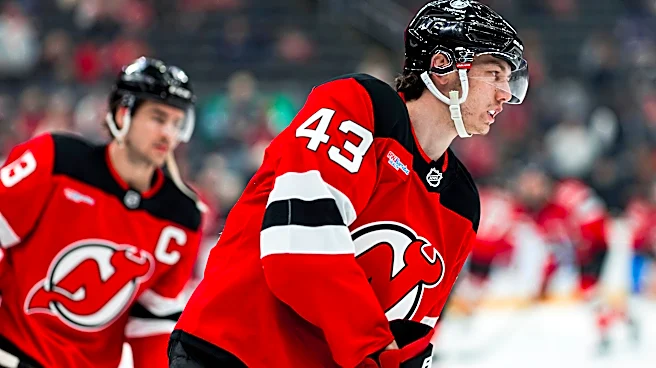



If there is a word that could be used to describe the season Luke Hughes had in 2025-26, it is “whelming”.
I wouldn’t say it was overwhelming in that he clearly made the leap to become an upper echelon defenseman in the NHL. That simply isn’t true and anyone who watched the games could see that as the season unfolded.
I wouldn’t say it was underwhelming in that he was flat out terrible, because that isn’t true either and does ignore the good that he did. Defensemen who are objectively terrible don’t
play 23+ minutes a night and don’t play on the top power play unit. Anyone suggesting he’s not an NHL talent, and believe me when I say those people are out there, doesn’t know what they’re talking about.
It was whelming. I was whelmed watching it play out, as you likely were as well. There was some good. There was some bad. And there were moments that I’m sure he’d like to forget entirely.
It’s one thing to have those growing pain moments when you’re 20 years old and you’re in your first full NHL season. It’s another when you fast forward to a couple years later, you’re crossing that 200 NHL games played threshold, you just became the newly minted $9M man after a contract negotiation that bled into training camp…and you’re STILL having those moments like the aforementioned Carolina game. It’s one thing to get beat. It comes with the territory of playing that position against the best players in the world. It’s another thing to have brainfarts.
Luke Hughes, like many highly touted former top prospects coming off of an ELC, didn’t necessarily “earn” that $9M AAV he got on his second contract, although a rising salary cap and 93 points in his first 155 NHL games might suggest otherwise. Former general manager Tom Fitzgerald ultimately bet on the youngest of the Hughes brothers reaching his potential as a potential top pairing defenseman much like he bet on Jack ultimately becoming a game-breaking offensive talent several years earlier. Fitzgerald bet on the talent. And while it didn’t pay off in Year 1 of Luke’s 7-year deal, its far too early to call that contract a disaster. Particularly in a rising cap environment where $9M may be viewed as a relative bargain four or five years from now.
After being relieved of his duties, Fitzgerald won’t get to reap the rewards if and when Luke takes that next step in his development as a player. But whether he was ultimately right in this case will likely have a hand in determining what the ceiling actually is for this Devils team.
The Time is Now for Luke to Take That Next Step
After being shut down late in the season to get a procedure done on his shoulder and with the contract drama in the rear-view mirror, there’s no excuse for Luke not to be ready to go come training camp.
Luke will be 23 years old on Opening Night. He’s right around that age and level of NHL experience where young defensemen figure it out and become the players they’re ultimately going to be. Obviously, not all players are the same nor do they develop at the same rate, but there are plenty of examples of young defensemen who gain that next level and start to put it all together right around this age. Moritz Seider did it this past season at 24. Cale Makar did it at 23. Rasmus Dahlin and, obviously, Quinn Hughes did it at 22.
Of course, I just name dropped four of the best defensemen in the league. But when you’re a high lottery pick like all of those players were (and like how Luke was), that’s the type of company you hope to keep. When you have the last name “Hughes” and your older brothers are both NHL superstars, the expectation is that you’ll be the next one, fairly or unfairly.
Luke Hughes isn’t a finished product as an NHL player. There are definitely things he still needs to improve upon…..his shot first and foremost, but he could stand to improve his decision making and positioning defensively as well.
The good news is that we saw signs of that late last season. After he returned from his injury around the Olympic break, there was a noticeable improvement in his game. He was better defensively. He was playing with confidence. He was driving play. He was part of the reason why they went 12-6-1 in the games he played in post-Olympics. And as Alex Chauvancy pointed out on his substack at the time, the underlying numbers were promising.
Hughes posted an xG% of 54.84 percent and an actual goals share of 60 percent after he returned from injury, with the former metric ranking him fourth among Devils skaters after the break.
There was noticeable improvement in Hughes’ two-way game, too. The Devils generated 3.10 expected goals per 60 minutes but allowed just 2.55 expected goals per 60 in Hughes’ five-on-five minutes after the break.
Before the break, the Devils generated 2.68 expected goals per 60 but allowed 2.94 per 60 in Hughes’ five-on-five minutes. That’s a stark difference between the two samples.
I don’t know if he was a player who was simply drowning mentally with some of the lows he had in the early portion of the season, but the injury that cost him games around the Olympic break was probably a blessing in disguise in that it clearly gave him an opportunity to reset, both physically and mentally. To Luke’s credit, he made the most of the time off and looked better once he returned to game action. If the Devils can bottle up that version of Luke Hughes and have that moving forward, it would go a long way towards making that proverbial leap this season.
The Human Element In All of This
I don’t personally know the Hughes brothers nor have I talked to them, but if there is one area I can relate to them, it’s that I also have brothers. And its human nature for brothers to be competitive.
I know when I was growing up that when one of my brothers had something that I didn’t have or did something that I didn’t get to do, it motivated me to one-up them. Not because of jealousy or envy, but competitiveness. I’m sure anyone reading this who grew up with brothers in a competitive household can relate to that.
I can only imagine that’s dialed up to extreme levels when you’re talking about a set of brothers who are good enough to be amongst the best in the world at their given profession. In a household where their mother is a former Olympian and their father works for an NHL team and sees that sort of competitiveness day in and day out.
This past calendar year has been a big year for the Hughes brothers (and family in general). Quinn got traded to the Minnesota Wild, had a huge second half of the season, and was a big part of the reason why Minnesota got as far as they did in the postseason. Quinn and Jack were both key members of the US Olympic team. Jack scored what may ultimately be the biggest goal he ever scores in his life and became an instant overnight celebrity when they won the gold medal in the fashion that they did. Quinn and Jack got to enjoy all the rewards that comes with that, from going on Saturday Night Live to throwing out the first pitch at a Yankees game to rubbing elbows with other greats at the ESPYs.
Luke kind of did as well, in that he got to be the plus-one for Jack’s victory lap tour. But not really. It’s not the same as actually being a part of the team.
Everybody outside of our hockey-centric bubble knows who Quinn Hughes is. Everybody knows who Jack Hughes is. They’ve become household names. Jack parlayed it into dating one of the biggest pop stars in the world. People know who they are.
But maybe just a handful of those people know that there’s a third Hughes brother. And if they are aware of him, he’s presented like the third wheel. An afterthought.
I don’t know how those people look at Luke Hughes. I don’t know if they view him like Rob Gronkowski’s far less talented brothers who stuck around the NFL longer than they probably should have because of their last name. Frankly, I think its insulting to Luke to compare him to that since he’s clearly a good NHL caliber player in his own right.
But there’s a difference between being a good player like Luke and an elite-level player like Quinn and Jack. Quinn and Jack are on that tier and deservedly so. Luke still has work to do to get there, assuming he ever can get there.
I do know that if I were Luke Hughes and I saw how Quinn and Jack’s lives have changed post-Olympics though, it would be one hell of a motivating factor to get to that level as a player. To get to that level where you are under consideration for the Olympic team. To get to that level where you’re considered one of the handful of best players in the world at your position. I would certainly want to shed any negative connotations that might even be remotely associated with being “the third Hughes brother that isn’t as good as the other two”.
I do know that if I were Luke Hughes and I had the season I just had where I was booed off of home ice to the point where things got uncomfortable, I’d be motivated to come back better than ever and prove all of the naysayers wrong.
I don’t know how Luke will look once we see him on the ice this season. I do know that betting against talent and betting against that particular bloodline in general is a losing proposition.
Of course, all of this is purely speculative. I haven’t been granted the ability to read minds, and like everyone reading this, I’m not in the room or behind the scenes. Luke didn’t speak to the media when the players cleaned out their lockers as he was injured and away from the team, and even if he did speak, I don’t read a ton into athlete-speak. I don’t know what makes him tick. And to be clear, I’m not saying anyone erred in leaving him off of the Olympic team. He’s not on that level yet.
That said, the physical traits are there. The skating is there. The puck is generally moving in the right direction when he’s on the ice more often than not. There’s no reason to think any of that is going away unless he’s coached in a manner to play a boring, conservative brand of hockey, which would be counterproductive given the skillset.
Obviously, Luke needs to stay healthy first and foremost. And obviously, there are aspects in his game that need to be buttoned up and improved upon. But the building blocks for a really good defensemen are already in place. It’s a matter of putting it all together, and if what we saw from Luke post Olympic-break is real, he’s likely on his way and its just a matter of time.
Roster Construction Has Likely Boxed the Devils In Where Their Only Path to Improvement on the Blueline is Through Luke Hughes
I believe that Sunny Mehta would like to make changes on the Devils blueline. Unfortunately, this is one area where other bets Fitzgerald has made on players in the past has likely tied Mehta’s hands to some extent on what he can do right now.
Mehta inherited the two years and $9M remaining on Dougie Hamilton’s contract. Fortunately for Hamilton, it would appear that he has the sort of analytical profile that Mehta is looking for where any trade rumors involving him have cooled off.
Mehta inherited the four years remaining on both Brett Pesce and Johnathan Kovacevic’s contracts. Both of those players have a full no-trade clause for this upcoming season that becomes a partial no-trade clause next July 1st.
I don’t know what Mehta thinks of those players, nor do I know what he thinks of Jonas Siegenthaler or Brenden Dillon. This is the roster he inherited from the previous regime. But I think its safe to say he’s not afraid to make the changes he sees fit because we’ve already seen it with the depth forwards and goaltender. I also think its safe to say all of those aforementioned defensemen are what they are as NHL players at this point. Dillon, Hamilton, Siegenthaler, Pesce, and Kovacevic have roughly 2250 games of NHL experience between the five of them. The only one of those defensemen I’d consider an offensive defenseman is Hamilton. And while I acknowledge that Sunny Mehta sees something in Declan Chisholm and Vladislav Kolyachonok that they took the time to bring them in, they’re more of a concept and idea than a proven commodity at this point. Maybe that changes with an opportunity to show what they can do but there’s no reason to believe it’s a given.
The Devils need more defensemen who can move the puck. It’s one area that Mehta has sort of addressed but not really addressed it in a meaningful way. And I get it. His hands are probably tied in that he’s stuck with guys like Kovacevic or Dillon or Siegenthaler or Pesce for now.
For the 2026-27 iteration of the Devils though, it likely means that it falls upon Luke Hughes to be a leader in that respect. Because you’re probably not getting those contributions elsewhere on the roster until Mehta can make other changes to the roster, and those changes probably aren’t coming until next summer at the earliest.
The Devils don’t necessarily need Luke to develop into Quinn 2.0, although that would certainly be a welcome development if it were to happen. But with Luke being a key piece of the Devils moving forward, they do need him to take that next step. They need him to show he is capable of being a #1 defenseman, because quite frankly, the Devils don’t have any other options at the moment, nor do they have one coming anytime soon.
Luke is young enough where time is still on his side. He’s talented enough that he has an additional level or two to gain in his development. But the time of talking about it has come and gone. We need to see it.