


An unforgettable Thanksgiving, a football game at Yankee Stadium, and a train ride that took an unexpected detour through Canada.
Since Notre Dame has a bye week, I thought we’d take this week’s Throwback Thursday a little off the rails.
Literally.
Instead of revisiting a memorable victory or one of those classic Notre Dame football games that still makes us smile, I’m sharing a story from my dad’s college days. It’s a story that involves Thanksgiving on Long Island, a football game at Yankee Stadium,
one of the most difficult moments in American history, and a train ride home that turned into an international adventure.
Oh, and there’s a photograph of my dad sleeping upside down in his train seat.
Yes, you read that correctly.
But before we get to the train, we need to go back to Thanksgiving 1963.
A Thanksgiving Invitation
My dad was a student at Notre Dame when his classmate Mike Fiore invited him and a few friends to spend Thanksgiving with his family on Long Island. The plan was to enjoy the holiday with Mike’s family, explore a little of New York, and attend Notre Dame’s Thanksgiving Day football game against Syracuse at Yankee Stadium in the Bronx.
Mike was studying civil engineering at Notre Dame, following in the footsteps of his father, who was also a Notre Dame graduate. My dad remembers Mike’s father as a highly accomplished civil engineer who had worked on bridge projects.
The Fiore family welcomed the young men into their home for the Thanksgiving holiday, treating them to a wonderful dinner and giving them the opportunity to explore Long Island and New York City during their visit. They arrived Wednesday evening, attended the Notre Dame–Syracuse game at Yankee Stadium on Thanksgiving morning, and spent the rest of the holiday weekend enjoying time with friends before heading back to South Bend on Sunday.
For a group of college students, it sounded like a pretty terrific Thanksgiving getaway.
But the timing made this particular holiday unlike any other.
On November 22, 1963, just six days before Notre Dame and Syracuse would meet at Yankee Stadium, President John F. Kennedy was assassinated in Dallas.
When I asked my dad what he remembered about that Thanksgiving, he told me the country was still very much in shock.
It’s difficult to imagine what those days must have felt like for a group of young college students. They were away from campus, spending time with friends, and looking forward to a football game, but the entire nation was grieving.
And Notre Dame’s football team had experienced that historic week in a particularly unusual way.
A Football Season Overshadowed by History
In 2018, Notre Dame published a fascinating retrospective titled “Yankee Stadium, Circa 1963,” written by Matt Storin, who had served as the senior manager of the 1963 Fighting Irish football team.
Storin, a member of Notre Dame’s Class of 1964 who went on to a distinguished journalism career, offered a firsthand look at a difficult season and an unforgettable Thanksgiving week.
Notre Dame had been scheduled to face Iowa on November 23, the day after Kennedy’s assassination. According to Storin, the Irish had already arrived in Iowa City and settled into their hotel when the game was canceled. The team returned to South Bend on Sunday morning, only to turn around and travel to New York on Wednesday for its Thanksgiving matchup with Syracuse.
The Irish were struggling through a season in which victories had been hard to come by. Under interim head coach Hugh Devore, Notre Dame had won just two of its first eight games.
There was also uncertainty beyond the football field. Storin recalled the economic anxiety surrounding South Bend as Studebaker announced plans to end automobile production in the city.
Between the assassination, the struggling football program, and concerns about the local economy, it was a particularly difficult time for the Notre Dame community.
Yet the football season continued.
Storin remembered the team arriving in New York and checking into the Waldorf Astoria. The traveling squad numbered fewer than 40 players, and the players had little time to prepare once they reached the city.
The Thanksgiving Day game would kick off at 10:30 in the morning, an unusual start time by today’s standards, before a crowd of 56,672 at the original Yankee Stadium.
For Storin, walking through the third-base dugout and onto the famous playing field was an unforgettable experience.
For my dad and his friends, it was another chance to cheer on the Irish.
Unfortunately, the game itself would provide yet another frustrating chapter in Notre Dame’s 1963 season.
Notre Dame vs. Syracuse: A Familiar Ending
The 1963 Notre Dame Football Review described Yankee Stadium as an unusual setting for college football. The enormous grandstands towered above the players, casting long shadows across the field and blocking much of the late-November sunlight.
The Irish had experienced several heartbreaking losses that season, and the Syracuse game would follow a painfully familiar pattern.
Syracuse controlled much of the early action but repeatedly failed to capitalize on scoring opportunities. On one promising drive, Orange running back Jim Nance fumbled near the Notre Dame goal line, and Tom Longo recovered for the Irish.
Eventually, Syracuse broke through when Wally Mahle connected with Billy Hunter on a six-yard touchdown pass. Dick Arrington blocked the extra-point attempt, leaving Notre Dame trailing 6-0.
Late in the second quarter, the Irish finally found some offensive momentum.
Starting at their own 14-yard line, Notre Dame put together an impressive 86-yard scoring drive. Nick Rassas gained 20 yards around right end, Jim Kelly hauled in a 15-yard pass from Sandy Bonvechio, and Tommy MacDonald helped move the Irish deep into Syracuse territory.
Then Notre Dame reached into its bag of tricks.
Bonvechio pitched the ball to halfback Frank Budka, who threw a touchdown pass to MacDonald in the end zone. Ken Ivan added the extra point, giving Notre Dame a 7-6 lead with just one minute remaining in the first half.
For a team that had struggled so much throughout the season, perhaps this would finally be the afternoon when everything came together.
The Irish defense certainly did its part.
Bill Pfeiffer intercepted a Syracuse pass in the third quarter, and MacDonald added another interception to his impressive career total. Bob Lehmann and Ken Maglicic also helped thwart Syracuse scoring opportunities as the Irish clung to their narrow lead.
But the fourth quarter brought another heartbreaking finish.
With 3:28 remaining, Syracuse quarterback Rich King connected with Mike Koski for the go-ahead touchdown. A successful two-point conversion extended the Orange lead to 14-7.
Notre Dame couldn’t answer, and the Irish fell to Syracuse by seven points.
In his 2018 recollection, Storin described the loss as the fourth time that season Notre Dame had surrendered a game-deciding score late in the contest.
He also remembered an exchange with a Syracuse player after the game. The player sympathized with Notre Dame’s difficult afternoon, and Storin replied that it had been much like the rest of the season.
Sometimes, that’s just the way football goes.
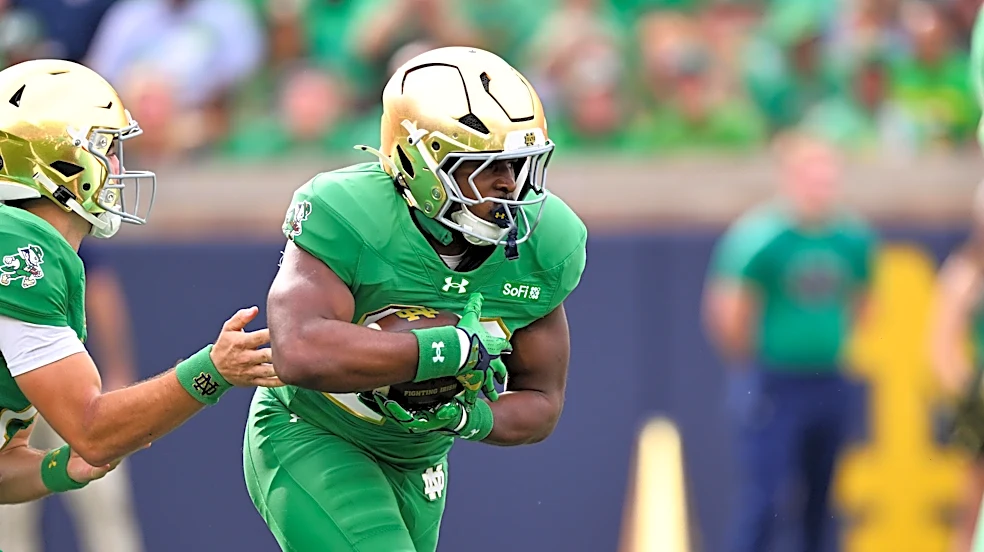
One interesting detail from Storin’s account is that Notre Dame wore green jerseys that Thanksgiving Day. The Irish wouldn’t wear green again until the famous 1977 game against USC.
And although nobody knew it at the time, the 1963 season was about to become an important turning point in Notre Dame football history.
Just 18 days after the Syracuse game, Notre Dame announced that Northwestern head coach Ara Parseghian would take over the program.
The Irish would go from a 2-7 season in 1963 to a 9-1 record in 1964, narrowly missing a national championship.
But back on Thanksgiving weekend in 1963, none of that was known.
My dad and his friends had enjoyed a holiday with the Fiore family, watched Notre Dame lose another close football game, and were preparing to return to South Bend.
And that’s when their adventure really began.
All Aboard the Wayward Train
Notre Dame’s Blue Circle Honor Society had organized special trains to transport students between South Bend and New York City for the holiday weekend.
My dad and his friends weren’t officially part of that organized student trip. They had traveled east to visit Mike Fiore’s family and attend the game, but they were aboard one of the student trains for the return journey.
The trains departed New York’s Grand Central Station on Sunday afternoon, December 1, with what should have been a relatively straightforward trip back to Indiana.
The scheduled journey was approximately 16 hours.
It took 24.
A December 5, 1963 article in The Voice, Notre Dame’s student newspaper, detailed the remarkable journey under the headline “Wayward Trains Make International Trip.”
According to the newspaper, freight train derailments forced the trains to abandon their planned route. Instead of traveling directly toward South Bend, the students found themselves heading north through New York, crossing the Niagara River into Canada, traveling across Ontario, and eventually reentering the United States at Detroit.
From there, the trains continued south through Michigan, passing through Jackson before finally reaching South Bend.
Two countries, three states, multiple border crossings, and nine hours behind schedule.
Not exactly the most efficient route home.
And the detour was only part of the problem.
The trains experienced shortages of food, water, and heat. Crews had to be changed at the borders. The hours dragged on, and the passengers grew increasingly restless.
Fortunately, they hadn’t lost their sense of humor.
The newspaper reported that the students entertained themselves by cracking jokes about their predicament.
At one point in St. Thomas, Ontario, someone suggested that a local drugstore owner could make a fortune by opening his doors to the hungry travelers.
They were so desperate for something to eat that they joked they’d even eat his corn pads.
When the train stopped after moving only a short distance, another student announced that they’d apparently lost their priority to a handcart.
And when someone finally noticed the train was moving again, another passenger spotted an elderly woman walking along the platform and joked that she’d been racing the train since Buffalo—and was winning.
I have to admit, I appreciate the sense of humor.
Although I’m guessing that after 20 hours on a cold train with very little food, some of those jokes probably weren’t quite as funny as they had been earlier in the trip.
Sleeping Arrangements, Notre Dame Style
As the journey stretched on, the students began looking for creative places to sleep.
Some curled up in luggage racks. Others stretched out on the floors of the club cars, slept beneath dining-car tables, or pulled chairs together to create makeshift beds.
And then there was my dad.
Somewhere along that very long journey home, a photographer captured him attempting to sleep in what may be one of the most ridiculous positions I’ve ever seen.
His feet were propped up on the headrest of his train seat, while his head hung down toward the floor.
Upside down.

I have no idea how anyone could possibly find that comfortable, but apparently desperate times call for desperate measures.
The photograph appeared in the December 5 issue of The Voice, accompanied by a caption describing the unusual sleeping positions students had adopted during the 24-hour return trip.
More than 60 years later, that photograph is still good for a laugh.
And I have to say, there’s something pretty wonderful about discovering your dad in an old Notre Dame newspaper, even if he happens to be sleeping upside down.
The Great Jackson, Michigan Food Run
Of all the stories my dad remembers from that train ride, one of the most vivid involves food.
Or, more accurately, the lack of it.
By the time the trains reached Jackson, Michigan, the passengers were absolutely starving.
The newspaper reported that complaints about the lack of food had become constant. Arrangements were eventually made to have refreshments available in Jackson, with the New York Central Railroad paying for coffee and doughnuts.
But my dad remembers something else.
When they finally had the opportunity to buy food, the students practically cleaned out the store.
He recalls that they bought just about every bit of food they could find.
After spending so many unexpected hours aboard a train without enough to eat, I imagine even the most ordinary snacks must have looked pretty appealing.
And knowing a little something about college students and their appetites, I’m guessing the shelves didn’t stand much of a chance.
Eventually, the exhausted travelers arrived back in South Bend, nine hours later than expected.
The newspaper called their transportation the “Wayward Train,” which seems like an appropriate name for a train that somehow managed to take a detour through Canada on its way from New York to Indiana.
But despite the delays, discomfort, and hunger, the students had something they probably hadn’t expected when they boarded that Sunday afternoon.
A story they would remember for the rest of their lives.
More Than a Football Game
One of the things I found especially interesting while researching this story was an editorial published in that same December 5 issue of The Voice.
Titled “The Student Trip,” it reflected on the behavior of the approximately 1,500 Notre Dame students who had traveled to New York for the holiday weekend.
Apparently, there had been concerns about what might happen when that many college students descended upon New York City.
But the editorial praised their conduct and suggested that the experience demonstrated a growing sense of maturity and responsibility among Notre Dame students.
It was a nice reminder that even in 1963, students understood that they represented something larger than themselves when they traveled away from campus.
And while my dad wasn’t officially part of that organized excursion, he was certainly part of the larger Notre Dame experience that Thanksgiving weekend.
A classmate had welcomed him into his family home. He had shared Thanksgiving dinner with friends, attended a football game in one of America’s most famous stadiums, and experienced an unforgettable journey back to campus.
All while the country was still mourning the loss of President Kennedy.
Looking back, I find the contrast between those moments especially striking.
There was the sadness and uncertainty of a nation in shock. There was the disappointment of another difficult Notre Dame football season. And there was the ordinary joy of young people spending a holiday together, sharing meals, laughing at their misfortunes, and making memories that would stay with them for decades.
Storin’s account also reminds us that better days were just around the corner for Notre Dame football.
The players and fans who left Yankee Stadium disappointed that Thanksgiving couldn’t have known that Ara Parseghian was about to arrive in South Bend and change the direction of the program.
History has a way of looking very different when we know what happens next.
And sometimes the little stories surrounding the big moments are the ones that stay with us the longest.
When I started asking my dad about that Thanksgiving weekend, I knew there was a funny train story involved. I knew there was an old newspaper photograph of him sleeping upside down. But I hadn’t realized how many pieces of Notre Dame history were connected to those few days in November and December 1963.
That’s what makes revisiting these stories so special to me.
Not every Notre Dame memory involves a championship, a legendary coach, or a last-second touchdown. Sometimes it’s about the friendships formed along the way, the families who opened their homes, and the unexpected adventures that became part of the college experience.
I’m grateful that my dad is still here to share these memories with me, and I’m especially grateful that someone at The Voice had a camera handy during that train ride.
Because otherwise, I’m not entirely sure I would have believed the sleeping position.
Notre Dame may have lost to Syracuse that Thanksgiving, 14-7.
But my dad came home with a story that’s lasted more than 60 years.
And thanks to a wonderfully ridiculous photograph, I get to share it with all of you.
Go Irish!
Historical Sources
- Matt Storin, “Yankee Stadium, Circa 1963,” Notre Dame Athletics, November 14, 2018.
- “Wayward Trains Make International Trip” and “The Student Trip,” The Voice, December 5, 1963.
- Bill Cragg, “Same Old Story,” 1963 Notre Dame Football Review.
- Personal recollections of my father, Frank Kirner, a Notre Dame student in 1963.