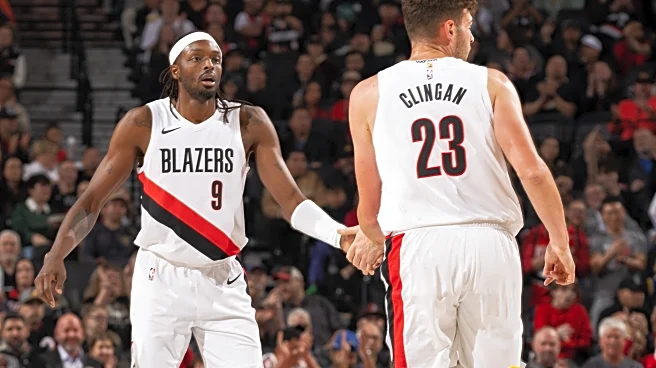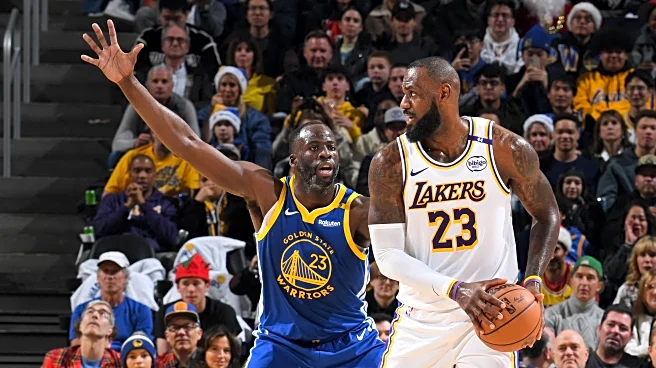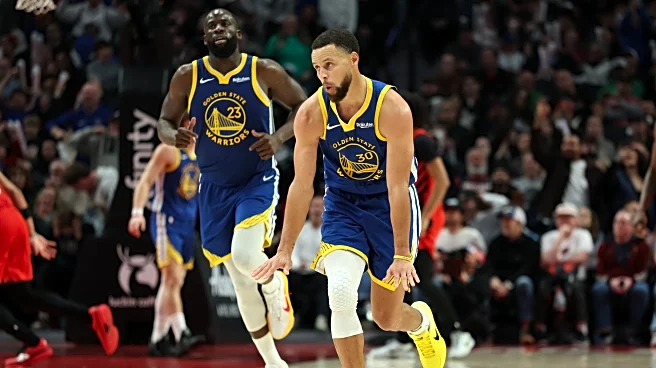


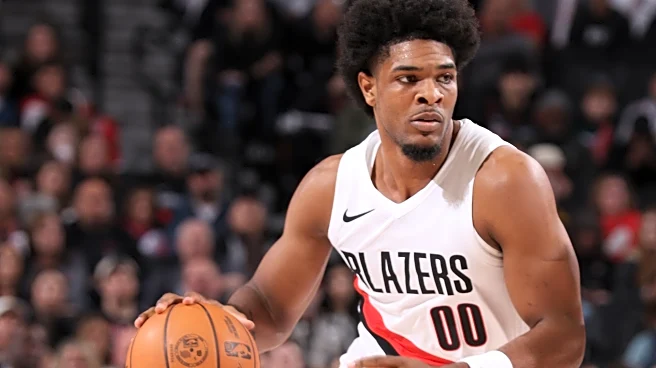

The Golden State Warriors, in their usage of the “tandem” 2-3 zone, have been one of the league’s most effective zone defenses this season. In 168 zone possessions, the Warriors have given up 143 points — 0.851 points per possession. Among 18 teams who have tallied at least 50 zone possessions this season, that figure is the second stingiest, per Synergy tracking.
There’s a reason why zones are rarely employed when going back on defense after a missed shot or live-ball turnover: teams would rather
match up and not let anyone through amid the chaos of transition. Instead, zones are deployed after some sort of stoppage — either after a timeout, after a made shot, or after a made free throw, when the risk of the opposing team trying to sneak through the defense is at its lowest.
It was a surprise, therefore, that the Warriors so easily gave up this wide-open Jerami Grant three in the corner after a made free throw, during a situation where they can easily set up their zone defense:
Simply put, this is unacceptable defense from the Warriors. No one sees Grant sneaking to the corner — as wide open as he can be — and as a result, no one slides over toward the corner. As the wing man in the zone, Curry takes the nearest player next to him. Brandin Podziemski floats aimlessly in the middle of the zone, while Draymond Green also doesn’t take notice of Grant (that, or he expects someone up to slide to the corner). Grant gets virtually a practice shot from the spot on the floor with the shortest distance between the line and the basket.
(Whose fault is it? Curry probably should’ve slid down to the corner, but as the wing man in the tandem zone, his immediate concern is to take whoever’s on the wing, which in this case is Shaedon Sharpe. It may not have been Podziemski’s rotation, but the moment he sees Grant open should’ve rung alarm bells in his head. Green is distracted by a cut toward his area of the floor.)
Grant is shooting 38.6% on threes this season, profiling as one of few on the Portland Trail Blazers who have to be monitored from beyond the arc. But overall, the Blazers are not one of the league’s deadliest outside shooting teams — far from it, if the numbers are of any indication. They shoot the fifth-most threes in terms of three-point attempt rate but are the worst in the league in terms of makes (33.4%). No one has been largely worried about their sniping ability. But for reasons both explainable and mysterious, the Blazers transform into the 2024 Boston Celtics whenever they face the Warriors this season.
The explainable and tangible reasons behind the Blazers turning into a bunch of Currys and Klay Thompsons are clear, the foremost being the Warriors’ lack of urgency to rotate and having to rotate in the first place due to an inability to contain at the point of attack. The chain of defensive responsibility comes to play in these instances; once a blow-by up front occurs, someone has to come over to help. The ball then finds its way to the person left open as a result of said help, and either that person takes the open shot or swings the ball to another open man if another defender comes over to rotate. Rinse, repeat.
Some three-point looks were created because of schematic choices — e.g., doubling Deni Avdija and the backline defense being unable to rotate against a numbers deficit, a risk that is always present whenever two defenders commit to the ball. Avdija profiles as the Blazers’ most dangerous offensive player, and it’s certainly not an inherently bad idea to let someone else do the decision making and scoring.
However, if the shot you’re opting to give up is another wide-open three, it’s akin to playing with fire that is burning dangerously hot:
It also doesn’t help massively if the possession battle is lost — even by the slightest of margins — namely because of boneheaded turnovers. While Green may have chipped in with a rare double-digit scoring game, it was offset by his eight turnovers — nearly half of the team’s 18 total. Assuming the coaching staff is continuously pounding the point of not turning the ball over, it seems as if that point is falling on deaf ears, with Green’s being the most unreceptive of them all:
When placed in stark contrast to the manner through which Curry has had to work painfully hard to get even a sliver of open space, it’s wholly representative of what this team has been this season:
Curry dropped 48 points on 86.5% True Shooting, boosted by a 12-of-19 clip on threes. In the past, such numbers would represent a team win, built mostly on the exploits of the Warriors’ superstar but also supplemented by a supporting cast that did just enough to help Curry.
But no other Warrior scored 20 or more points, while the Blazers boasted not only three 20-plus-point scorers, but two 30-plus-point scorers in Grant (35 points) and Sharpe (35 points), while Avdija finished with 26 points. Meanwhile, Jimmy Butler could only muster 16 points on 11 shot attempts, Green chipped in with his 14, Moses Moody put up 12, and Quinten Post finished with 11.
Without mincing any words, the problem this team has is multi-fold. The defense at the point of attack waxes and wanes, and it waned to the utmost degree against the Blazers tonight. The offense cannot function without having Curry to act as its lifeline, especially with Butler’s recent form of being too oddly passive.
(Partly, because in units that feature him as the sole offensive engine, teams sell out toward him and the shots being created from such situations are not being converted at a consistent rate.)
The roster is unathletic and vertically challenged across the board, with its most prominent rotation pieces either too old, limited by injuries, or both. The second-timeline experiment has been an abject failure, a development in which the fault can be distributed among every stakeholder: the players themselves, the coaching staff, and the front office.
As previously mentioned by this author, there needs to be some sort of reckoning from the decision-making body of this organization. This team cannot continue to exist in a state of flux, wherein there is a clear need to surround a still-capable Curry with win-now pieces but not without having to surrender draft picks, both made in the past and ones that have yet to be used. The front office and ownership must pick a direction: rebuild (and more than likely lose Curry, signaling a clear endpoint of this current era), or go all in on supporting Curry in his final years as an impactful high-level fulcrum, with the understanding that while it may be risky to exchange long-term stability for short-term gain, Curry is a caliber of player who may not be replicable in the near future, if at all, for this franchise.
Until a clear mandate is declared, this team will continue to be painfully situated in the middle of the pack, as average as average can be. For a team that employs one of the greatest players to have graced an NBA court, it would be an awfully mighty shame for him to repeatedly wear a cape for a sinking ship.