





At the peak of the Detroit Lions’ offensive success from 2022-24, the engine that drove the team’s identity was a proven, dependable, and imposing offensive line—arguably one of the most defining units in all of football.
Since then, that group has undergone significant turnover. Frank Ragnow retired, while Taylor Decker and Graham Glasgow were released amid contract differences and a desire to get younger and more sustainable. Jonah Jackson and Kevin Zeitler also departed in free agency at different
times.
While there were other factors at play—including an underwhelming tenure from offensive coordinator John Morton—the Lions’ fall from first to worst in the division last season can largely be traced back to the offensive line’s regression. What was once a strength became a clear Achilles’ heel.
This offseason, the organization has made a concerted effort to reclaim its identity in the trenches, adding players like Cade Mays, Larry Borom, Ben Bartch, and Juice Scruggs to help restock the unit.
Given the premium nature of the offensive tackle position—and the strength of this draft class at the top—the Lions are well positioned to use a top-20 pick to put the finishing touches on their offensive line remodel. Blake Miller, Clemson’s right tackle, stands out as a strong candidate to be the best player available when Detroit is on the clock.
Previously
- Why the Lions should draft OG Olaivavega Ionna
- Why the Lions should draft LB Jacob Rodriguez
- Why the Lions should draft OT Francis Mauigoa
- Why the Lions should draft DB Keionte Scott
- Why the Lions should draft EDGE Keldric Faulk
Athletic traits
Blake Miller’s most underrated trait is his athleticism, which is often left out of the discussion when he’s labeled as a “safe” or “high-floor” prospect.
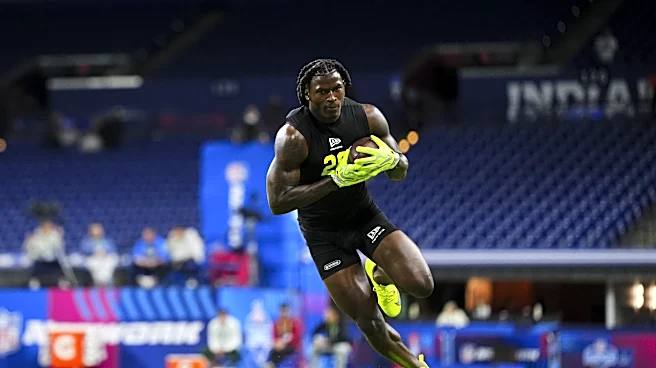
He checks in at over 6-foot-6 and 317 pounds, with an 83 7/8-inch wingspan and 34 1/4-inch arms—comfortably checking all of the boxes from a size and length standpoint.
The Midwest native (Strongsville, OH) also registered a 5.04-second 40-yard dash (86th percentile among offensive tackles), a 32-inch vertical (87th percentile), a 113-inch broad jump (90th percentile), and 32 reps on the bench press (91st percentile).
For a player not typically defined by elite athleticism, Miller is more than well-equipped physically, proven out by having the third-highest Relative Athletic Score (9.90) among all offensive tackle prospects in this draft, with the movement traits and testing profile to support a long and successful NFL career.
Accolades
- 2× First team All-ACC (2024, 2025)
- Third team All-ACC (2023)
- Freshman All-American (2022)
- Set school record for most consecutive starts by a non-specialist (54)
- Set school record for career snaps (3,778 – school kept track since 1986)
- Team captain (2025)
Strengths
Elite movement skills
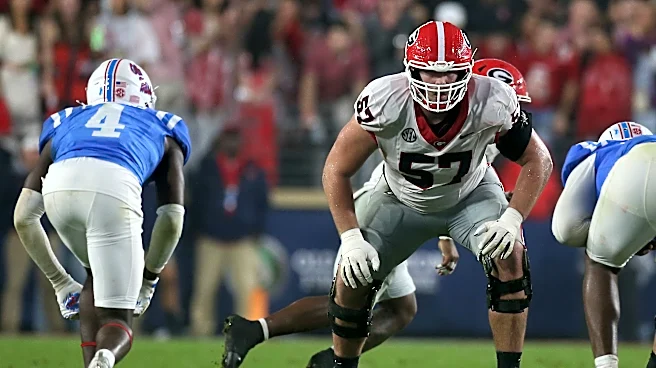
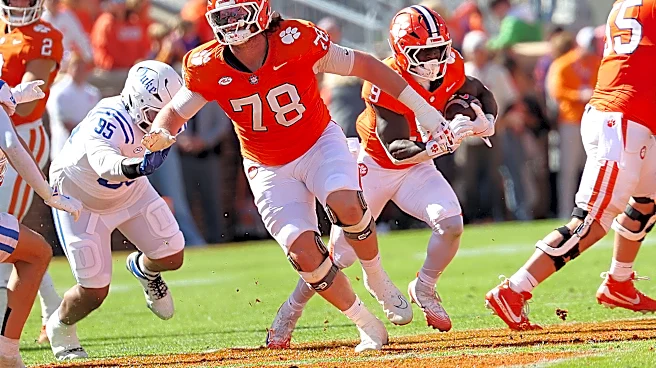
Miller is one of the most efficient-moving offensive tackle prospects in this draft. Despite being over 6-foot-6, he’s an incredibly fluid and effortless mover. One of his defining traits is his smooth movement ability paired with outstanding lateral quickness—allowing him to reach his landmarks with controlled urgency while maintaining favorable leverage and positioning to sustain blocks.
Whether it’s backside cut-off blocks, down blocks, sealing the edge, climbing to the second level, or executing skip pulls, Miller consistently gets the job done. His ability to operate in space is a major asset.
That trait has real translation to the Detroit Lions. Frank Ragnow was previously a valuable weapon on pulls and second-level work thanks to his quickness and control, and, outside of Penei Sewell, the Lions lacked that type of polished mover last season. It’s a missing element that can help create more chunk plays and open explosive rushing lanes for Jahmyr Gibbs.
Miller projects as a player offensive coordinator Drew Petzing could utilize across a versatile run-blocking repertoire—adding another dynamic layer to the Lions’ offense.
Initial steps, base, & footwork
What goes hand-in-hand with Miller’s movement skills is his first-step quickness, initial burst, and ability to establish a strong base rapidly. He consistently beats defenders off the line of scrimmage and into contact in both run blocking and pass protection, allowing him to dictate positioning early in reps and play with leverage.
That early advantage shows up across a variety of block types and is a major reason for his consistency. Simply put, he doesn’t move like a player of his size, and it makes him a dependable presence snap-to-snap.
That footwork also translates cleanly into pass protection. His springy, controlled slide allows him to stay balanced and mirror rushers effectively, while maintaining the flexibility to pass off stunts and pick up blitzers. There’s clear awareness in his game—he’s constantly processing, identifying, and adapting post-snap.
When he does lose leverage, his recovery ability stands out. His feet and base reset quickly, allowing him to regain positioning and stay engaged through the rep.
Finish them
Miller is a competitive blocker, and his finisher’s mentality is another one of his superpowers. While his raw power can be more adequate than overwhelming at times, his effort and play demeanor never waver—he’s relentless from snap to whistle, consistently working to sustain blocks and finish defenders.
He looks to make opponents feel him at the end of plays, bringing an edge that shows up over the course of a game. As a former offensive lineman, he’s the type of player that makes you miss football—when he gets into a rhythm and starts stacking dominant reps, it’s a beautiful thing. A refusal to be outworked or let his teammates down.
It’s a mentality that would fit seamlessly within the Lions’ offensive identity.
Thud, not buddy
Blake Miller may not have prototypical hand size (9 3/4”), but he uses his hands effectively. There’s real thud in his strikes—particularly in the run game—where he generates movement on drive blocks and down blocks. He consistently wins early at the line of scrimmage by delivering forceful, well-timed punches.
It’s easy to envision Miller pairing those momentum-churning mitts on double teams with Tate Ratledge or in short-yardage situations where the Detroit Lions want to win at the point of attack.
Weaknesses
Pad level
There are times—unsurprising for an offensive tackle of his size—where Blake Miller’s pad level rises, costing him leverage in the rep. When he plays too high, his base can get too narrow, which leads to balance issues and, at times, him ending up on the ground or losing ground in the rep.
It’s a technique issue that shows up more than occasionally, but it’s also coachable. Similar tendencies have surfaced at times with Taylor Decker (6-foot-7), and it’s the type of refinement offensive line coach Hank Fraley can help clean up, to some degree, at the next level.
Hand placement
Another area where Blake Miller could use refinement is his hand placement consistency. While his punch can be a weapon when timed correctly, there are moments—more often in pass protection—where his hands are late or mistimed, and at times set too wide.
When his hands get outside his frame, and defenders establish inside leverage on his chest, Miller can lose control of the rep and slide off blocks. These issues often show up in conjunction with higher pad level and a narrower base, with the combination leading to some of his more inconsistent reps.
Right tackle only
Blake Miller enters the evaluation process as a four-year starter at right tackle with extremely limited experience elsewhere (two starts at left tackle and only 24 snaps in-line or as a move tight end). That lack of positional versatility could impact how some teams stack him on their boards, both relative to other offensive tackles who offer more flexibility and against prospects at other positions when teams are grouping and tiering players.
However, it’s unlikely to be a significant negative in the eyes of the Detroit Lions, who have position flexibility with Penei Sewell and already have some of their interior players.
Production – PFF Grades
- 2025: 78.5 overall, 73.5 run blocking, 83.5 pass blocking
- 5 penalties
- 2024: 75.6 overall, 69.3 run blocking, 76.4 pass blocking
- 1 penalty
- 2023: 72.9 overall, 71.4 run blocking, 73.2 pass blocking
- 6 penalties
- 2022: 71.8 overall, 76.8 run blocking, 63.8 pass blocking
- 10 penalties
Character
As highlighted in the 2026 Grit Index—put together by Erik Schlitt and his buddy Anthony—Blake Miller ranks sixth overall on the Grit Index with a 9.67 score (No. 1 among offensive tackles). The feedback from evaluators and those around him consistently reinforces the same theme.
AFC regional scout:
“It wasn’t surprising that he played in (Clemson’s) bowl game because he doesn’t opt out of anything or miss any games. Has a team-first mindset.”
NFL scout:
“Love his focused mindset. Doesn’t cheat himself or his teammates.”
Former Clemson offensive coordinator Brandon Streeter:
“He brings a toughness every single day. There’s no question at all that he’s one of the toughest guys we’ve got.”
Former Clemson OL teammate (and roommate) Walker Parks:
“I could talk forever about Blake Miller… Blake is the epitome of a dude who’s just going to show up and work, and he’s going to do the work every time, no matter how he feels or what’s going on … Blake is a guy, and I’ll tell all the scouts this too when they come around, if you’re looking for a guy who can play ten years at the next level and you never have to worry about what he’s feeling or what he’s going through, [look at him]. That dude is going to be the same every single day. He’s as solid as a rock. I’ve never seen somebody more consistent.”
Highlights
Fit in Detroit:
Miller projects as an ideal fit in Detroit Lions—a plug-and-play Day 1 starter at right tackle with added value as a long-term program builder from a culture standpoint. He would help stabilize the offensive line immediately while allowing Penei Sewell to shift to his more natural left tackle spot over time.
That alignment also creates a cleaner developmental environment across the line, with Sewell helping elevate the left guard spot—whether it’s Christian Mahogany or another option—while Miller pairs with Tate Ratledge on the right side. The potential for long-term continuity on both edges and along the interior is very real.
Miller comes from a system that incorporated both gap and zone run concepts along with play-action, giving him a strong foundation to transition into Detroit’s multiple offensive approach. His run blocking should translate early, while the structure of the offensive line allows the Lions to send extra hands his way as he acclimates to NFL pass protection.
While he was never the “flavor of the month” prospect during the draft cycle, Miller profiles as a reliable, team-oriented player with mauler tendencies—especially when working to the second level, where he goes hunting and gathering, overwhelming defenders in space.
Adding Miller would help create a more consistent runway for Detroit’s skill players to feast, while further solidifying the long-term stability of the offensive line. With each projected starter under contract for at least the next two seasons, the Lions would have a real opportunity to reestablish this unit as a dominant force.