
Bills Mafia, you may now collectively say it:
Well, duh.
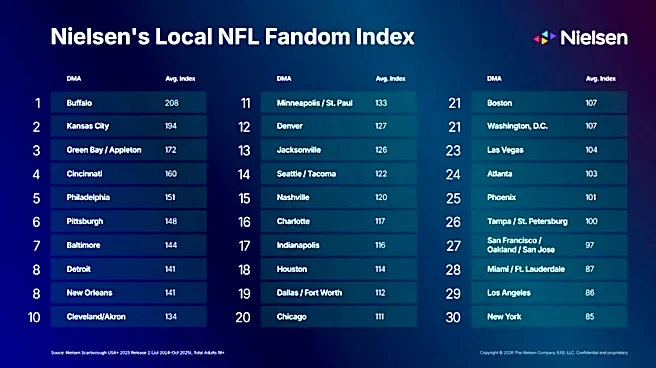
According to Nielsen’s inaugural Scarborough NFL Fandom Index
, Buffalo has the most avid NFL fan base in America. For those of us who have spent our lives around other Bills fans, this probably qualifies less as breaking news and more as independent confirmation of something we already knew. Still, there is something satisfying about seeing the numbers back it up.Buffalo finished first overall in Nielsen’s ranking, ahead of Kansas City and Green
Bay, with Cincinnati and Philadelphia rounding out the top five. More importantly, Buffalo reportedly finished with 208 total points, making it the only market to eclipse the 200-point mark.
And this wasn’t simply a television ratings contest. What makes Nielsen’s study particularly interesting is the way it attempted to measure fandom.
The Nielsen Scarborough NFL Fandom Index incorporates eight different areas of fan behavior:
- Apparel purchases
- Overall interest in the NFL
- Live-event attendance
- Betting intent
- Social-media engagement
- Radio listening
- Streaming
- Linear television viewership
That matters when talking about Bills Mafia because Buffalo’s relationship with the Bills has never been limited to three hours on Sunday afternoon. Nielsen describes its broader Scarborough research as a way to understand consumers across their lifestyles, shopping behavior and media consumption, rather than looking at one measurement in isolation. Scarborough conducts more than 330,000 surveys annually across the United States and examines consumer behavior across more than 2,000 categories.
Applied to NFL fandom, that means buying the jersey counts. Going to the game counts. Turning on the radio counts. Streaming counts. Watching on television counts. Engaging with the team online counts. In Buffalo, apparently, it all counts.
Buffalo doesn’t need to be a huge market to make a huge impact
Perhaps the most interesting takeaway from the rankings is what happened at the top. Buffalo. Kansas City. Green Bay. Three cities that aren’t remotely close to being the NFL’s largest media markets finished first, second and third.
That’s significant.
The NFL has teams in New York, Los Angeles, Chicago, Philadelphia, Dallas, Houston, South Florida, and other massive metropolitan areas. Yet when Nielsen attempted to measure the intensity of NFL fandom rather than simply the number of people available to consume it, smaller and mid-sized markets rose to the top.
Radio still matters in Bills country
One of the more fascinating pieces of the study is the continued strength of traditional media in the NFL’s most passionate markets. Buffalo joined Green Bay and Kansas City among the markets that ranked particularly high in radio listening. That tells us something about the type of fandom Nielsen is capturing.
We spend so much time discussing streaming services, social media engagement, and the increasingly fragmented ways people consume sports that it can be easy to assume traditional local media is becoming less important.
Not everywhere.
In markets such as Buffalo, local sports radio remains part of the ecosystem. The game itself is only one piece of the week. There is the buildup, the discussion, the reaction, the arguments and then another six days to dissect what happened before doing it all over again.
Nielsen’s broader research has similarly emphasized how sports fandom increasingly stretches across different forms of media instead of existing solely on television. It has highlighted audiences alongside billions of social-media impressions and year-round digital conversations surrounding the league.
Bills fans certainly understand the concept. We can turn one incomplete pass into three days of conversation.
The GameDay experience matters, too
Buffalo also ranked among the markets strongest in live-event attendance, another category that shouldn’t surprise anyone who has watched Bills Mafia operate. Going to a Bills game isn’t simply consuming football. For many fans, it is an entire weekend ritual.
There are generations of families who have shared season tickets. There are parking lots with traditions nearly as established as some NFL franchises. There are fans who plan vacations around road games and others who return to Western New York specifically because the Bills are home.
And then there is the traveling fan base.
Anyone who has attended a Bills road game knows the strange moment when you look around an opposing stadium and wonder exactly how many people wearing blue and red managed to get there.
That part of Bills fandom can be difficult to capture with television ratings alone. Nielsen’s decision to incorporate attendance, merchandise, radio, streaming, social media and other behaviors gives us a much better picture of what an avid fan actually looks like.
Small-market football remains mighty
Buffalo’s No. 1 ranking also fits a larger pattern in Nielsen’s results. Kansas City finished second. Green Bay finished third. Cincinnati finished fourth. Pittsburgh, Baltimore and Cleveland also landed inside the top 10,
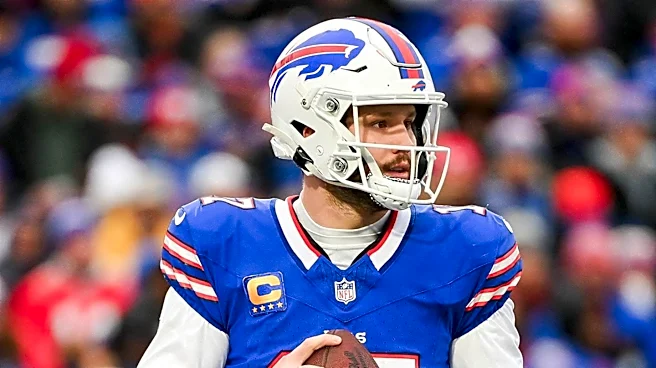
Smaller population. Enormous percentage of that population emotionally invested in what happens to 53 men wearing charging buffaloes on their helmets every fall. That’s Bills country. That’s Bills fandom.
Of course, there is an amusing part of all this. Bills fans didn’t exactly need a national research company to inform us that we’re obsessed with the Buffalo Bills.
We’ve known.
We’ve seen fans greet the team at the airport in the middle of the night. We’ve watched thousands travel across the country for road games. We’ve seen Bills Backers bars turn Gameday into little pockets of Western New York from Florida to California and well beyond the United States.
We own the shirts.
We listen to the radio.
We watch the games.
We travel.
We stream.
We post.
We comment.
We argue about roster spots that 95% of NFL fans have never thought about.
Apparently, Nielsen finally figured out how to add it all together…and confirmed what we already knew: Buffalo fans sit alone at the top. But now we have the receipts.