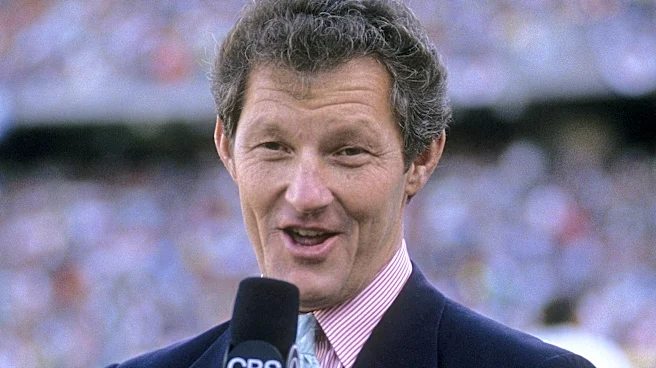



As someone whose formative Yankees-watching years came during the late 1990s and early 2000s, Ken Singleton and Jim Kaat were two of the voices I most associate with the team. It came as a bit of a shock to me once I got to an age where I could readily look stuff up that neither were most known for wearing a Yankees’ uniform during their playing career. Singleton never played for the team, while Kaat threw a total of 63.1 innings across two seasons towards the end of his career.
Yet for fans around
my age, they’re associated with the team forever thanks to their announcing work. Today happens to be the birthday of one of those guys, so let’s give a happy birthday to a great player and announcer in Jim Kaat.
James Lee “Jim” Kaat
Born: November 7, 1938 (Zeeland, MI)
Yankees Tenure: 1979-80
Kaat, of Dutch ancestry, was born in 1938 in Michigan to John and Nancy. Fittingly for said Dutch ancestry, his father was a shoemaker. His father also passed along a love of baseball to Jim.
The younger Kaat was a good athlete in a number of sports — including baseball — in his youth, but was still fairly small, even as he graduated high school. As a result, Kaat didn’t get much of a look from professional teams or big colleges, leading him to attend Hope College in Michigan, which plays in what is today called Division III in the NCAA.
However as he began his college life, Kaat began to shoot up in size. During his one year attending Hope, Kaat grew to 6-4. That, plus his continuing good run on the field, finally began to get him looks from MLB teams. In June 1957, he inked a deal with the Washington Senators.
Kaat made quick work of the minors and received a call-up in August 1959. He made a handful of appearances for Washington that season and the next. Kaat eventually became a big league regular in 1961, albeit not exactly for the Senators. Ahead of the 1961 season, Washington moved to Minnesota and became the Twins. There, Kaat would emerge as one of the Twins’ first stars and often the ace of their rotation.
Over the next 13 years, Kaat would become a mainstay for a Twins’ team that quickly became pretty good. In 1965, the Twins won the AL Pennant and took the Dodgers all the way to Game 7 of the World Series. Kaat was entrusted to make three starts in the series, including the decisive Game 7. He and Minnesota took the loss that day, but considering their offense was blanked by Sandy Koufax in arguably his most famous performance, Kaat shouldn’t be blamed too much.
On an individual level, Kaat would make two All-Star appearances over his career with the Twins. He also became known as the preeminent defender on the mound. Starting in 1962, he won 16 consecutive pitcher Gold Gloves, tying him with Brooks Robinson for the most wins in a row. His record for pitching Gold Gloves was later surpassed by Greg Maddux, although there was a one-year break in his run.
The Twins returned to the postseason in 1969, appearing in the first ever American League Championship Series. They had been led there in part by new manager Billy Martin. However, Kaat wasn’t used at all by Martin in the three-game sweep at the hands of the Orioles, as the manager had a distrust of the pitcher, believing that Kaat hadn’t fully backed previous Twins’ manager Sam Mele, who Martin had served on the coaching staff under. Despite returning to the postseason, the Twins opted to move on from Martin after just one year.
Kaat returned to favor under Bill Rigney in 1970, and the Twins again advanced to the ALCS. However, Minnesota again was swept by the Orioles. Kaat started Game 3, but once again fell victim to a gem from a Hall of Famer, this time by Jim Palmer, who allowed one run and struck out 12 in a complete game.
The Twins began to fall back to the pack after that. In 1973, owner Calvin Griffith opted to put Kaat on waivers after the two had previously sparred over salary. The Chicago White Sox snagged him and were rewarded with arguably the two best years of Kaat’s career. According to Baseball Reference, Kaat posted 14.8 WAR over the 1974-75 seasons, making his third and final All-Star appearance in the second of those two years. That wasn’t enough to get Chicago to contend though, and they traded Kaat to the Phillies in December 1975.
By this point, Kaat was in his late 30s. After a good debut season in Philly, helping them to the NLCS, he struggled the next two years and moved mostly to the bullpen by 1979. In May of 1979, the Yankees purchased him from the Phillies. He was pretty good in 58.1 innings over 40 games with the Yankees and opted to re-sign with them for 1980. However, he got off to a bad start to that year, and in April, the Cardinals purchased him from New York.
Kaat remained in St. Louis for the next four seasons. Individually, Kaat’s numbers in St. Louis were never all that dominant, but he became a respected member of the Cardinals’ bullpen. He also got to finally enter the winner’s circle. Kaat appeared in four games of the 1982 World Series, as St. Louis beat the Brewers. Kaat was dinged with a blown save in Game 4, but pitched well otherwise.
He played one further season with the Cardinals in 1983, marking the 25th of his MLB career. Kaat is one of 31 players who have appeared in a major league game in four different decades.
Following his playing career, Kaat got into the broadcasting booth. He first joined the Yankees’ team in 1986 but left after that season. Following a stint with the Twins, he returned to the Yankees in 1995 and remained with them through 2006. He was regularly honored with Emmys for Sports Broadcasting during that tenure. He retired from the Yankees after 2006, but later returned for MLB Network shortly after that channel began airing. Kaat did occasional work for MLBN through 2022, when he officially hung up his mic.
Having appeared on the ballot on previous occasions, Kaat was voted into the Hall of Fame via the Golden Era Committee (also called the veteran’s committee) as part of the class of 2022. These days, Kaat resides down in Florida, playing golf and being a parent and grandparent.
Jim Kaat wasn’t a Yankee for very long, but for many of us, we’ll always associate his familiar voice with the Yankees.