


With the transfer portal window closed, high school recruiting all but wrapped up and the dust fully settled from a coaching search, preparation can now fully begin for Michigan’s 2026 football season.
With so many new things coming to the program for the upcoming season, fans should expect things to look a bit different on the field than what we’ve grown accustomed to the last two years. The offense in particular should take on a different form with new offensive coordinator Jason Beck and several
additions via the transfer portal and high school ranks.
Amid all the new, there will still be a handful of players from last year’s roster that will still play big roles; the goal during the spring will be to determine how all the pieces fit together. Today, we’ll be taking our best crack at figuring that out by predicting what Michigan’s offensive depth chart looks like now that the portal is closed.
As a note, freshmen will only be included in this depth chart if they are early enrollees.
Quarterback
Starter: Bryce Underwood
Depth: Brayden Fowler-Nicolosi (not yet official), Colin Hurley, Chase Herbstreit, Tommy Carr, Brady Smigiel
There’s no real mystery as to who will start at quarterback with Bryce Underwood set to return. We saw him take his lumps while also showing some flashes as a freshman. Now with some better guidance, an improved scheme and more weapons around him, fans should expect to see a significant jump from Underwood in 2026.
Michigan totally remade the quarterback room behind him, something that was badly needed with minimal depth last season. Former Colorado State quarterback Brayden Fowler-Nicolosi was brought in to be the primary backup, while Colin Hurley was brought in from LSU to compete for added depth. Redshirt freshman Chase Herbstreit is also back, while Tommy Carr and Brady Smigiel — the latter of whom is still recovering from a torn ACL — enter the program as true freshmen.
Running Back
Starter: Jordan Marshall
Depth: Savion Hiter, Bryson Kuzdzal, Micah Ka’apana, Donovan Johnson, Tomas O’Meara, Jonathan Brown, Taylor Tatum (maybe?)
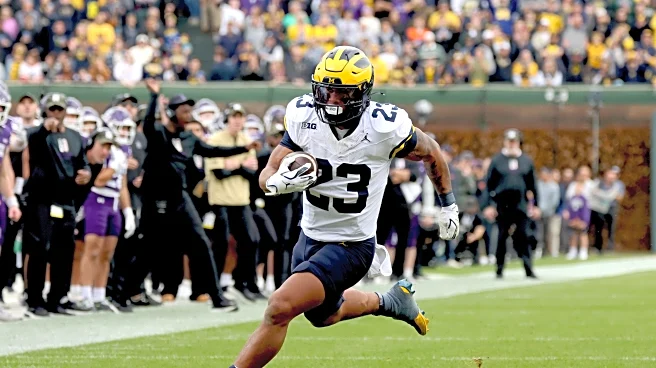
Michigan gets Jordan Marshall back after a breakout sophomore campaign where he ran for 932 yards and 10 touchdowns on 150 carries. There’s no question he’ll enter the year as the favorite to be the lead back, but five star freshman Savion Hiter has all the makings of a star player and should get a solid workload, too.
Right behind them, Bryson Kuzdzal is back after getting a decent workload at the end of 2025 with Marshall and Justice Haynes both banged up. He was impressive with his opportunities, running for 326 yards and four touchdowns, so expect him to see some carries as well.
Michigan’s depth chart is pretty green at the position. Micah Ka’apana and Tomas O’Meara combined for just 21 carries in spot duty last season, while Donovan Johnson redshirted and didn’t see any action on offense last year as he recovered from a torn ACL. Jonathan Brown is an early enrolling freshman, while Oklahoma transfer Taylor Tatum is reportedly moving to safety to begin his career in Ann Arbor.
Wide Receiver
Starters: Andrew Marsh, Jaime Ffrench, JJ Buchanan
Depth: Channing Goodwin, Salesi Moa, Jamar Browder, Travis Johnson, Kendrick Bell, I’Marion Stewart, Jaylen Pile, C.J. Charleston, Jacob Washington
If you want to talk about positional upgrades, look no further than wide receiver, as the room now has about eight guys that could realistically get plenty of snaps in 2026.
Andrew Marsh is undoubtedly at the top of the depth chart after putting up one of the best true freshman seasons we’ve seen from a Michigan receiver in years with 41 catches for 651 yards and four touchdowns. Right behind him is Texas transfer Jaime Ffrench, who redshirted last year but still boasts plenty of talent that should be put to good use in Beck’s scheme.
JJ Buchanan is a bit of an interesting case, as Utah listed him as a tight end but he lined up in the slot more often than not. At the end of the day, it doesn’t really matter what he’s listed as as long as he’s catching passes like he was brought in to do.
A bit further down the depth chart, Michigan has a handful of players that could make an impact and see the field plenty. Channing Goodwin and Jamar Browder are both holdovers from last years’s team — Goodwin was the more productive of the two with 148 yards, but the 6-foot-5 Browder could take a step forward in his second year in college. Kendrick Bell is in a similar boat, as he could make a leap with the new coaching staff.
In addition to the returnees, Michigan brings in three freshmen, and two of them could see the field quickly. Two-way player Salesi Moa transferred in after being briefly enrolled at Utah and was one of the higher rated recruits in the country. He has the skills to make an impact as a pass-catcher right away, but we’ll have to see how the coaching staff wants to utilize him first. Travis Johnson could similarly see immediate playing time.
Tight End
Starter: Zack Marshall
Depth: Hogan Hansen, Deakon Tonielli, Jalen Hoffman, Eli Owens
Zack Marshall may be in line to take over as Michigan’s starting tight end in 2026. He unexpectedly broke out as a junior last season, catching 16 passes for 199 yards. However, Hogan Hansen shouldn’t be too far behind him in the pecking order. He was expected to take a leap in 2025, but injuries kept him off the field for most of the season. If he’s fully healthy through the spring and performs well, he could claim the top spot.
Deakon Tonielli and Jalen Hoffman are both entering their senior seasons, but neither have proven much from a pass-catching standpoint. Tonielli had just eight receptions for 72 yards in 2025, while Hoffman operated more as depth behind Max Bredeson at H-back; he did have 148 yards in the spring game though, suggesting there could be some more receiving potential to be unlocked.
Regardless of how you want to stack the depth chart here, Michigan should rotate all these players into the lineup a good amount throughout the year.
Offensive Line
Starters: Blake Frazier (LT), Evan Link (LG), Jake Guarnera (C), Nathan Efobi (RG), Andrew Sprague (RT)
Interior depth: Brady Norton, Houston Ka’aha’aina-Torres, Lawrence Hattar, Luke Hamilton, Bear McWhorter, Adrian Hamilton
Tackle depth: Andrew Babalola, Avery Gach, Marky Walbridge
Much like wide receiver and tight end, there are plenty of ways Michigan could combine the offensive line and still make it work. However, the best combination to start the spring will feature several returning starters. Blake Frazier and Andrew Sprague should be the tackles, while Evan Link moves to guard. Jake Guarnera should take over at center, while Nathan Efobi gets another shot at right guard.
Behind the starters, there are several good depth pieces that could push for starting roles. Chief among them is redshirt freshman Andrew Babalola, who could have been a starter last year if he didn’t suffer a knee injury during fall camp. Additionally, Brady Norton got some starting experience at guard last year, but seemed to be overwhelmed at times; perhaps another year of strength and conditioning training at the FBS level has done him some good and he’ll be more apt to push Efobi for the starting right guard job.
Meanwhile, several newcomers and young players will also look to take steps forward. Houston Ka’aha’aina-Torres comes in after redshirting at Nebraska last year, Avery Gach is a player that many are expecting to take a step forward this offseason, and college veteran Lawrence Hattar returns after transferring in last year.
One caveat to the offensive line’s depth chart is the absence of prized four-star recruit Malakai Lee, who was originally set to enroll early but will now wait until the summer to join the team. He has a college-ready frame at 6-foot-7 and 350 pounds, and could compete for a tackle spot in the two-deep.