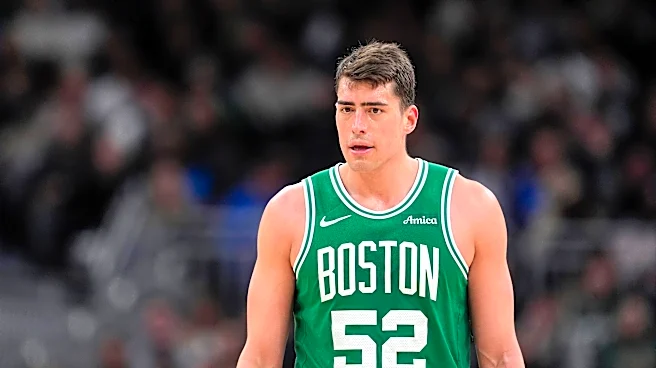


Celtics fans have questions. A lot of them.
And after the offseason they just had, there’s plenty to talk about.
Boston has already shown it can build a championship team, but what does this team need to do to get back to the top? Has the roster been built the right way? Which players are going to take the next step? What must change for the Celtics to become a legitimate postseason threat again?
Those are some of the things I assumed most fans would inquire about. But instead of guessing what’s on
the minds of C’s fans, I decided to ask them.
Let’s get into it.
Q: What do you think the biggest deficiencies are to address for the Celtics to be a serious postseason threat?
Since Boston’s latest successful run at the prized jewelry in 2024, they have endured multiple disappointing and premature playoff exits. One of the things I believe has plagued them in both years has been their offense and shot making, and a number of things tie into this.
To start in the simplest form, since the 2013-2014 season, there has only been one team (2021 Milwaukee Bucks) to win the championship while being ranked outside the top five in Field Goal percentage for that year’s playoffs. In caveman terms: the Celtics have to put the ball in the basket at a higher rate than what they’ve done the last two playoffs.
Last postseason, Boston shot 43.4% from the field, which ranked 13th among the 16 playoff teams. They also struggled at the stripe, slotting in at 13th in free throw percentage as well. Furthermore, they were 15th in catch and shoot field goal percentage (32.9) and dead last in corner three-point percentage at 24. The year before, the Celtics shot 44.3% from the field, which was good for 12th. Conversely, the 2024 championship team shot 47% from the field, which ranked fourth.
There is always going to be a discussion about the amount of threes Boston takes when they don’t fall even if they are generated properly. In my opinion, the team has struggled to consistently generate the easiest opportunities available on top of that.
Last postseason, Boston ranked last in rim frequency, dunks, and fouls drawn; second-to-last in points in the paint and steals; 13th in paint touches and points off turnovers; and 11th in fast-break points.
Here is how the champions have fared in some of these categories since 2020 (Celtics excluded).

This is not to suggest that ranking highly in these statistical categories is the only way to win. The 24’ Celtics, after all, ranked ninth, 12th, ninth, and sixth, respectively, in those areas, but that team possessed an extraordinary combination of talent, versatility, and shot-making that will be difficult to replicate, and that makes finding easier ways to get buckets even more important for the current Celtics.
Boston hasn’t been a dominant team in terms of paint points or rim frequency, even during its championship run, and I don’t expect that identity to change. The teams that excelled in those areas had elite interior forces such as Nikola Jokić and Giannis Antetokounmpo, making their success in those categories relatively predictable.
Instead, I believe Boston has a more realistic opportunity to make up ground in three areas: steals, points off turnovers, and fast-break points.
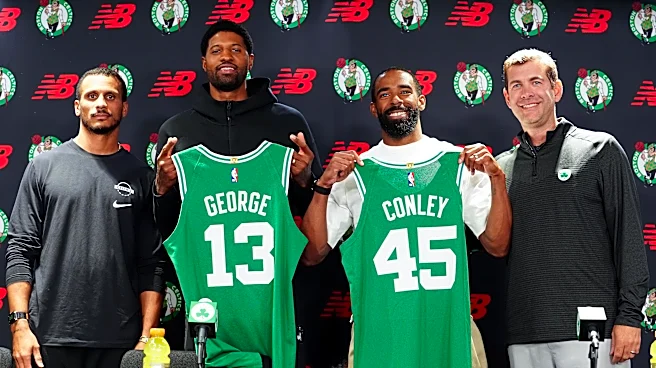
Boston added Paul Georgeand Mitchell Robinson this offseason, who were two of the best defensive playmakers at their positions last season.
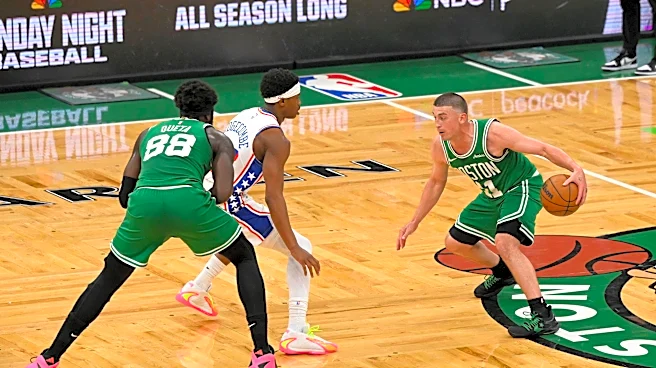
As I mentioned earlier, Boston has struggled to consistently capitalize on its offensive opportunities, even when the team generates quality looks from three. That disparity was particularly stark in its losses to Philadelphia. Across the Celtics’ four losses, Boston shot just 40% from the field and 27% from three. In their wins, however, those figures climbed to 47% and 41%, respectively.
In theory, the additions of George and Robinson should help Boston take the ball away more, which in turn can create additional fast-break opportunities. That fits into a broader possession-game philosophy: create extra possessions for the inevitable nights when the shots aren’t falling.
The Knicks also ranked first in second-chance points last playoffs, with Robinson playing a major role in that success. His presence gives Boston a potential source of high-quality offense, one that doesn’t depend on the team shooting its way out of a slump even though, the quality if threes off offensive rebounds could be great.
There are certainly more holes you can find in this roster come playoff time, but these were the big ones for me. I think the addition of George helps the fluctuation of 3-point percentage and catch and shoot numbers, being that he has been one of the best spot up wings for a while now. But when those bad nights do come, I trust that the team will create more turnovers than it has in the past to allow them to get easier buckets.
Q: Chris Cenac Jr. ceiling and floor player comps?
Chris Cenac Jr. really intrigued me when I started thinking about what a fully developed version of his game could look like.I wrote extensively about everything he showcased in Summer League, and I’m still amazed by the sheer number of things he can do at his size.
At 6-foot-11, Cenac showed flashes of an incredibly diverse skill set. He rebounded, protected the rim, defended on the perimeter, knocked down threes, played above the rim as a playfinisher, passed, and created for himself both off the dribble and as a jump shooter. The biggest question is consistency. The flashes are undeniable, and his athleticism should allow a simplified NBA role to raise his floor early in his career. Still, there is a considerable amount of development ahead of him, which is exactly what you would expect from a 19-year-old prospect.
But the word ceiling means the absolute top of his powers and realistically, the name that keeps popping into my head as a do it all athletic big with self-creation skill is Bam Adebayo.
The first thing that brought the thought to my head was just how comfortable Cenac looked on those floating/moving mid-range shots Bam has really developed over the years.
Bam has also developed into an incredibly comfortable ballhandler for a big, particularly as a handoff facilitator and passer. He can put the ball on the floor and attack the rim from virtually anywhere in the half court. I don’t expect Cenac to reach Bam’s level as a passer, but the movement ability he displays with the ball in his hands is legitimate and gives you another intriguing layer to his offensive upside.
And on the defensive end, it again starts with the foundation of fluid movement and vertical pop. Bam has developed into so much more than just an athletic big, so for Cenac to reach that level, he’ll have to learn the backline communication, positioning, and mental nuances that come with being a high-level defender. When projecting his ceiling, though, I’m expecting him to learn most of those responsibilities. Coupled with this level of athleticism, that combination could be scary.
Sadly, Cenac reaching his ceiling is far from a guarantee. So, when it comes to his floor, I’ll go with Chicago Bulls big man Jalen Smith. Smith is a really solid rotational big who averaged 10 points and seven rebounds last season while shooting 48/37/74 from the field, in just 20 minutes per game.
I think Cenac is too talented to completely flame out in the league. His floor, in my eyes, is a player who never fully harnesses his on-ball skills but still develops into a versatile big capable of rebounding, defending multiple positions, and knocking down threes at a respectable clip.
Q: Do you think Joe will be willing to play the young wings this postseason more than last
Coach Joe Mazzulla took plenty of heat from the fanbase after last year’s premature playoff exit, and one of the biggest points of confusion was why the young wings who had contributed throughout the regular season didn’t seem to get the same opportunity once the playoffs rolled around.
In the case of Hugo Gonzalez, Baylor Scheierman, Jordan Walsh, and Ron Harper Jr, here are how their minutes differed from regular season to post season.

The one that hit me the most was Hugo. All regular season long this kid had a certain superpower. No matter how long he sat before he entered a game, he always changed the energy and intensity of it. And in a series where it seemed the Celtics desperately needed an energy boost to just get one more win; his minutes dropped by ten (this is my main point), and he wasn’t called upon in real minutes until game seven.
In that Game 7, he entered in the second quarter and immediately got the crowd going, making several defensive plays and drawing an offensive foul. He ultimately played 10 minutes in the quarter and was a +7. Then came the second half. He played for just two minutes in the third quarter and never saw the floor in the fourth.
For Scheierman and Harper Jr though, they got a surprise start in Game 7 but couldn’t catch a rhythm quick enough.
To give you an answer, I do think Joe will be more willing to play them, or at least the ones most deserving of the opportunity. I thought those guys did enough during the regular season to earn a longer leash, but I also think Joe will learn from that experience. And, ultimately, I expect someone from that group to separate themselves from the pack this season.
In a press conference sometime after Boston’s season ended, Brad Stevens was asked a very similar question. He explained that none of the young wings had clearly separated themselves from the pack, which made it difficult for Mazzulla to determine who should consistently be in the rotation. Whether I agree with Steven’s sentiment or not, certain matchups may favor one player over another, but overall, I think Mazzulla has learned from what happened last postseason, and a player will solidify themselves.
Q: Who should start next to White and Paul George on the perimeter?
For this question, let’s assume Payton Pritchard is coming off the bench. He absolutely deserves to start, but I’ve seen the bench role work really well for him, and I expect that to continue. He’ll still play more minutes than some starters and, more importantly, will be on the floor to close plenty of games.
So, then that leaves Scheierman, Gonzalez, Sam Hauser, Walsh and Harper Jr.
Harper Jr. is the most guard-like of the group, boasting one of the NBA’s best height-to-wingspan differentials. He’s a smart, heady player with some real juice on ball, and he showed last season that he can really defend. Most notably in an impressive showing while guarding superstar Kevin Durant. I just don’t think he’s in the mix to start unless injuries to multiple guys occur. I do believe in this player though and have no doubt in his readiness in big games.
Walsh is the best defender, albeit by a very slight margin over Hugo, as well as the best rebounder and screener of the group. He’s also the tallest and gives you tremendous defensive versatility, much like the others in this group.
The question with Walsh is on the offensive end. He shot a career-high 38% from three last season, which has been a real bright spot in his development over the years. However, if Boston is looking for that additional wing to earn the consistent starting tag next season, it seems to me that the player needs to be more adept at putting the ball on the floor than Walsh currently is.
While I think that’s true, Walsh did so well last year in his 20 starts and was a true catalyst in the team going 15-5 in that stretch. Maybe Mazzulla will take that into consideration.
Sam Hauser has the advantage of seniority, which could help him at least to start the season. Getting into a head coach’s circle of trust is difficult, and given how long Hauser has been in Boston, he could be Mazzulla’s safe option. Hauser is one of the league’s best specialists, particularly as a shooter, but he is also the weakest defender of the five.
We already know what Hauser can provide, whereas the younger wings offer the possibility of developing something more. But if none of those guys separates themselves from the pack, there’s a very real chance Hauser starts a number of games simply because Mazzulla knows exactly what he’s going to get from him.
Gonzalez has the most potential and is the guy I want to take the starting spot the most, but I’m not sure when that will happen.
He has all the intangibles at such a young age and the athleticism to play against most playing styles. A ton of players in the NBA have a motor, but from Day 1 it was evident that Gonzalez’s was one of a kind. The ferociousness and intensity were well on display last season and works in tandem with his other skills to help him be a great on and off ball defender. He can be a chess piece on defense as we saw him guard the likes of Jalen Brunson one game then turn around and matchup with bigs such as Karl Anthony-Towns and Bam Adebayo well.
González’s summer has given me legitimate intrigue about what his offensive game can eventually become. Between his FIBA run with Spain and his time in Summer League, we saw more of the playmaking and offensive versatility that made him intriguing coming out of Real Madrid. The passing chops were already there in Madrid, but they look more refined now, particularly in his ability to make reads out of pick-and-rolls and create for others. His overall offensive craft also appears to have taken a step forward.
That said, he still has to prove that those skills can jump against NBA competition when the games actually matter. There are still questions surrounding his shooting consistency and handle, and those will ultimately determine how much of this expanded offensive game translates.
Which leaves my pick for the starting shooting guard position: Baylor Scheierman. For me, it ultimately comes down to balance. Scheierman offers the best combination of offense, defense, and size at the position right now.
On offense, he’s a legitimate three-point shooter, a very underrated passer, and someone with plenty of untapped skill and craft as a two-point scorer. Defensively, he can also take on point-of-attack assignments and give you everything he has on that end of the floor. And, like everyone here besides Hauser, he consistently gives maximum effort when crashing both the offensive and defensive glass.
Q: Not sure if you are that tapped into Maine, but curious if there’s anyone, you’re particularly intrigued by down there that u could see making an impact in Boston eventually?
I just want to thank you for giving me a quick chance to talk about Amari Williams.
The unique seven-foot big man is entering his second season after averaging 17 points, 10 rebounds, 5 assists, and 2 blocks per game in the G League last season. Williams possesses several outlier traits for a player his size, most notably his extraordinary passing vision, pass placement, and ability to handle the ball.
That combination is what makes him so intriguing, but the areas he needs to prove he can handle, and continue to improve upon, are the more traditional responsibilities of a big man: rebounding, rim protection screen setting, and overall physicality. While he still has a ways to go to be ready for regular minutes, Williams played in several games with the big club versus legitimate competition and impacted them.
The first rotational minutes of his career came against Jalen Duren and Isaiah Stewart of the Detroit Pistons, and the physicality didn’t look too much for him. His best game of the season came in a game versus the Portland Trailblazers where he faced Donovan Clingan and Robert Williams where he posted 9 points, 7 rebounds, and 2 blocks.
The best thing Williams did as a rookie was protect the rim. His most electric night was when he swatted a shot to save the game in Double Overtime vs the Brooklyn Nets. The rebounding still needs work, but knowing that he could play real time as a rookie shows his floor is higher than even I thought.
Hayden Gray, who is now back in the Celtics program, was someone I kept a close eye on last season for Maine. He led college basketball in steals, and the ball hawking instincts in passing lanes are evident.
This year I’m excited to see the time Cenac and Dillon Mitchell spend there if any. Another name to look out for is Milos Uzan out of Houston.
Q: What changed offensively last year for DWhite that drove his efficiency to fall so far?
Derrick White’s entire offensive profile flipped on its head last season. Let’s take a look at his play types the last two seasons.

The three primary play types for me are Handler (22.9%), Spot-Up (35.3%), and Transition (15.3%). These percentages represent the share of White’s offensive possessions that came from each particular play type. As you can see, a significant portion of White’s offense came from spotting up rather than operating as the ball-handler.
Furthermore, in 2025, 6.7 of his 12.6 shot attempts came with zero dribbles.
Now fast forward to last season and look at how drastic this change is.

His Handler possessions increased by 10.1%, the Spot up possessions decreased by 8.9%, and he got out in transition 4.5% less.
All in all, White was used to more than half of his shots coming with a premade advantage from his teammates. He spent most of his time as a play finisher rather than someone on the ball the majority of the time. Until last season.


I’ve made up a most important number theory for DWhite and the number is 36. My ideal situation for White’s upcoming season is that he gets somewhere in the middle of his Play Finishing percentage the last two years. If we can go from the 30.8% we saw last year up to say 36%, I think the extra load off could get his 3-point percentage back up.
And it doesn’t have to be the 39% he shot the previous couple years. Maybe just something in the middle of the 33% he shot last year and the 39% marks. What would that number be you might ask?
36%.
Q: Have you told Joe or Brad about Amari Williams as PnR ball handler yet?
No. My life’s mission has not been completed yet.
If you have any questions, answers, thoughts, or want to see this again, please don’t hesitate to reach out in the comments.
Part one of this series was done in video form. Check it out below!