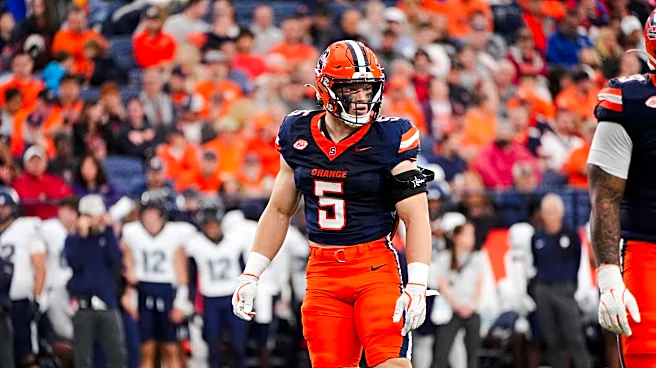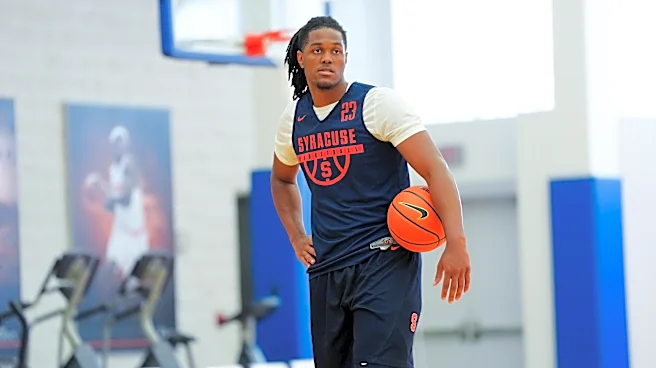





If your first instinct while watching Luke Wilson play for Syracuse this coming season is that he looks like he should be playing football, well, that’s because he is a football player. Wilson played both basketball and football growing up, and was up to 290 pounds by the time he was a senior in high school for 2022-23. While he’s no longer as big as he once was, down to a listed 255 pounds at 6-foot-9, Wilson, at his best, is still a physical specimen at the five spot with the football genes running
deep in his game.
App State head coach Dustin Kerns told Nunes Magician that Wilson choosing to dedicate himself to basketball fully for the first time when he got to college supercharged his development. It eventually led to winning Sun Belt Defensive Player of the Year this past season, and committing to Syracuse.
So what made Wilson an elite Sun Belt defender, and how does it translate to the ACC level? I’ll break down his rim protection and ball screen coverage, as well as exploring his offensive skillset to see how he’ll impact the game for Syracuse. But also importantly, what makes me concerned?
Rim Protection
The most impressive metric on Luke Wilson’s profile is the impact that he made on App State’s rim defense when on the floor. In Sun Belt play, the Mountaineers held opponents to just 48.2% at the rim. That number would’ve ranked second in the country for a full season, but App State’s rim defense dropped to 323rd when Wilson wasn’t on the floor at 62.7%.
The Mountaineer defense allowed its fair share of dribble penetration, especially on ball screens, knowing that they typically had another defender in the paint to ward off the threat. But that would sometimes lead to miscommunications of who was supposed to be the low defender when multiple players would converge, or if there was a screen across the face of the basket.
When Wilson was able to stay in position, he was extremely effective as a shot-blocker. Teams didn’t want to challenge him all that much, and when Michael Marcus was on the floor with him, it gave App State their signature twin towers. It led to a 7.7% block rate and the impressive defensive metrics I mentioned earlier.
However, the film that I watched reveals that the numbers may have been a little padded. I thought that he was late reacting to decisions made in small spaces, leaving him in no-man’s land underneath the basket. Despite his size and the numbers, there were plenty of instances where an opponent came right into his chest and scored through him. He was hardly the aggressor in these situations, as shown by a low foul rate despite his high block rate.
Players found ways to work around or through him to score, where the physicality that should be his calling card just didn’t show up.
Wilson did a good job killing off baseline drives, like when the App State defenders funnelled the ball into him.
But when there was a little more space moving toward the basket, I felt he sometimes invited the ball a little bit too much. Given that his strength is an asset, this is a concern moving up to the ACC level.
What I do think translates better to the ACC is his rebounding. He won a lot of possessions for App State with physical, violent rebounds.
Ball Screen Coverage
App State played a unique defensive scheme that typically had multiple big men on the floor, which impacted the way that they defended ball screens. They had the typical drop coverage in the bag, but also had coverages that played the big man a little higher than a typical drop while placing the other big in the paint.
The more Wilson was able to stay home, the better for App State. Their guards went over ball screens pretty aggressively and forced a good deal of mid-range shots. Having the deterrent of Wilson for a drive was helpful.
However, I thought that he struggled against some of the quicker and more talented guards who found ways to create against the App State pick-and-roll. Marshall’s Landen Joseph tore him apart in the second half
App State also used some hedging against different types of guards, which had Wilson out on the perimeter more.
Wilson was on the floor for 389 opposing ball screen possessions during Sun Belt games, and opponents scored .905 points per possession on them. During the 124 ball screen possessions in those games where he was off the floor, App State opponents were held to just .839 points per possession. That’s the difference between the conference’s second and seventh best ball screen defense.
Offensive Skillset
The place where you most see his football player background is around the rim on the offensive side of the ball. Whether he’s battling with multiple bodies to draw contact, going up for a shot, or fighting through for offensive rebounds, he’s trying to asserting his physicality.
Ball screens were not a heavy part of App State’s offense, but Wilson was an efficient roll man when the time arose. He turned into a lob threat for the Mountaineers and was a strong play finisher. Wilson shot 67.5% at the rim last season, including 46 dunks, to rank third in the Sun Belt.
However, he has attempted exactly one jump shot in his college career, and it came out of shot clock distress.
One of the very first plays that I watched in my evaluation was a pass that caught my eye. Against Troy, he drew a double-team in the post, but was calm enough and showed the feel to zip a pass across his body to the weak-side wing to an open shooter.
While he only had a 4.3% assist rate, I think it undervalues his passing ability. I don’t think it’ll be his role to pass a ton, but he showed some aptness passing out of the post. Meanwhile, his post-up game is how he generated much of his first-shot offense. He often tried to establish deep positioning before the entry pass, but even when pushed out of the paint, he had the ability to find his way back. Wilson lived off of contact, constantly forcing the issue into a foul in post-up situations.
Wilson averaged the most post-up possessions per game in the Sun Belt, and he won’t be asked to do that at Syracuse, but having some semblance of frontcourt scoring threat is important.
When Wilson was on the floor in conference play, the Mountaineers rebounded 35.4% of their misses, a rate that would’ve ranked 29th in the country. With him off the floor, that number dropped all the way down to 23.6%, or 345th in the country.
Conclusion
I left my film session with more questions about Wilson than I expected to have. He’s a 6-foot-9 big man, which isn’t inherently undersized, but he doesn’t quite have the explosive athleticism of a William Kyle, switchability of a Maliq Brown, nor any semblance of floor spacing, for now, and thus, it makes him undersized for what he is.
But he does excel as a rebounder on both sides of the floor and knows how to block shots without fouling. The metrics are kinder to him than the film on the defensive end, but I still think he will clearly be a key piece of the rotation for the Orange this season.