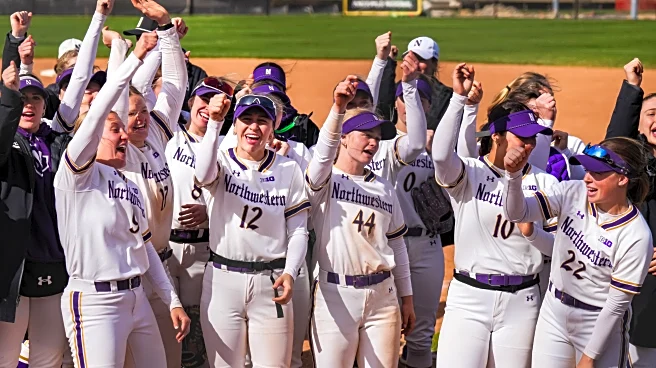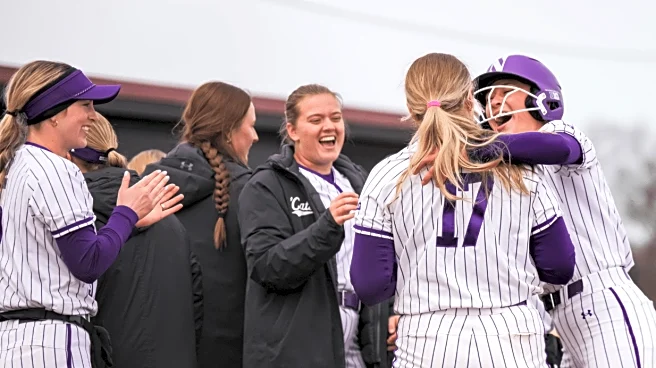




We’re about halfway through the regular season, and the official stretch of Big Ten play starts this week. Northwestern has already experienced its fair share of ups and downs, and if the first half is any indication, the rest of the season should bring plenty more twists and turns.
Regretfully, there was no available broadcast from Kentucky, so I’m doing this week’s column a little differently. I hope you enjoy it nonetheless!
Grab your favorite snack and let’s dive in.
Last Weekend, I Bet On Purple
Northwestern went 4-0 this weekend
(11-2 and 8-3 against Detroit Mercy, 16-1 against Northern Kentucky and 10-2 against Northern Iowa), with three run-rules. I mentioned last week that it was imperative these games were won, so I am very happy to see they were. It got a little shaky in the second Detroit Mercy game, but the ’Cats pulled through in the end. I’m going to rapid-fire some things I noticed.
Offense: Northwestern racked up 12 home runs across the weekend, almost doubling what it had the entire season so far (17). Two of these 12 came from Bridget Donahey in the first game, and three came from Emma Raye. Speaking of Raye, the catcher certainly had an incredible weekend; she went six-for-10 with 15 RBIs and one triple. Kaylie Avvisato also had one home run and broke out of her two-week slump, hitting .500 with two doubles added on as well.
The graduate transfer Abby Harvey also picked up her first career hit as a Wildcat in the first Detroit Mercy game!
The entire weekend, Northwestern crossed the plate 45 times (30% of its total runs this season). Out of the 23 innings it played, it scored in 14 of them — a 60.87% scoring rate. In the nine innings it didn’t score in, only 11 runners were left on base.
Defense: For the most part, defense looked good. Opponents were held to eight runs in total, and pitchers combined for 19 strikeouts and nine walks, a total K/BB ratio of 2.11. Although a pretty solid ratio, 55% of those free bases came in to score, which is not so solid.
Of the nine total hits allowed, only three were extra-base hits (home runs). Riley Grudzilanek pitched the most with 9.1 innings and eight strikeouts, while Marina Mason was close behind with a complete six-inning game and six strikeouts. Emma Blea did not see the circle at all.
As a whole, the ‘Cats committed six errors, and thankfully for them, no runs were scored because of it. Two of these came from Tru Medina, who was placed back at third for the weekend, but otherwise, she did well with the 11 other balls that came her way.
A Familiar Midseason. Will the Ending Be the Same?
The ’Cats sit at 12-14 overall and 0-3 in conference play, a record that is very similar to last season’s slow start (11-14). In both seasons, the team also faced six ranked opponents through the stretch, meaning the early schedule once again leans toward the difficult side.
On paper, the parallels are hard to ignore, and last season the team ultimately steadied itself in conference play to earn a postseason berth. If the 2026 team follows that same trajectory, this slow start may start looking more and more like a learning curve.
But for some reason, this team just feels different.
Part of it may come down to how games themselves have played out, as the results have felt more uneven. There are flashes of good pitching, good hitting or defense, but against strong teams, it never seems to come together. It may not be pre-conference jitters anymore; at this point, it feels more like an identity question. Is this inconsistency a temporary phase, or is it how this team is built this year?
Only time will tell. Until then, here are the stats.
Defense: On average, Northwestern still lags No. 1 Tennessee and No. 17 Washington in defensive efficiency ratio (how likely a defense will convert a live ball into an out). See the graph below for the entire comparison (Note: in week four, the ’Cats trumped both teams!)

In all, Northwestern’s DER has swung a lot, and I’ve compiled a couple of explanations for this.
Some of this goes back to defensive errors, which NU now has 39 of. While errors are not the only factor in defensive efficiency, they are often the most visible sign to point at when things go wrong. When balls that should be routine outs turn into baserunners, innings stretch longer than they should. The extra on-base opportunities can be the difference between escaping a jam and allowing a crooked number on the scoreboard.
Another explanation is the pitching staff’s current contrasting styles. I’ve updated the table I used in week three to encompass the whole season thus far, and I added a couple of extra columns as well. You can see it visualized below. From top to bottom, the rows represent strikeout percentage (K%), strikeouts per seven innings (K7%), walk percentage (BB%), walks per seven innings (BB7%) and extra-base hits allowed (EBH%).

I focus a lot on Mason in the coming paragraphs, but she’s clearly the favored pitcher and shows the most promise overall. The first-year (21 earned runs) has nearly double the innings of Signe Dohse and Blea, 20 more than Grudzilanek and almost triple that of Renae Cunningham, who all have 17, 16, 22 and 13 earned runs, respectively. It’s no wonder that Mason’s ERA still sits at the lowest with 2.77.
Mason has also brought a lot of her high school expertise to the circle thus far, collecting almost as many strikeouts as all other pitchers combined (62 vs 65) — leading the K7% category by nearly three percentage points.
In this sense, Mason’s presence has functioned almost as a defensive equalizer at times, taking pressure off a fielding unit. Every time a hitter doesn’t see contact, the chances for defensive mistakes or unlucky shots to the gap decrease. It’s a huge part of any defensive picture.
However, where Mason falls short is in extra-base hits allowed. Currently, she sits at 47.62% in this category — nearly half of her hits allowed have been either a double (10) or a home run (10). If she trims that rate even slightly, the impact could be significant. The reduction in hard contact could force opponents to string together multiple hits to score. However, this is where I turn to another solid individual in this rotation: Emma Blea.
The sophomore has stopped power off the bat considerably well. Her EBH% is nearly 8% lower than the next lowest rate from Dohse. Her ability to suppress extra-base hits provides a different look within the rotation. While she may not generate strikeouts at the same rate, keeping hitters from driving the ball into the gaps or over the fence helps stabilize innings and limit sudden offensive surges. She has also proven to be an effective relief option, which I dove into last week.
In general, for EBH%, Northwestern sits at 38% (with 28 home runs and 30 doubles). Compared to the rest of its Big Ten opponents this season, they sit behind Michigan, Penn State and Minnesota, but are ahead of Oregon, Illinois, Michigan State and Purdue.
Limiting extra-base hits is important in several facets. A single misplayed ball can quickly snowball into multiple runs, add in doubles or home runs, and you have a whole different ball game. Moving forward, limiting those big swings can determine whether a solid outing turns into a win or a loss.

Pictured above are added graphs showing where the ‘Cats sit for K% and BB% against the rest of its conference foes. As you might see, it sits closer to the bottom in both categories.
In all, it’s encouraging to have two of the team’s youngest pitchers anchoring the rotation. Grudzilanek, though the second option, struggles with a high ERA and BB%. Dohse showed early-season promise, but has been unable to regain that form. Meanwhile, Cunningham remains the least used relief option, most likely because of her even higher ERA.
Offense: I could talk about many individual hitters, but I find it better to analyze offensive production as a whole at this moment.
Through the first half of the 2025 season, Northwestern scored 117 runs while allowing 121. This season, the offense flipped that margin slightly, producing 145 runs while allowing 117. The five fewer runs allowed is fairly negligible, but the 28-run jump in offense is a great increase!
Still, the overall results suggest there is room for refinement, particularly when capitalizing on opportunities.
Across the Wildcats’ 14 losses this season, 95 innings were played. In 32 of those innings, Northwestern had a runner on base with one out or less but failed to produce a run. Nine of these missed opportunities came with no outs, when the chances to manufacture a run should be at their highest.
That inability to convert chances has often stalled innings before they can build momentum. The ‘Cats collected 194 hits and only 72 walks — contributing to a .375 on-base percentage. However, 144 strikeouts is a small cause for concern. Especially compared to the number of walks (which is half the number of strikeouts), this tells me the team isn’t seeing the ball as well as they can.
If Northwestern can improve its situational hitting and make more of those innings count, the offensive gains already shown this season could start to translate more consistently into wins.
The Bounce Back
Conference play resumes this week when the Wildcats travel to Illinois. Now they have the opportunity to prove that numbers are only the beginning of the story.
Until then, we wait to see which version of this team shows up.