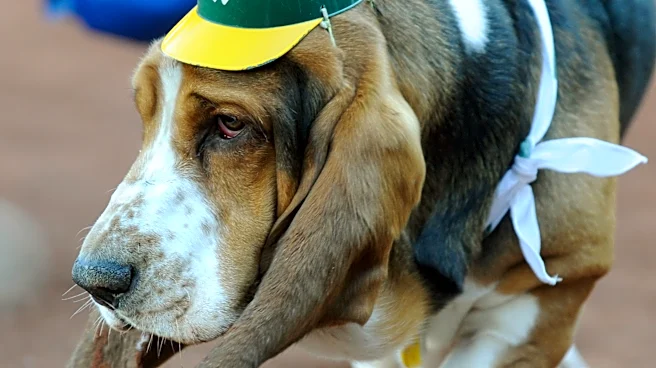





Crumpet and Lobo love walks. Unfortunately, so do opposing batters and my dogs only wish they could get walked at the rate A’s pitchers are offering. It’s been an issue all season and not only does it continue to be a major barrier to success, it is a widespread phenomenon across all types and levels of pitchers.
Last night the A’s issued 8 more free passes, 5 from starter JT Ginn in just 4.1 IP. Today’s starting pitcher, Jacob Lopez, is trying to bring down a walk rate that started at over a batter
an inning and currently sits at 21 BB in 24.1 IP. “Ace” Luis Severino has put together two excellent starts in a row, but has still walked 23 in his 38.1 IP for the season.
Team wide, strangely the A’s have issued the 3rd most walks in all of MLB yet also only the 3rd most walks in the division. More generous than A’s pitchers are only those who toil for the Angels and Astros. But for contrast, the A’s have now walked 147 batters in 32 games (4.6 per game) while despite playing one more game the Mariners staff has walked only 82 (2.48 per game).
What is typical this season, with the ABS challenge system shrinking the strike zone a bit as umpires can’t “Verlander” the opposing hitters? 3.5 BB/game is the median, meaning the A’s staff is a whopping 31.4% above the league average so far in 2026.
Here’s the ominous part. The issue is far from limited to the big league club. Currently the A’s have an organizational problem with throwing enough strikes, including their very best pitching prospects.
Gage Jump? Scouts continue to be excited about his potential and his ceiling and cite him as not being far from ready to pitch in the big leagues. Yet one stat stands out as still needing work and attention: so far this season at AAA, Jump has thrown 18.1 IP and walked 10.
Luis Morales was envisioned to be a breakout candidate pitching his way to the front of the A’s big league rotation but he has been wild at 3 levels in the span of a month. In spring training Morales threw 19 sad innings in which he walked 14 and was tagged for 16 ER. Then he lasted only 7.1 IP in the big leagues as he walked 8 and was soon shipped back to AAA for more seasoning. At AAA he has completed just 12.1 IP in 3 starts, walking 9. So that’s, in aggregate, 38.2 IP, 31 BB.
Mason Barnett continues to struggle greatly to throw enough strikes, with an MLB mark of 13 BB in 24.1 IP. At AAA he has not made strides, with 12 BB in 19.2 IP.
Even Kade Morris, a “pitch to contact” sinker baller with low K rates but strong “pitchability,” has walked 16 in his 31.1 IP.
Dipping down to AA, Jamie Arnold is, like Jump, viewed as a “fast mover” with upside and in fairness to Arnold starting his pro career at AA is an aggressive assignment. Arnold came with some concerns around his control and so far, indeed control has been his main vice. In 21.1 IP he has walked 10.
Perhaps most puzzling is Wei-En Lin who, at 19 years old last season, established himself as a strike throwing machine. Lin issued only 22 free passes in 87 IP as a teenager (while striking out 117), walking just 2.28/9 IP at AA. But Lin walked 4 batters in his 3.1 IP in spring training and hasn’t been nearly as efficient at Midland so far this season with 9 BB in 21 IP (3.86/9 IP). It’s as if everyone in the A’s system has caught the walkies bug.
To what can we attribute what is becoming a serious issue impeding the A’s quest for success on the mound? There are myriad potential explanations, most of which are probably entirely inaccurate. They include:
1. Lack of talent. If the group of MLB pitchers and top MiLB prospects just doesn’t measure up to the industry norm then you’re going to see it reflected in performance. Certainly pre-season projections did not favor the big league staff as a whole, but few organizations would not want to have Jump, Morales, Arnold, and Lin among their top pitching prospects.
2. Mechanical issues not solved. Control problems often arise when a pitcher loses that “repeatability” or something gets off with their mechanics, they can’t get right in real time and coaches are unable to help them right the ship.
3. Approach not geared to limit walks. If pitchers are nibbling, throwing breaking pitches in fastball counts, trying to miss bats with chase pitches instead of challenging, etc., the cost is going to be higher walk totals along the way.
4. Drafting/Acquiring philosophy. Certainly, from Joe Boyle to Elvis Alvarado to Braden Nett to the selection of Arnold, the A’s have not shied away recently from pitchers with plus stuff whose biggest red flag on the mound is their control. Perhaps the organization is paying the price of a “be careful what you wish for” approach.
5. Home field disadvantage. Both in Sacramento and Las Vegas/PCL, A’s pitchers face a hostile pitching environment that discourages being aggressive in the strike zone and tempts hurlers to be extra careful. This could inflate walk totals as well as embedding bad habits even when in the comfort of a “pitcher’s park”.
What do you think is at the root of the A’s system wide breakdown in throwing enough strikes in 2026? It’s having a significant impact on the big league team’s success and on the development of the A’s top prospects, so it would be prudent for the A’s to identify and solve the issue. Walks are great for doggies and terrible for ERAs.