
As the 20th century entered its final decade, the Yankees were truly reaching a nadir in their franchise history. Yankee Stadium marking a full decade since its last taste of postseason baseball by the fall
of 1991, owner George Steinbrenner turning over managers and GM’s faster than a sick person goes through a box of Kleenex. Beloved team captain Don Mattingly was in the throes of his degenerative back problems and would never again be the player he once was. Dave Winfield was run out of town and Rickey Henderson had moved on to greener pastures, leaving the offense as one of the most punchless starting nines across the sport.
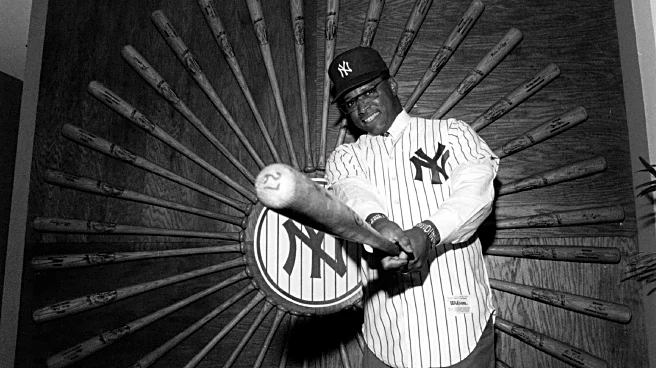
At the conclusion of the ’91 campaign, something had to give. Over the previous four seasons, the Yankees finished no higher than fifth in the division and had endured three consecutive losing campaigns. It just so happened that that same offseason, one of the most productive hitters in the league over the previous seven years was hitting the free agent market. Suitors lined up to woo Danny Tartabull, but the Yankees ultimately swooped in and got their man. And while he did put together a couple productive seasons in the Bronx, Tartabull’s time with the Yankees is more remembered for some questionable decision making and a contentious relationship with Steinbrenner that ultimately led to his being jettisoned like many other players who incurred the vengeful owner’s ire in that era.
Danny Tartabull
Signing Date: January 6, 1992
Contract: Five years, $27 million
Born on October 30, 1962, in San Juan, Puerto Rico, Danilo Tartabull Mora was the son of former major leaguer José Tartabull, who played nine seasons for the Athletics and Red Sox. He was drafted by the Reds in the third round of the 1980 MLB Draft, but struggles in the minors convinced Cincinnati not to protect his rights, and he was chosen by the Mariners as a compensatory pick in 1983. He tore it up on the farm and was handed his MLB debut in late 1984, hitting a walk-off RBI single in his first career at-bat, before becoming a full-time major-leaguer in 1986. That year, he finished fifth in AL Rookie of the Year voting and also transitioned from shortstop to right field, which would remain his primary position for the rest of his career.
Despite this immediate success, the Mariners traded Tartabull and minor league pitcher Rick Lueken to the Royals for outfielder Mike Kingery and pitchers Scott Bankhead and Steve Shields. The trade shocked the Seattle fan base while Kansas City had a potential future cornerstone practically fall into their laps. In KC, he continued to develop into one of the premier sluggers in the AL, batting over .300 with over 30 home runs and over 100 RBI in 1987 and 1991. He was selected to his first and only All-Star team in 1991 and finished the year with a career-high .316 batting average to go along with 31 home runs, 100 RBI, and an MLB-best .593 slugging percentage.
Tartabull might have been one of the best power hitters on his team, but he rubbed many people in the organization the wrong way. Between his self-absorbed attitude and ostentatious lifestyle, the Royals were happy to grant Tartabull free agency on October 28, 1991. The Angels, White Sox, and Rangers emerged as the early frontrunners, but each dropped out of the race for varying reasons. Chicago’s GM balked at Tartabull’s ask of a five-year contract while the Angels’ vice president Whitey Herzog was still bitter over previous negotiations with Bobby Bonilla, who was represented by the same agent as Tartabull, Dennis Gilbert.
Perhaps sensing a market opportunity, the Yankees jumped in and offered Tartabull a five-year, $25.5 million contract, which to that point would have been the richest contract in franchise history. They also included an additional $1.5 million endorsement clause, and Tartabull had no choice but to accept given how much this deal exceeded all of his other offers. He was officially signed on January 6, 1992, and you could tell he was immediately excited by the prospect of playing for this new team and city:
Texas and the Angels were both very attractive to me, but the New York Yankees, man, they’re something else. How can you not get excited about that tradition? There’s a great mystique to it. Everyone and everybody would love to have that prestige.
Despite missing 39 games to hamstring and lower back injuries in his debut season with the Yankees, Tartabull made an instant impact and was the team’s best hitter, slashing .266/.409/.489 with 25 home runs and 85 RBI. His 19.6-percent walk rate was the highest in the AL and 152 wRC+ fourth-best. Though his overall production dipped in 1993, he still slashed a respectable .250/.363/.503 accompanied by improvements in the home run (31) and RBI (102) departments.
Tartabull still drew walks at over a 15-percent clip, but a soaring strikeout rate for that era — 156 strikeouts in 1993, second most in baseball — began to sour the recently-reinstated Steinbrenner’s opinion of him and began to turn the tide of fan reception against him.
He did himself no favors with some of the decisions he made. In 1993, Tartabull injured his arm on a throw from the outfield and was primarily a DH for the rest of his tenure in pinstripes. Rather than address the shoulder injury at the start of the offseason, Tartabull opted to undergo cosmetic facial surgery and embarked on a lengthy European vacation, delaying the much-needed shoulder surgery by almost two months. This resulted in Tartabull appearing in near-exclusive DH duty and 104 games in 1994, which proved the final straw for Steinbrenner.
New York attempted to trade Tartabull in spring 1995, even offering to eat $2 million of what he was owed that season, but unsurprisingly found no takers given he was still their highest-paid position player at the time. Steinbrenner continued to pepper the public media with criticisms and negative comments about his player in a bid to force Tartabull out of town. This led to Tartabull handing in a trade request in June of that year, but the Yankees had already been trying unsuccessfully to find a taker for their now want-away player.
That summer, fans at Yankee Stadium would boo every time Tartabull stepped to the plate and every time his name was announced over the PA system (his Seinfeld cameos only helped so much with the New York audience). It didn’t remedy matters that Tartabull was mired in a slump, slashing .224/.335/.380 with just six home runs and and 28 RBI in 59 games while continuing to miss stretches with a growing list of minor injuries. Steinbrenner meanwhile continued to pour fuel on the fire, questioning the veracity of Tartabull’s injuries that were causing him to miss time — behavior reminiscent of the saga with Winfield when Steinbrenner decided he no longer wanted to pay the player’s salary.
Both parties finally got what they wanted on July 28, 1995, the Yankees trading Tartabull to the Athletics for the similarly disgruntled Ruben Sierra and pitching prospect Jason Beverlin, the Yankees agreeing to pay half of his outstanding contract for 1995. Manager Buck Showalter regretted that they were giving up “a good player in Danny Tartabull,” but also admitted that the inclusion of Beverlin in the deal represented “a quality prospect back from Oakland, which finalized the deal, [and] allowed us to replace some of the people we had to give up in the Cone trade.”
Once the deal was made official, Tartabull summed up his final days with the Yankees by saying, “I feel like I’ve been released from jail,” maintaining that he would have loved to continue playing for the Yankees, but that it became an impossible situation to continue playing for George Steinbrenner.

Nonetheless, Tartabull’s career plummeted off a cliff from that point forward, Tartabull appearing in just 24 games for the A’s before being traded to the White Sox that winter for pitcher Andrew Lorraine and minor-league outfielder Charles Poe, Oakland agreeing to pay half of Tartabull’s $5.3 million salary in 1996. That season, Tartabull would remain relatively healthy, appearing in 132 games — his most in three years — slashing .254/.340/.487 with 27 home runs and 101 RBI. That marked the expiry of the contract he signed with the Yankees, and though the South Siders expressed an interest in bringing him back, it was only provided that he take a significant pay cut.
The only major league offer Tartabull received that winter was for one year and $2 million from the Phillies — one he initially rejected as “insulting” and “lowball.” He finally signed during spring training, only to break his foot on Opening Day when fouling a ball off his left foot. He’d appear in just three games for the Phillies, and that spelled the end of his career at age 34 with no team interested in signing him the following winter. Per SABR, Tartabull’s life after baseball has not been a happy story, riddled with unpaid child support, probation violations, appearances as a fugitive on “Most Wanted” posters, and finally, arrest.
Given the state of the franchise in the early-‘90s the Yankees had little choice but to shell out top dollar for Tartabull. Any offensive addition at that point was an upgrade and the once-proud organization was mired in a prolonged period of decay, and fans needed to be given a reason, any reason, to continue showing up to the ballpark. In his seven years before joining the team, Tartabull was one of just nine qualified hitters in MLB with at least a 140 wRC+. Between his final season in Kansas City and first two in New York, only Barry Bonds, Frank Thomas, and Ken Griffey Jr. managed a higher wRC+ than Tartabull’s mark of 150. Unfortunately, injuries prevented him from ever reaching the heights that Steinbrenner expected, particularly in the second half of his Yankees tenure. As too many players found playing under George Steinbrenner, once you run afoul of the owner, your days in pinstripes were limited.
See more of the “50 Most Notable Yankees Free Agent Signings in 50 Years” series here.