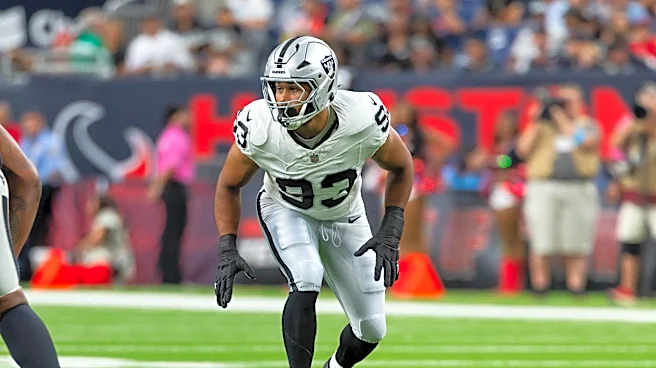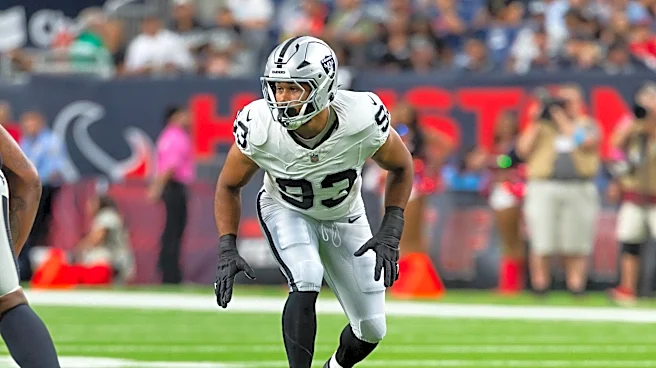



Arguably the biggest surprise from the Las Vegas Raiders’ preseason was the emergence of edge defender Patrick Johnson. The 28-year-old was signed the day before veterans reported to training camp but was arguably the team’s top performer during the preseason to earn a spot on the Raiders’ 53-man roster.
According to Pro Football Focus, Johnson led Las Vegas with five pressures and tied for second among NFL edge defenders with a 90.2 defensive grade. The latter was the result of recording a pair of sacks
(including a strip sack) and four ‘defensive stops’ against the run. Clearly, that was enough to catch the coaching staff’s attention, so let’s flip on the tape and see what he can bring to the team.
We’ll start with Johnson’s best rep of the preseason, and apologies for the Houston Texans being in preseason mode with their endzone camera.
It’s third and five as the Texans leave their left tackle on an island with no tight end or running back on his side. That, combined with the Raiders putting three defensive linemen on the other side of the offensive line and having the middle linebacker present a blitz threat over the center pre-snap, sets up a one-on-one opportunity for the right edge defender.
Johnson takes advantage by winning with speed and a rip move around the edge before ripping at the ball while the quarterback starts his throwing motion, creating the turnover that gives the Raiders the ball on the plus side of the field. This was something that stood out about the late free-agent signing’s performance, showing good speed around the edge on a handful of occasions.
We’re working backward as this is Johnson’s first sack of the preseason, which shows off some pass-rush diversity.
This time, the tackle he’s going against has some help with the in-line tight end chip blocking before releasing into a route. Notice how Johnson eyes the tight end off the line of scrimmage. He sees the chip is coming and beats the tight end to the punch by planting off his outside foot to turn speed to power into the right tackle.
While he’s still going in the direction that the offense wants him to go, that allows the edge-rusher to stay in control of his pass-rush rather than getting knocked off-balance and reduced inside. That’s a smart decision because the offense’s formation/play call protects the edge, meaning it’s going to be very difficult to win with an outside move.
Instead, Johnson gets the right tackle off-balance by maintaining his momentum and effectively turning speed to power. He also does a great job of using his hands before and after initial contact to keep the tackle off his body. So, when the quarterback tries to step up and escape the pocket, the pass-rusher is in position to come up with the sack.
The Cardinals have a similar pass protection call here, where the tight end chip blocks Johnson. The difference is that the tight end is more aggressive this time and makes contact with Johnson before Johnson can turn speed to power or work an inside pass-rush move.
That creates a soft edge for the defense, which the quarterback tries to take advantage of by scrambling out of the pocket. However, the veteran pass-rusher makes a heads-up play, recognizing the scramble and taking a good pursuit angle to meet the quarterback near the sideline.
While Johnson can do a better job of breaking down in space to finish with a sack here, he doesn’t completely overpursue and is still in a position to force the ball out for an intentional grounding call. So net-net, the result is about the same as a sack.
Shifting gears to run defense, Johnson is on the backside of a zone run here. The Texans have a receiver in a reduced split (in other words, close to the offensive line) to protect the backside of the play. Technically, the edge defender should stay inside of the receiver’s block to take away the D-gap between the tight end and wideout, while the cornerback (No. 28, Jermod McCoy) is responsible for containing the outside.
However, Johnson still fulfills his responsibility by closing the gap with the man, pushing the receiver inside so that the receiver ends up hip-to-hip with the right tackle. That takes the C- and D-gaps away from the running back and puts Johnson in a perfect position to get involved in the TFL after a great rep by Foley Fatuaksi, where Fatuaksi gets immediate penetration in the backfield.
For a breakdown of this play from the defensive tackle’s perspective, see the related article below.
Finally, what stood out the most about the six-year pro’s run defense was that he refused to get blocked by tight ends.
He’s on the playside/strong side of Houston’s halfback dive call. Fatukasi pops up again by taking away both A-gaps and forcing the running back to bounce outside. The back tries to take advantage of the open lane in the C-gap. However, Johnson wins at the point of attack against the Texans’ tight end to set the edge and beat the tight end across the tight end’s face to make the tackle for a short gain.
That effectively takes away two rushing lanes because the edge defender was also in perfect position to make the play had the running back bounced outside even further.
It remains to be seen how much playing time Johnson will get and how impactful he will be when the competition level rises during the regular season. But there’s no denying that the veteran earned the job as the Raiders’ fourth edge defender with his performance this summer.