
On Tuesday night, the BBWAA welcomed two new members to the National Baseball Hall of Fame. Each of them—Carlos Beltrán and Andruw Jones—had stints for the Yankees, but were most well-known for their tenures
elsewhere, and both figure to go into Cooperstown repping NL East franchises.
Of course, the Yankees have more than enough players donning the interlocking NY on their caps in the Hall’s plaque gallery (24 to be exact), including one last year when CC Sabathia was inducted on the first ballot. As we look ahead to see who could be No. 25, there’s one player on the ballot who made serious momentum in 2026 to boost his once-longshot candidacy (and no, it’s not A-Rod).
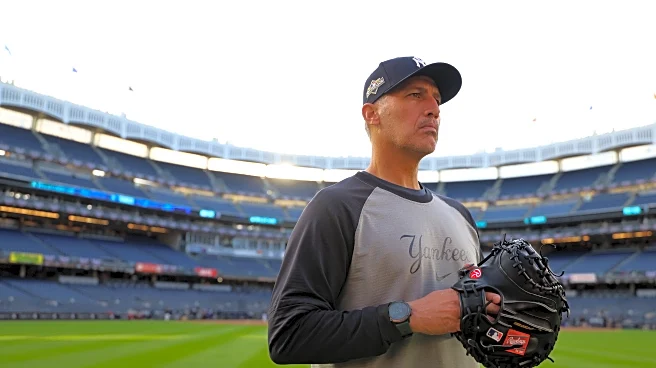
Andy Pettitte’s case for induction is one that has both supporters and detractors. If you believe that postseason performance should be a big part of a player’s case, you likely would vote for Pettitte, who has at least an argument as the greatest postseason pitcher in MLB history. His counting stats are solid when you account for the era he played in, and it’s always important to remember that numbers that are similar on surface to regular season results are not actually equivalent, as it’s much harder to maintain that production in the playoffs against MLB’s best teams.
Detractors will almost always cite his connections to PEDs, as he was named in the Mitchell Report and later admitted to taking human growth hormone to recover from an elbow injury in 2002. He, like many other players who played in the Steroid Era and used PEDs prior to the league beginning drug testing in 2003, has been punished when they get onto the ballot, regardless of circumstance.
Barry Bonds and Roger Clemens, who hold the MLB records for MVPs and Cy Youngs, respectively, will likely never be enshrined because they took steroids. The same can be said for the likes of Mark McGwire, Sammy Sosa, Manny Ramirez, and Alex Rodriguez. Not every steroid-using player is judged the same, but unless you’re someone like David Ortiz, you will be blackballed from Cooperstown if you used steroids.
But could Pettitte’s more loose association with PEDs allow him the same grace as Big Papi? Well, he debuted on the crowded 2019 ballot at a paltry 9.9 percent in 2018, and for the first six years of his candidacy, he got less than 20-percent support. He seemed doomed to the same fate as everyone else, with an awfully stagnant trend, even with a modest jump last year to 27.9 percent.
But 2026 was different. With a very weak first-time candidate field and a relatively weak field overall, members of the BBWAA were forced to look closer at some of the holdovers. This massively benefitted the candidacy of several players, including Félix Hernández and Chase Utley, but Pettitte got the second-biggest boost:
Pettitte was tracking at over 57.6 percent through an estimated 58 percent of the balloting according to Ryan Thibodaux’s yearly Hall of Fame ballot tracker, before the results were released, but tumbled nine percentage points due to a more conservative voter base that doesn’t reveal their ballots.
Still, the gains were extremely encouraging. To nearly double your support (110 to 206 total votes) in one year is spectacular, even if he’s running out of time. In the pre-reveal balloting process, Pettitte gained support from 38 writers who previously left him off (one of the most in the 17-year history of Thibodaux’s tracker) and was at nearly 70 percent on 39 new voters with public ballots. Those two factors alone show more than enough positive momentum for optimism.
Why did so many voters change their minds about Andy? Jayson Stark of The Athletic, while having supported Pettitte in the past, is one of several who do not hold his “hazy connections to the Mitchell Report and the PED era.”
Ken Rosenthal, also from The Athletic, didn’t hold the PEDs over Pettitte, but rather didn’t believe his stats were up to snuff, referencing Pettitte’s lack of a Cy Young. He changed his mind after seeing the disparity between him and Sabathia in last year’s balloting. Similarly, his colleague Dan Brown couldn’t justify keeping Pettitte off after talking himself into King Félix (he also said he “holds his nose” and ignores the PED allegations for he and A-Rod).
Rich Dubroff of BaltimoreBaseball.com combined the more common opinions for those who wind up voting for Pettitte, commending the postseason hero for the way he handled the Mitchell Report, comparing his numbers to the likes of Sabathia and Mike Mussina, and acknowledging his postseason success.
Another aspect that helps Pettitte’s candidacy is the growing list of younger writers getting Hall of Fame ballots. Older, more experienced writers tend to be “small hall” guys and extremely negative towards anyone linked to PEDs. As shown with his stellar performance among first-time voters, the new generation is much more forgiving.
So, is it possible? The wall* that fellow Mitchell Report figures Bonds and Clemens hit (around 70 percent) threatens to exclude Pettitte, even as he gets the late surge. He needs to gain approximately 113 more votes in two years, and he would be on pace to do that if he enjoys a similar rise next year in an even weaker class that only welcomes one potential first-ballot option (Buster Posey) and a few that may barely stay on the ballot (Jon Lester, Ryan Zimmerman, Brett Gardner).
*Said wall could also apply to any future Veterans/Eras Committees that Pettitte might face if his BBWAA eligibility is exhausted before he’s elected. Although some of his old-school credentials could compel committee members, no one with PED ties has even come close to being elected by that group.
Pettitte’s path to getting in will likely involve an even stronger performance with new voters, coupled with the even more important softening of older voters that dragged his numbers down this year. This year’s BBWAA voting bloc had a higher surge of new names than normal, as the BBWAA had not officially welcomed MLB.com writers into the fold until a decade ago. At least 25 active writers from that contingent became eligible to vote for the Hall of Fame this year, and there were over 50 new first-time voters per Thibodaux; it’s unlikely for there it be nearly as many new entrants for the 2027 ballot.
Still, a similar (though superior) case to Pettitte, Mike Mussina made it in on his sixth ballot, slowly rising from under 30 percent to getting in. 2026 inductee Andruw Jones debuted even worse than Pettitte in 2018 at 7.3 percent. Furthermore, the likes of Billy Wagner, Scott Rolen, Tim Raines, Larry Walker, and Edgar Martinez have enjoyed massive jumps in their later years to sneak into Cooperstown. The Walker path in particular has to stir up some hope in Pettitte, as the right fielder actually underperformed Pettitte on his eighth ballot (34.1 percent) before making huge gains to 54.6 percent in Year 9 and then just over the 75-percent threshold on his last shot in 2020.
Can Pettitte do the same before time runs out in 2028? He’ll have a chance, and he’ll take that considering how bleak it looked entering this year.
Thanks to Ryan Thibodaux and his team for research assistance.