

There’s a pretty deeply ingrained belief among Bengals fans when it comes to the Brown and Blackburn families.
You know the one.
They’re cheap. They’ll never spend enough. They’ll never make the big move. They’ll always find a reason not to push the chips into the middle of the table.
For years, there was plenty of evidence to support that frustration. But then came the 2026 offseason.
And according to Bengals legend Ken Anderson in an exclusive chat with The Orange and Black Insider, perhaps it’s time
to reconsider some of those preconceived notions.
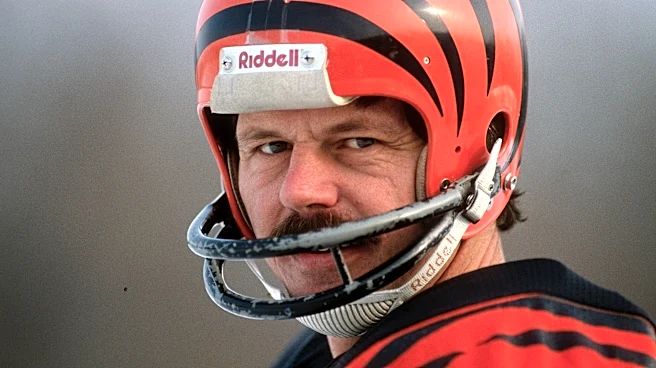
Anderson, who spent his entire 16-year playing career in Cincinnati and quarterbacked the Bengals to Super Bowl XVI, spent some time with us to discuss the current team and reminisce on his great career. His perspective on the organization and its ownership is particularly interesting because he has seen just about every version of the Bengals there has been.
Anderson isn’t looking at the Browns and Blackburns from the outside. He lived through the Paul Brown years. He played for the franchise when Mike Brown was taking on an increasingly significant role. He has watched the organization evolve for decades, including being a coach at one point.
And what he’s seeing now is different.
That’s not to say Bengals fans should suddenly forget every frustration they’ve had with ownership. They shouldn’t.
But there’s a difference between giving the Brown family a lifetime achievement award for spending money and acknowledging when the organization actually does something that fans have been demanding for years.
The Bengals went all-in this offseason. At least, by barometers they have previously set for themselves. Not “all-in” in the NFL buzzword sense where a team restructures a couple of contracts and signs a mid-level free agent.
They went out and got Dexter Lawrence. They went out and got Jonathan Allen, Bryan Cook, and others. Anderson, a guy who has been linked to the Bengals for over 50 years, took notice.
We initially asked Anderson about what he thought about these moves.
“At the end of last year, Joe Burrow said: ‘We’ve got to do things differently’, and it was encouraging to see the Bengals do things differently,” Anderson said. “Nobody in their right mind thought they would give up the 10th pick in the draft to make a trade for a guy like Dexter Lawrence. And that was, maybe, the best trade in the history of the Bengals; I don’t know how that’s going to turn out.”
He also noted the amount of money devoted to the defense this offseason, including Cook’s Super Bowl background upon his return to Cincinnati.
They made major investments in the defensive line and dramatically changed the personality of a defense that had been one of the biggest problems on the roster. Anderson’s comments essentially challenge the idea that the Bengals’ ownership group has never been willing to make those kinds of moves.
That’s worth considering.
Because sometimes Bengals fans — myself included — have allowed the reputation of the franchise to become so entrenched that we automatically view every move through the lens of what the Bengals used to do.
This offseason wasn’t what the Bengals used to do. It was aggressive and expensive.
And, most importantly, it was exactly the kind of offseason that people had been demanding from the organization. That’s easy to dismiss as front-office speak. And, frankly, Bengals fans have heard plenty of talk over the years.
Later in the interview, we asked Anderson about preconceived notions about the Brown/Blackburn family.
“Well, number one, they really do want to win. I mean, that’s the whole goal of Mike Brown,” Anderson said. “But also, he’s thinking two or three years down the road. You know, making sure that they can field good teams then, as well.”
This lines up with the Bengals previously rolling over cap space in recent years, as well as never being in salary cap hell. They also often draft in a way that does supply the roster with players who may not be pegged as immediate starters, but ones who could supplant incumbents once their contracts expire.
The Bengals’ own reporting later highlighted just how involved Mike Brown remained in the process, with Tobin saying Brown was “instrumental in getting a lot of things done” during the offseason. Tobin also emphasized that the personnel department’s work was collaborative and that he wasn’t making it happen without the rest of the organization.
That’s a pretty different picture from the cartoon version of Bengals ownership that has existed in the minds of many fans for decades.
Does that mean the Browns and Blackburns should suddenly be immune from criticism? Absolutely not.
The Bengals haven’t won a Super Bowl in their existence as a franchise. They haven’t even gotten back to one since Super Bowl LVI. And ultimately, the only thing that will make this offseason truly meaningful is what happens when the games matter most.
But give credit where credit is due. The Bengals identified a problem in a year of urgency, and they attacked it. They spent the money. They made the trades, while simultaneously trying to bring continuity to other areas on the team.
They added established players rather than simply hoping the draft would solve everything. And now, with Anderson offering his perspective, there’s an interesting question for Bengals fans to consider:
What if the biggest change isn’t that the Browns suddenly became a different ownership family? What if the biggest change is that the circumstances finally convinced them to operate differently?
Joe Burrow changes the equation. A franchise quarterback entering his prime changes the equation. Maybe they learned a hard lesson 15 years ago with Carson Palmer.
And, perhaps most importantly, the pressure to capitalize on that window changes the equation. Anderson knows what a Super Bowl team looks like. He was the quarterback of the Bengals’ first one.
So when someone with his history and perspective pushes back against some of the long-standing assumptions surrounding the organization, they’re saying, “I’m willing to listen.”
That doesn’t mean blindly trusting ownership. It means acknowledging what actually happened.
The Bengals talked about going all-in — and then they actually went all-in. Now it’s up to the players, coaches, and front office to prove that those moves were worth it.
And if they do?
Maybe Bengals fans will finally have to retire a few of those old assumptions about the people running this franchise.
We were pleased to chat with the Bengals’ legend, courtesy of HeartFlow. The former Cincinnati quarterback recently learned that up to 1 in 3 retired football players die from cardiovascular disease, yet much remains unknown about their risk. Wanting to be proactive with his health in new ways, he enrolled in HeartFlow’s GAMEFILM Registry, a program designed to analyze the heart health of former professional athletes with the goal of improving the standard of care for everyone.
Just as coaches study game film to anticipate what’s coming next, HeartFlow’s first-of-its-kind AI technology helps predict what’s coming for your heart. From former professional athletes like Ken, whose bodies endured years of elite physical demands, to the everyday person with a family history of heart disease and beyond, these kinds of advanced insights can be life-changing.
Be sure to be proactive about your health, and check out our amazing chat with one of the best Bengals players to ever suit up!