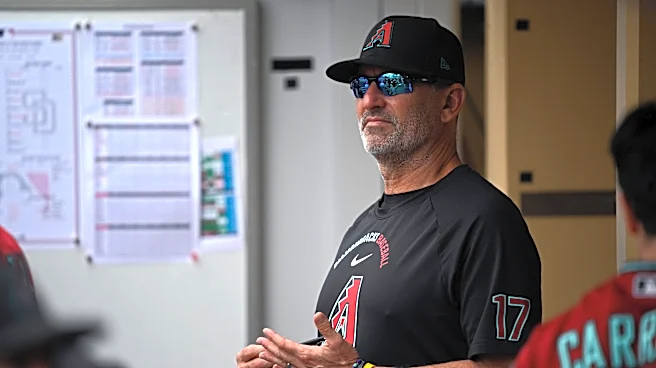






Thursday, the Diamondbacks made an announcement that surprised many and also ruffled a great many feathers. After in-season comments were made by Torey Lovullo and the organization that the team needed to make the playoffs to secure Torey Lovullo’s job moving forward, the club handed their manager of ten years a two-year extension, despite coming up short on the final day of the season, being officially eliminated from postseason play with about 45 minutes left in their season.
There were some… spirited
responses to this announcement to be sure.
As we try to keep things fairly PG-rated around the Pit, I’ll refrain from embedding a slew of examples. But suffice it to say, there were two camps at work after the announcement. On one side, there were a ton of mostly reasonable takes that retaining Lovullo, while not entirely ideal, is almost certainly the right call – especially given the particular circumstances in play. The other half, as many might suspect, were full of vim and vigor, all vitriol and hate. I’m fairly certain even Samuel L. Jackson might have had enough with the free-flowing, hyper-vulgar language employed by commenters by the end of the third or fourth take.
Of course, only time will tell if either side was right or wrong. In fact, the single-most likely outcome is that both sides are proven to be partially valid. Full disclosure, this author was in support of bringing Torey Lovullo back and thinks the organization made the right call by extending him and lining up the end of his term with what is currently the end of Mike Hazen’s contact. That isn’t to say though, that there are not some reasons the contract has some problems, problems that the team would like many to ignore – problems that actual fans are unlikely to ever just let go without being given good reason.
Some Potential Problems with the Extension
While there are a number of potential issues, none of the reasoning here is particularly deep. That is not to say, the reasons are any less valid. It just so happens that they are fairly easy and straightforward. Therein is a big part of the problem. Given that the simplest answer to a puzzle is often the proper one, the fact that there is such a pile of simple reasons for dismissing Torey Lovullo makes one wonder what sort of convoluted logic is necessary to justify keeping him. (We’ll get to that momentarily.) Torey Lovullo has been in the job for 10 years now. In that time, he has only made the playoffs twice. Once he backed in and then went on a lucky run that ended with the team losing the World Series in five games to the Texas Rangers. Two postseasons in 10 years is not great. Some would argue it isn’t even good, though it is actually closer to normal than I think many realize. IN 10 years, Lovullo has been plagued by similar problems cropping up again and again, hinting that there might be some underlying logic falling short in the team’s game-planning or in Lovullo’s implementation. In 10 years, Lovullo has a managerial record of 750-768 for a .494 winning percentage. A losing record after such a large sample size is tough to sell to anyone.
There is certainly something to be said about a change of approach. If one keeps doing the same thing over and over but expects a different result, they are usually bound to be disappointed. Added to this assortment of reasons to dismiss Lovllo is the Ketel Marte saga and Lovullo’s own performance in pressers. It is no secret that Torey Lovullo has been a massive shield wall for Ketel Marte over the last few years, taking the brunt of the public’s ire for various offenses (perceived or real) committed by Ketel Marte. This has (somewhat unfairly, but understandably) led to Lovullo being labeled as an enabler, a root cause of Marte’s issues.
Additionally, Lovullo is not a wordsmith by trade. He’s a baseball skipper. This means that often, the way things work in his head and the way he articulates those thoughts in pressers can be at somewhat cross purposes. One need look no further than the comments made after the team was eliminated from this season’s playoffs. Torey Lovullo’s comment that he, “Wanted to see what he could do,” regarding using Jose Cabrera in the season’s final game, a must-win for Arizona. On the face of things, this comes off as completely detached from reality, someone who isn’t paying attention to the situation and who is just flying by the seat of his pants. None of that is actually true though. But damn if 10 second sound bites don’t come with some razor-sharp teeth in this day of using clips for “news stories” and leaving out context to save space and putting thought into a piece. One could argue that perhaps Lovullo should be a bit more circumspect with his word choices in pressers, but such a choice comes with time and effort and likely leads to Lovullo being available to speak to the public far less. One thing about Lovullo is, he has never run from the microphones when they come around. He puts himself squarely between the press corps and his club. He is the face of the franchise and he wears the plaudits and the criticisms and he doesn’t shy away from it. that feels like it is probably far more productive and likely to endear him and his methods to the team than cutting back on the interviews so he can be more careful with his word choices. Does anyone really want a manager spending hours every week working on their public presentation skills instead of game-planning for the next series? Some people are simply more comfortable and gifted in front of cameras and microphones than others. Lovullo is clearly not uncomfortable, but he also is clearly not a trained wordsmith. Imagine that.
Given all that, it is entirely understandable why many fans wanted (and still want) Torey Lovullo to be shown the door. There is a real feel among a large portion of the fanbase that a return of Lovullo means mediocrity moving forward. Given what has just been laid out, that seems a fair concern. However, there are two sides to this coin.
Managerial Types and Their Impact Here
This could be an entire Master’s thesis project, but we’ll stick to a short, Cliff Notes version. There are plenty of various managerial styles and all of them have pluses and minuses. However, there are fewer managerial archetypes and those archetypes tend to inform a great deal of the overall structure of how a team functions.
The Standard Setter (sometimes considered a disciplinarian): This is one of the most straight-forward types. It also happens to be one of the less common types. This manager is the one that goes into a clubhouse and takes over everything. They micromanage the hell out of a club until it starts to function more or less they way they think it should Dissent is not tolerated. Push-back can cause a breakdown in cohesion. At the same time, once the team finally buys in and does things the “right way”, success follows. Often times, a great deal of success. These managers accept very little outside meddling and they tend to be quick to keep even the biggest egos in check. For longtime Arizona fans, there is a ready-to-hand example of such a manager. In fact, he may be one of the very best examples of this sort of manager in the last 20-30 years. That would be Buck Showalter. Buck Showalter builds teams into championship contenders. The year after he left the Yankees, they won it all. The year after he left the Diamondbacks, yup, they won it all. He was less successful in Texas, but a good deal of that likely comes down to the fallout between Showalter and John Daniels. Showalter had one idea for cleaning house and getting right. The disconnect with the front office that rsulted in a .500 finish led to both the GM and the skipper getting the boot. He then went to Baltimore where he led them to a fair amount of success in what was supposed to be a spat of transition years. He gave the team five years of knocking on the door of greatness, but never got them across the finish line. Then he went to the Mets, laid down the law and won 101 games. But again, no glory. Then, what almost universally happens with such managers, the clubhouse decided they had enough. They didn’t win under him and his rigidity was irksome. If one is going to be a strict disciplinarian, results must follow so the players have a reason to buy in to the dogmatic, sometimes suffocating rules. Showalter never quite got that ring to help make his cause. Showalter’s departures from the Yankees and Diamondbacks followed a similar pattern, success, but no silverware at the cost of the game remaining fun and loose. Veterans objected and Showalter was moved on. For footy fans out there, this is one of the main archetypes of arguably the greatest manager in the history of English football, Sir Alex Ferguson. Except in Fergie’s case, he brought the silverware too, which led to a very long and celebrated tenure. Silverware almost always smooths most problems over – almost always.
The Tactician/Strategist: This one is about as straight-forward as they come. These are your exes-and-ohs guys. These are more commonly found in sports like basketball and American football. But they have representation in every sport. Unsurprisingly, these tend to be the ones closely associated with analytics movements. Again, fans of the Diamondbacks need not look far for an example of this manager. Tony La Russa was one of these types of managers. Granted, in Arizona, La Russa was part of the front office, but he brought his mentality to running a team with him when he stepped off the field and into the office. Kevin Cash is probably the closest example from modern baseball managers while Earl Weaver might well be the OG tactician among baseball skippers.
The Reactionary: Representation from here is basically the polar opposite of that of the tactician. While tacticians are uncommon in baseball but the norm in other sports, the reactionary is probably the most common type of manager in baseball. These managers are the ones that are given a team that they create a lineup and general gameplan with and then they simply let it loose into the world and then wait to see what happens. Until such time as things appear to be headed to catastrophic failure, they tend to let the players do their part and let the process take care of itself. Then, when the choppy waters hit, they think on their feet and implement what they hope is a stabilizing solution. Teams gifted with loads of talent often thrive with these sorts of managers, especially if the team is filled with both talent and veterans. As this is a very common archetype in baseball, it is unsurprising that Arizona again has an example (or examples in this case) of the type. The most successful in terms of seasonal results was Bob Brenly. Coming off a strict disciplinarian, the team was well-marshalled to succeed, but the stifling atmosphere was rubbing players the wrong way in such a manner as to impact on-field performance. Brenly coming in and allowing talented veterans to be talented veterans resulted in the only major sporting championship in Arizona history. Of course, it doesn’t take much to see where this archetype runs into problems. This is not the best sort of archetype for rebuilds or even just big team overhauls. It requires there to be talent for the manager to rely upon and discipline enough among the players to remain successful without constant supervision. Thus, it should not be surprising that these sorts of managers can flame out quickly after their moments of success. Among today’s managers, Dave Roberts is your man for this category.
The Players’ Manager (aka the best buddy): Frankly, there aren’t many of these left. Most tend to have backgrounds as a successful player, but that is not an absolute necessity. Some of the more prickly managers in the league will have bench coaches that hew close to this archetype. Mostly though, managers that rely on being friends with the players find out in a hurry they need more. Being on understanding terms continues to make communication easier though, so they will never leave that behind. But they do tend to slowly drift into one of the other archetypes as their primary means of finding success and then rely on being a “players’ manager” to smooth things over and keep most of the conflicts external to the club itself.
The Press Secretary: This manager puts together lineup cards and tells the team what sort of schemes they will use, but much of the actual decision-making is done by the math geeks and front office. They then take their place front and centre before the press to take any and all fire for failures while deflecting success to the players performing the gameplan excellently. These are managers who need to be adept at constraining their ego. They need to have thick skin. They also need to be able to think quickly on their feet (much like the reactionary) for when things simply do not go according to plan, sometimes so poorly that the team appears to be in the wrong place entirely, having taken a wrong turn back in Albuquerque. This is not to say these managers lack any executive input. They are among the chief decision-makers. But they are not autonomous either. They, more than others, tend to be able to work with extensive meddling from the front office based on analytics, personal bias, or just plain gut feelings from on high. In organizations where everyone has their own lane and they understand their job and stick to it, a great deal of success can be found here. This is the quintessential “all rowing in the same direction” manager. The big decisions and general daily developments are the result of groupthink and highly organized teamwork. On the other hand, this archetype runs into brick walls when faced with unexpected obstacles. Every manager encounters obstacles, but most are planned for to some extent or another. However, when the unexpected arises, the entire conceit of the position starts to fall apart. It takes time for groupthink to come to solutions. Meanwhile, the team usually flounders and falls further from contention. This is not a flexible managerial style. It require buy-in from the top down and also requires execution without much lead-in. Arizona tried flirting with this method once and it was a complete (as in utterly disgusting) disaster. There is plenty of success to be found in these sorts of coaches, but mostly in other sports that do not require quite as many decisions across so many games. The game of baseball is a dynamic one that changes hundreds of times per game over 162 games. Coaches of this type that find success almost invariably begin to morph into coaches from one of the other categories – especially in baseball. Arizona need look no further for an example of this than the dumpster fire period of A.J. Hinch’s time as the manager of the team.
The Developmental Coach: These coaches know the ins-and-outs of the game. They understand the nuances that many overlook. They tend to be more patient than others, often to their detriment. They also tend to have a few different modes they work with in their locker. They tend to give veteran players instruction and then get out of the way, letting the assistant coaches fine-tune any necessary changes. Meanwhile, they may also spend more time with the newer players to a squad, hoping to drill into those newer players his understanding of the nuances. These managers succeed the most when they can help train their charges to understand the finer aspects of the game and then how to attack those nuanced points. Some are more rigid and unyielding, hewing toward disciplinarian. Others try to make everyone feel like part of the family, skirting closer to being a best friend type of coach. The best of these sorts of managers tend to walk a very careful balance between the two. Unquestionably, these managers tend to be the best at working with younger teams, represented largely by inexperience. The deference they give the veterans is something the youth sees and understands they are working toward. The attention he gives the youth is what helps them get there. These managers have a few things in common though. They have clear standards that they expect the players to adhere to along with clear expectations of what success looks like. That goes not only for the team as a whole, but also for each and every individual player. Each player knows that, if they can apply what that manager is teaching them, they are going to be able to reach certain expected outcomes. That is important in the early-going to make sure players keep their confidence up and their egos in check. But above all, they need to have patience. Without it, the trust breaks down almost instantly and locker rooms can be lost overnight. Once a locker room is lost, only wholesale changes can fix things. One thing that this archetype (at least the good ones) excels at is blending veteran and “youngsters” on the roster. Veterans become secondary coaches and models for success. Youngsters provide the dynamism and exuberance. Clearly, the Diamondbacks have some of these in their history as well. Among them is Torey Lovullo. Another prime example of such a manager in today’s game is Pat Murphy, currently skipper of the team with the best record in baseball.
There is indeed a reason for this tangential trip through the managerial archetypes. As we examine the case for retaining Lovullo instead of parting ways, it will be useful to apply these notions to the various facets of the club needing attention for Arizona to move foraward.
Torey: A Tale of Two Tenures

Somewhat conveniently, Torey Lovullo’s time as skipper of the Diamondbacks can be spilt into two fairly distinct halves, both with their ups and downs. However, the ups and downs are not the same and they paint pictures of two very different franchises being run by the man, and with two drastically differing results.
The first stretch began when Torey Lovullo was brought in by Mike Hazen at the time Mike Hazen was appointed General Manager of the Diamondbacks. He was a brought over by Hazen for the good work he did with player development and coaching with the Boston Red Sox. That’s right, Lovullo was that final example of a manager listed above, the “Developmental Coach.” Lovullo inherited a rather patchwork but spunky group of players and managed to lead them to a 93-win season, good enough for second place in the NL West, a very distant 11 games behind the early juggernaut Dodgers. A one-game Wild Card game against the Colorado Rockies of all teams was his first postseason appearance. The game provided one of the more memorable moments in the Diamondback’s history, a triple by relief pitcher Archie Bradley.
Sadly, the Diamondbacks next had to travel to Chavez Ravine to face the Dodgers at home. That series was a disaster and the Diamondbacks were eliminated in three games in what was a wholly uncompetitive season. The next season, hopes were high that the Diamondbacks would once again play in the postseason. However, the team underwent a number of significant changes between 2017 and 2018. Nearly all of the changes were changes for the worse. J.D. Martinez was allowed to walk. Heart of the order bat, Jake Lamb was lost for the season in May. The Diamondbacks wound up with a three-headed monster behind the dish, with Jeff Mathis being the team’s best backstop. The three catchers; Mathis, Alex Avila, and John Ryan Murphy, all had over 200 PA, amounting to 675 trips to the plate. Jeff Mathis led the way in value, contributing 0.7 bWAR, while the other two brought that down to a net 0.3 bWAR for the season. The team was forced to part with promising bullpen arm Jhoan Duran (an arm that would have been eminently useful in the late season) in order to acquire Eduardo Escobar from the Twins in an early season trade to replace the lost Jake Lamb. Not only did Arizona’s bullpen suffer late in the season, but Escobar, despite being dedicated and an all-around good guy, simply was not up to the task of being the necessary bat at third base. Overall, the team promoted some future regulars into the squad, but watched nearly every holdover player have a demonstrably rockier 2018 than they had in 2017. This resulted in the Snakes finishing third in the NL West, albeit with a winning record of 82-80.
The next season brought about a massive overhaul of the team. The most notable changes happened at first base and behind the plate. The face of the franchise at the time, Paul Goldschmidt was traded to the St. Louis Cardinals in exchange for a handful of MLB-ready prospects, including MLB’s #1 catching prospect, Carson Kelly. Goldschmidt and his reps made it clear early on that they would not be extending with Arizona. Mike Hazen did the responsible thing and moved him on. The result was that Christian Walker finally had himself an opportunity to show the world what he could do, after years of being blocked behind some of the best first basemen in the game. Walker, while no Goldschmidt, was entirely capable and posted an above average season. Carson Kelly brought stability to the catching position, something the team had not had since the year before parting ways with Miguel Montero. It was also the season that saw Mike Hazen make another bold trade, this one at the deadline. Hazen parted with the team’s #1 prospect, Jazz Chisholm, in exchange for 23-year-old Zac Gallen. Unfortunately for Torey Lovullo and the Diamondbacks, the overall upgrades were not quite enough. The Diamondbacks finished 85-77 and finished in second place in the NL West. Both these marks were clear improvement over the previous season. That was also the year the NL East beat up on MLB and the Dodgers decided to stop messing about with their winning ways. Despite winning more games in 2019 than they did in 2018, the Diamondbacks went from 9.5 games off the division lead to 21 games off the division lead and missed the playoffs by four games. It was a tough pill to swallow, but it weas also a third consecutive year of having a winning record, something Arizona had not managed since the glory days more than 15 years prior.
Then 2020 happened. The COVID season is filled with stories from every team about how the pandemic screwed everything up. The Diamondbacks were no exception. Except the Diamondbacks were then hit by a second wreaking ball, Ken Kendrick’s impulsive ego. Between what COVID alone did to the team and Ken Kendrick’s late desire to gut everything (a position he did not take firmly until after the trade deadline passed), the team was left in shambles. The Diamondbacks finished dead last in the NL West with a 25-35 record. No one was happy, not the players, not Lovullo, not the front office, not Kendrick, not the fans. The Diamondbacks finished tied with the Orioles for the fifth-worst record in the Majors. For the most part, people had bigger worries than the results of what amounted to an aborted season, so the backlash regarding the dismal finish was largely water off a duck’s back. For the most part, nobody really cared.
Nobody really cared, until the 2020-2021 offseason that is. That’s when the true damage done to the franchise was revealed. Taylor Widener, Matt Peacock, and Luke Weaver combined to make 44 starts for the team, despite only Weaver honestly being MLB-ready. This trio, despite short outings and a flurry of injuries, still outperformed the elephant in the room for the pitching staff, a depleted Madison Bumgarner, who had 26 starts and rated out as the team’s worst starter, posting a mediocre, below-average 90 ERA+. The list of things that went wrong for the club in 2021 is long enough that a 7,500 word article about just the problems that landed on the team would be insufficient to cover it all. Highlights include Zac Gallen missing 10 starts and Merrill Kelly missing five or six. Christian Walker missed 47 games and forgot how to hit a baseball for the other 115. In addition to stinking up the joint, Bumgarner ended up also missing six starts. David Peralta started showing his age. Ketel Marte started showing his immaturity, while also playing out of position and only appearing in 90 games. The list goes on and on. As expected, the team’s overall performance was almost historically awful. They ended up losing 110 games in the 2021 campaign. If ever there was a time that it made sense to change managers, after losing that many games seems like the most likely time. After all, if not for Josh Van Meter launching a solo shot with two outs in the bottom of the ninth inning of game 162, the Diamondbacks may well have ended up with the worst record in the game, instead of only the second-worst. Few managers survive such epic levels of stinking out loud. Yet, Torey Lovullo had a few things going in his favour. One thing in his favour was the injury list and Madison Bumgarner’s continued descent into oblivion. Another was the team’s move towards promoting young, developing talent to take their ;lumps at the MLB level in lieu of losing with a bunch of overpriced veterans. One other point, one rather big one, was the other managers available to replace Lovullo. The number of managers that could honestly be trusted to take a young team, filled with players still learning the game at MLB speeds, was a very small number. Add to that, the problem of Arizona simply not being a desirable destination at the time, and suddenly, there is a case for retaining Lovullo, despite the 110 losses.
Survive the sacking, he did. Had he been sacked in the offseason, no one would have raised much of a stink. Even his staunchest supporters among the fandom were mostly willing to admit that a season that ends in triple-digit losses generally leads to managers being fired. Had the team parted with him at that low point, it would have just been another random Tuesday as far as most people are concerned. Instead, Torey Lovullo was brought back and began a second, far more impressive run of managing.
The next season, Lovullo at least had the ship pointed in the right direction again. Sure, the team was almost certain to have a better record in 2022 than it did in 2021, regression to the mean takes care of that most of the time. The team managed to win 22 more games that season. However, it was not sunshine and roses along the way. The last date the team had a record of .500 or better in the season was on Thursday, 26 May when they were 23-23. With 116 games left in the season, they never again sniffed an even record. June was an especially harsh month for the team, with the Snakes going only 9-16. July was a slight improvement with the team at least scoring more runs than it allowed, despite still losing more than it won. August was much better, with the team going 16-12, despite another negative run differential. After that, the wheels fell off with the team going 13-20 over the last month of the season (plus five games in October). It was then that Lovullo was once again on the hotseat. One thing working in Lovullo’s favour (somewhat) was that, proven closer Mark Melancon, former ace Madison Bumgarner, former front of the rotation starter Ian Kennedy, and former ace Dallas Keuchel all combined for 153 appearances totaling 283.2 IP. This amounted to a whopping -3.5 bWAR. Meanwhile, Zac Gallen spent an entire month of the season being impossible to score against. If not for his huge August, things might have gone much differently for Lovullo. As it is, there were enough individual positives in the season; Zac Gallen, the resurgence and breakout of Christian Walker, Daulton Varsho showing he was an elite defender with wheels, and Geraldo Perdomo coming around as he picked up time while starting shortstop Nick Ahmed was out injured, that the team was able to call the season a good step in the right direction, regardless of the eventual record.
Tentatively, Arizona entered the 2023 season. In the offseason, they made a massive trade. They sent pre-arbitration all-star Daulton Varsho to the Toronto Blue Jays for pre-arbitration catcher Gabriel Moreno and left fielder Lourdes Gurriel Jr. They also picked up old-timer Evan Longoria to provide veteran cover at third. At the end of June, the team was 49-34, first place in the NL West. Brandon Pfaadt was promoted mid-season after a historic run in AAA-Reno. Zac Gallen was once again pitching well, as he did most of the previous season. Merrill Kelly had a career year. Corbin Carroll picked up where he left off after his 2022 debut and excelled. Most things were coming up Snakes, so much so that Mike Hazen was talking about finding help at the trade deadline instead of talking about selling players. That’s when the team hit a snag. July was unkind to the Diamondbacks. The team went 8-16 and tumbled from atop the division to third. But, Mike Hazen kept to his word and he found them help. He went out and picked up Paul Sewald, along with an extra year of control in a trade with the Seattle Mariners. After the deadline, he claimed Ryan Thompson from the Tampa Bay scrap heap. These reinforcements, along with a turn of the calendar to August, put Arizona back on the path to success. With four games left in the season, Arizona just needed to win a game and they were headed to the postseason. Unfortunately for Torey Lovullo and the Diamondbacks, they lost out the season. Thankfully, no one else seemed interested in playing in October either. As a result, the Diamondbacks backed their way into the Wild Card round against the Brewers.
Most Diamondbacks fans know what happened from there. The Diamondbacks swept the series in Milwaukee before heading to Southern California to face the Dodgers. There, they dispatched the Dodgers with some extreme prejudice, taking Clayton Kershaw to the woodshed. Then, the series shifted to the NLCS against the Phillies, a series that was far more competitive, but no less in Arizona’s favour. Offseason acquisition Gabriel Moreno was in the thick of nearly every big moment in the playoffs to that point. What was more, Torey Lovullo was pushing all the right buttons. Lovullo’s handling of the bullpen and switching up the lineup against the varied opponents produced like a master class in managing. This propelled the Diamondbacks to their unlikely second trip to the Fall Classic, where they faced off against the Texas Rangers. That’s when Torey Lovullo was bitten by the bullpen he had so expertly guided through the postseason. Paul Sewald was brought in to close out a victory that would have had the Diamondbacks leading and in control of the World Serries. Corey Seager had other ideas.
While that was far from the final at-bat of the World Series, that was the moment the series shifted inexorably in favour of Texas, who went on to win the series handily. No one wants to end the season on a down note. But every manager in the game, save one, ends their season on a loss. Torey Lovullo guided his team to the World Series and was competitive in that series. For bonus points, the Diamondbacks embarrassed the Dodgers along the way. Suddenly, bringing Torey Lovullo back for another season was a no-brainer.
The next season saw Mike Hazen back his manage in the offseason. Mike Hazen went out and brought in Eugenio Suarez and World Series winner Jordan Montgomery. He signed World Series winner, Eduardo Rodriguez. He also added an impact bat in Joc Pederson. The team got off to a rough start, going nine games under .500 through April and May. IN reverse form from the previous season, the team got hot in June and July. Then they continued that hot play in August, where they suddenly stormed back into the playoff race by posting a 35-17 stretch, much of that punctuated by Lovullo once again pulling the right levers, especially with the bullpen. September though, was less kind. The team looked visibly exhausted. After two straight months of playing such positive baseball, the team looked flat. Mental mistakes began to creep. The team went 13-13 in September, just barely missing out on a return trip to the playoffs as a Wild Card team. While the middling September raised a few eyebrows, the reality of the season was, the team was five games better at the end of the season than they were in 2023. Despite the team’s inability to get another playoff appearance over the finish line in September, there was no denying the team was simply better than the season before, when they nearly won it all. This, despite Jordan Montgomery, the team’s big acquisition, being terrible and Eduardo Rodriguez only making 10 starts while spending the rest of the season injured. Such a performance meant that Torey Lovullo’s job was secure.
That brought more offseason changes by Mike Hazen in an attempt to back Lovullo. Josh Naylor was acquired to man first as an impact bat. Eduardo Rodriguez returned from injury and started to perform as a capable, but not great starter. Most notably, the Diamondbacks signed former Cy Young winner and still MLB-level ace, Corbin BurnesFor their part, the team – well, the team was inconsistent. Through June, the team remained a strong contender in the Wild Card standings (we aren’t going to go into what the Dodgers were doing after buying all the talent on the market). Then July rolled around and the team basically forgot how to win games. Nothing Torey Lovullo did seemed to work. Even the basics were left wanting by the team. They went from being a solid contender for October baseball to fading from the discussion almost entirely. On 30 June, the team was 42-42. On 30 July, the team was 51-58, seven games under even. They made up five games in August. By 23 September, the team was three games over .500. Once again, much of the success was down to the bullpen and resting the right players at the right time, decisions that fell squarely on Lovullo’s shoulders. Then, almost inexplicably, the team lost the final five games of the season. The result was, the team missed the playoffs through the new rules tiebreaker. Disappointing to be sure, especially since it meant the team finished 80-82, below .500 once again. Yet, that was far from the whole story.
Yes, Diamondbacks fans were incensed at the Diamondbacks collapsing at the end of the season. There was simply no excusing the five-game collapse at the end of the year. Just one win in five would have sent them into October. But the bigger, the deeper story began way back on 6 June on a cold, rainy day in Cincinnati. After five innings of play, the Diamondbacks were up 3-2. The umpiring crew, in its infinite wisdom, decided that, despite rain coming down in sheets so heavy it was difficult to see the ball on the television screen, that the game should continue. The weather actually got worse. The umpires refused to call the game, or to even call for a delay. So another inning was played, an inning in which the Reds tied the game in the bottom of the sixth, after Arizona’s emergency starter, Christian Mena left the game due to an injury. Oh, and after Gabriel Moreno, one of the biggest contributors to the team’s success was also injured. After that, the umps finally suspended the game. It was finished the next day, in nearly as heinous weather, with the Reds pulling out a victory in 10 innings, before then going into the clubhouse to put on dry uniforms and play another game, one the Reds won handily 13-1 as the Diamondbacks scrambled frantically to have enough healthy bodies to play the game. That one decision, made a month before the All-Star Game, was the difference between the Diamondbacks earning themselves a Wild Card berth and finishing the season a game under .500. In addition to poor decisions by the officiating crew, the Diamondbacks lost Their two best relief pitchers, A.J. Puk and Justin Martinez after 8 and 17 appearances respectively. Then, the Diamondbacks lost Corbin Burnes after only 11 starts. After a trade deadline that was essentially a massive sell-off for future bullpen arms, the team turned things around and did not miss out on the playoffs until game 162. They did that without their three best pitchers. They did that with Gurriel missing 33 games and Moreno missing 79. Sure, the Arizona fandom was disappointed in the final result of 2025. Some even called for Lovullo to be sacked because of the five game losing streak to end the season. However, cooler heads prevailed. There was an understanding (even amongst the fire Torey crowd) that Arizona’s end of season fate was not indicative of the team’s actual competitive ability. Even those that wanted Lovullo gone weren’t ready to tar and feather the man for righting the ship after an injury crisis that gutted the core of the team.
That brings the narrative to 2026. The team entered the spring between a rock and a hard place. The injuries to Puk, Martinez, and Burnes meant that the team’s three best pitchers were expected to be out until anywhere from early-August until 2027. Lourdes Gurriel was attempting to return early from a significant leg injury that his age was not helping. Rotation stalwarts (good, bad, or otherwise) Zac Gallen and Merrill Kelly were gone. The team was looking down the barrel of entering the 2026 season with Eduardo Rodriguez, Brandon Pfaadt, and Ryne Nelson (still vacillating between rotation and bullpen) as the entirety of their rotation. The free agent and trade markets had nothing much to offer Arizona to fix that situation. In the end, Mike Hazen ended up bringing back Kelly and Gallen for a bit over $40 million in 2026 and then added oft-injured Michael Soroka on a make-good, pillow contract. Gallen and Kelly both crapped the bed, to put things bluntly. Michael Soroka pitched like a borderline ace – until he once again missed 8-10 startsdue to injury. Lourdes Gurriel Jr. was a shell of his former self and spent nearly the entire season on the IL. When he did play, he was bottom feeder level talent. The team also watched as all of their options at first base either proved ineffective or pulled up injured (here’s looking at you Tyler Locklear – in both categories). A.J. Puk never returned to service, having a “setback” to his recovery from internal brace surgery in midseason. Corbin Burnes also suffered a setback in his recovery from Tommy JOhn, pushing his return date from late-July to sometime later than that. When he did finally return, it was after an exceptionally abbreviated rehab assignment of two innings. He was atrocious, with his velocity down 3-5 mph, his curve spiking as the feel was all wrong, and his storied cutter, his best pitch, suddenly cutting the wrong direction – opposite of the way it broke when he was one of the best pitchers in the game. Ketel Marte decided to go walkabout while the team was in Boston, during a particularly rough patch on the schedule. He ended up missing nearly two weeks as that lunacy unfolded.
Despite one setback after another, Torey Lovullo kept the team within shouting distance of the Wild Card. At the end of July, the team was six games above even. At the end of August, they were seven above. In recognition of the team grinding things out in the dog days of summer, Mike Hazen promised reinforcements. Alas, Hazen was only able to partially deliver. On one hand, he was able to find a much-needed left-handed bat to put in against right-handed pitching. While Lars Nootbar is never going to be remembered in the annals of Diamondbacks history, he provided solid production in the final third of the season, posting a 113 OPS+ while providing positive value on both the offense and defense. Sadly, what Arizona needed most was pitching reinforcements. That is where the injury bug came back and bit Arizona once again. Except this time, almost no one saw it coming. On deadline day, Mike Hazen was in the final stages of adding Grant Holmes to the pitching staff to help stretch things out and give Arizona’s exceptional bullpen some breathing room. Instead, New York’s trade target failed his physical and Arizona possessed no other player beyond Jordan Lawlar and Ryan Waldschmidt that any team had a lick of interest in. Unwilling to trade either of the building blocks for Arizona’s future for a 2.5 month rental, the Diamondbacks were left with no pitching reinforcements at the deadline. Then Burnes returned and was atrocious. Yet, somehow, Torey Lovullo got Arizona back to its winning ways. At the end of the day on 25 September, the Diamondbacks were 12 games over .500, a highwater mark going back to Lovullo’s first year in charge back in 2017. Then they lost the final two games of the season to the San Diego Padres, a team that went a ridiculous 18-6 in the month of September. That .750 winning percentage (on the back of a .607 August) allowed San Diego to leapfrog the Diamondbacks in the NL West. The losses to the Padres over the final two games of the season allowed the Phillies to edge out Arizona for the final Wild Card.
This is where things got messy. Many started to cry out that Lovullo failed the team, that he led the team to a third consecutive September collapse, this even though September was their second-best month of the season. Others pointed at the 86-76 record as being an insufficient improvement on previous seasons. Yet, all this was accomplished despite, the numerous setbacks the team was confronted with, including losing out on a ridiculous amount of winning via the injured list. The team’s three best pitchers essentially missed the entire season, with only Justin Martinez coming back to give any sort of positive contribution. Zac Gallen had the worst season of his career and may be out of the game. Merrill Kelly was borderline terrible. Corbin Carroll had a very down season. Geraldo Perdomo regressed to his career norms. Despite all this, the team was not eliminated from playoff contention until about 45 minutes before the end of game 162.
Despite all that, many things went right in 2026. Almost all of those things not named Nolan Arenado were the result of young talent stepping up and answering the bell. Jose Fernandez, Tommy Troy, Ryan Waldschmidt, the oft-injured Jordan Lawlar – all of them stepped up and provided positive value. Brandon Pfaadt worked with coaches and found the fix that unlocked him and turned him into one of the better National League pitchers over the final two months of the season. Gabriel Moreno, amazingly, took yet another step forward in his development, earning the honor of being the National League batting champion, an accolade that even Luis Gonzalez never managed. Individually and collectively, the group credited Torey Lovullo for his confidence in them and setting them up to succeed (even when Arizona fans thought otherwise). The players that thrived, or at least managed to find success despite early/premature promotions did so, largely because Tory Lovullo understood how to get the most out of developing talents, even when his decisions caused fans to rip their hair out.
None of that stopped armchair GMs and fans expecting every season to be a playoff push towards the World Series from calling for Lovullo’s head at the end of the season. Losing the final two games to the Padres was just the icing on the cake. Lovullo had, for the third year in a row, come up just short. For many, the third time was a charm, despite the caveats of 2025 and 2026.
The calls for Torey Lovullo to be sacked were loud and many. There are, however, two more considerations to keep in mind. First, the list of candidates that have a resume that suggests they would be an upgrade over Lovullo is a short list.
- Bob Melvin, special assistant to the homeless Athletics who has already had multiple stints with the Diamondbacks
- Matt Quatraro, who, despite his record in Kansas City in 2026 looks to remain secure in his position with the Royals having signed an extension that keeps him in Kansas City through 2029, making him unapproachable
- Terry Frnacona, who, much like Quatraro, is in more or less good graces with the Reds and also under contract, so also unavailable
- Pat Murphy, under contract with the Brewers while leading Milwaukee through one of their best stints of continued success.
That is likely the entire list, unless the team wants to play long odds on picking an outsider to take over guiding the Diamondbacks as they continue to grow and develop talent internally while remaining competitive, even on down season. For the record, before it gets brought up, this author believes Alex Cora should never manage again.
Secondly, MLB is preparing to enter a lockout. There is, frankly, no way to avoid it at this point. During the lockout, teams are prohibited from making moves. If, and it is a very big if, there are games in 2027, the Diamondbacks would have precious little time to fill the vacancy of Torey Lovullo before games resumed. There would be not more than a month of ramping up before games get underway in order to salvage what is left of the season. Chances are exceptional that the entire 2027 season may be lost. That rolls the calendar over to 2028, the final season that GM Mike Hazen is under contract with the team. Mike Hazen brought Torey Lovullo over as one of his very first acts as GM. It is only fitting that the two might just go out together. What extending Lovullo does do is keep Arizona from having to scramble to find appropriate mentors to help guide the team to success during the turbulent lockout and the regular season chaos that inevitably follows. Ken Kendrick has already made it abundantly clear that payroll will be slashed moving forward. A.J. Puk is leaving. Ketel Marte’s situation and behaviour has still to be addressed. Zac Gallen is departing (addition by subtraction). Michael Soroka is also departing and is in line for a substantial raise. Nolan Arenado is a year older, as is free agent catcher, James McCann. Exactly what sort of manager is Arizona going to be able to find in an abbreviated window of only a few weeks that is going to want to step into that sort of complete mess of a situation? The simple answer is, no manager that is already worth their salt. Arizona would have to take a flyer on an unknown quantity and hope that everything falls into place with precious little time to coordinate anything at all. That is not a recipe for success.
From 2017-2021 Torey Lovullo was 320-371, including a trip to the playoffs and finishing second-worst in the Majors, quite the spread. From 2022-2026, Lovullo is 413-397, a .510 winning percentage. Is that amazing? Far from it. Is that aa competitive winning percentage for expecting a Wild Card? Absolutely. In fact, in a league based solely on cumulative schedules without division play, that record gets Arizona into the playoffs every year for the last four years. In that time, Arizona has gone to the World Series and has come up two games short of the playoffs in total over three seasons. Missing the playoffs by an average of less than a game per year is essentially the textbook definition of being a competitive team.
No team makes it through a season without hitting some snags along the way. The few times it has ever happened has resulted in teams running away with the league in a landslide. Torey Lovullo, in the second half of his time with Arizona, is one of the better managers in the game not gifted with a super team bought with unlimited funds. Between Lovullo obviously getting improved performances out of developing players and the complications associated with the impending lockout and Ken Kendrick’s fickle nature, it is incredibly difficult to see where Arizona can reasonably expect to improve on Torey Lovullo if they had kicked him to the curb. Do we want better results moving forward? Of course we do. But, it is also important to not try and fix what isn’t broken. Torey Lovullo might not be the manager to finally get Arizona to the promised land. But he certainly is going to get them close. It behooves Arizona to make sure that any attempts to move on from Torey Lovullo happen in a controlled environment where Arizona is able to tick as many boxes as possible and to not have to worry about outside interference. Leaving Lovullo in place allows Mike Hazen to focus fully on bettering the team for the final two years of his stint with the team, a tenure that itself may come to an end of Arizona does not win another trophy.