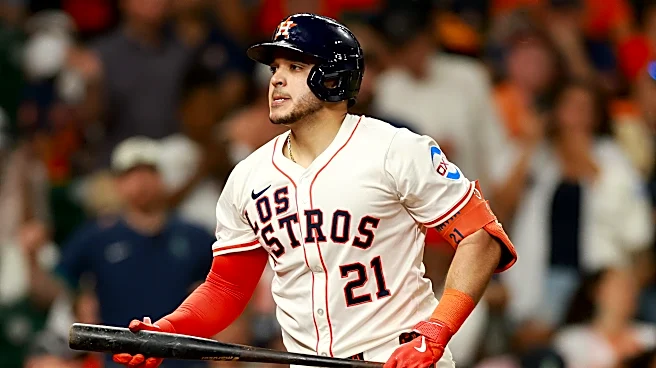



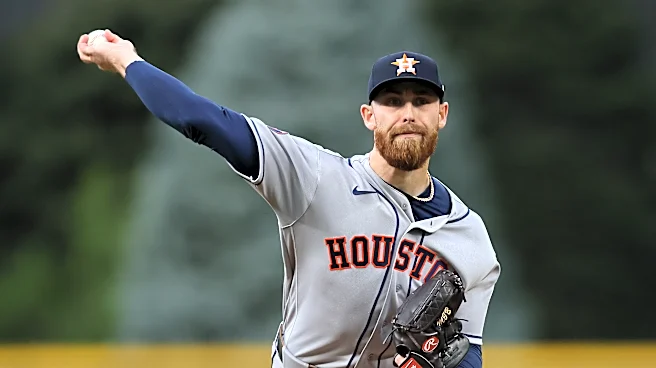



As the Astros approach the all-star break, there are a few positions that are potentially intriguing and could spell the difference between sneaking into the playoffs and falling short. Catching is one of those positions. There can be no doubt that Yainer Diaz has disappointed up to this point, but could a hot second half make a bigger difference? Plus, there is a significant difference between league wide expectations and positional expectations.
One of the more fascinating debates in baseball is
the notion of how one chooses the MVP. Last season, there was a significant debate between Cal Raleigh and Aaron Judge. By most conventional and sabermetric yardsticks, Judge was the better player and deserving of the award. However, even if jettison WAR and other similar indicators, there is a compelling argument that Raleigh was extremely productive at a position where it is rare to get that kind of production.
My favorite stat when it comes to production is bases per out. Simply put, the out is the blood currency of the sport. Each team gets 27 of them and the goal is cause as much damage as you can for every out you generate. This is why sacrificing has gone by the wayside. It is one thing to look at league averages and those can be very instructive, but league averages don’t tell the whole story.
When I compare players for the Hall of Fame, I always look at only the position. It makes no sense to compare a catcher with a first baseman. The demands of the position are different and the comparative performances are different. I ran through the semi-regular to regular catchers in the American League. In order to qualify you had to have at least 120 outs. That usually corresponds to about 200 plate appearances. Comparing the likes of Yainer Diaz and Christian Vazquez to the league average is depressing.
The major league average bases per out sits at .676 through the last weekend. A few days of numbers aren;t going to change that much once you are 90 games into the season. We can look at both catchers and come away underwhelmed when looking at the big league average. Of course, the same would be true for most of the AL catchers. Below is a table of the catchers in the AL minus Diaz and Vazquez. What we are essentially looking for is a positional mean and median.
This is a reminder that bases per out is calculated by adding total bases, walks, stolen bases, and hit by pitches and dividing it into total outs. I love this stat because it encompasses everything a player does offensively into one number. It is more accurate than OPS and actually tracks pretty well with rOBA and wOBA. Below is a look at the AL catching universe through the weekend.
Remember, we are looking at regular catchers in the American League minus Diaz and Vazquez. We do that to give us an idea of what the competitors are doing and to look at something to shoot for. If you are adept at math, you will notice that the median row does not add up. Somehow, the components of bases per out do not equal what the players are actually doing. The mathematical median of the row would actually equal .5548 or .555 rounded to the thousands place.
What does this mean effectively? In short, there are five really good offensive catchers that are driving the numerical average up. If you are looking for the actual 8th or 9th best catcher here (there are 16 in the table) then you would get your .526 mark. What that means is that asking a catcher to be overall league average is a hard ask. Victor Caratini is the sixth best offensive catcher in the AL and he doesn’t come particularly close to the overall major league average. So, when we look at the numbers for Diaz and Vazquez below (through Wednesday’s game) we need to look at their numbers through that context.
Diaz is a statistical enigma wrapped in a riddle. Conventional wisdom and simple mathematics would tell us these numbers are simply not good. They are not good compared to MLB norms and they are not good for him historically. However, recent play and the table above tells us something different. Officially, he is right in line with the median catchers in the American League. Obviously, that would look different in a MLB universe and all numbers have their caveats and exceptions. We could look at his total career numbers and look at what expectations he had coming into the season.
The 64,000 dollar question is whether Diaz can ever be this catcher again. My guess is no. The 2023 power numbers are driving this up and he hasn’t been THAT Diaz since. He would obviously need to become THAT Diaz again for his 2026 numbers to approach his career average. The more logical question is whether he could a .600 guy from this day forward. That seems like a doable thing and it could be a huge key at the bottom of the order.
Keep in mind that the Astros wouldn’t be asking Diaz to be an average big league hitter. They would be asking him to be an average offensive catcher. Those are two entirely different things. There are inevitable questions about whether he is a long-term solution at the position. Given his defensive struggles and the inability to draw walks the answer is likely no. Yet, when you are looking for players that haven’t performed well that could in the second half, he is at the top of the list.
The next logical question is how the time share between Diaz and Vazquez should work. Offensive production is only part of the equation. Diaz currently sits at -6 defensive runs saved and -5 in fielding run value. Vazquez sits at +5 defensive runs saved and +2 fielding run value. So, they are separated by approximately one win with the glove. We could also break down catcher ERA and reach the same conclusion. Without getting into commentary on the manager, this decision will be one of the keys after the all-star break.