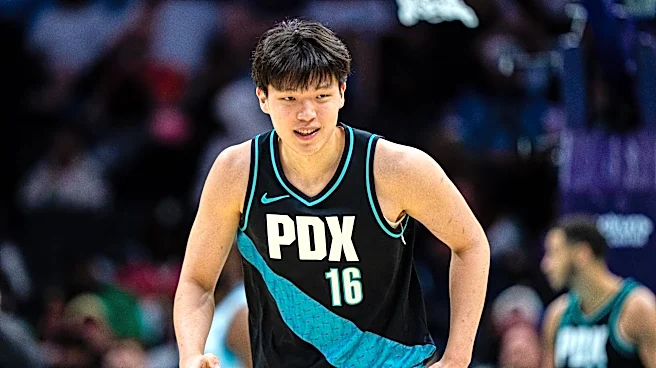





Over the last few weeks we’ve been recapping the 2025-26 season for each member of the Portland Trail Blazers roster. Some Blazers had excellent years, others struggled. Now we arrive at the player who makes Portland fans scratch their heads and say, “What, exactly, is going on here?” That would be rookie center Yang Hansen, selected 16th overall in the 2025 NBA Draft.
Portland traded 11th pick Cedric Coward to the Memphis Grizzlies for Hansen on draft night, also receiving a first-round pick in 2028
originally belonging to the Orlando Magic. Coward averaged 13.6 points, 5.9 rebounds, and 2.8 assists while making semi-frequent defensive highlight plays for the Grizzlies last year. Hansen…didn’t. That 2028 pick is doing a lot of heavy lifting in the equation so far.
Let’s take a look at Hansen’s year to see why.
Season Stats
Here are Hansen’s basic stats:

OTHER STATS
Hansen is 7’1, weighs 270 lbs, and played this season as a 20-year-old. Those are the most significant numbers in his portfolio right now. He’s big, he’s young, and there’s time for his game to develop. We all knew these stats before the season started, though. That they remain central and indicate zero change shows how Hansen’s rookie campaign went.
Hansen played in a respectable 43 games for the Blazers. His low minute average (7.0) was indicative of his contributions.
Hansen’s calling card coming into the league was his ability to see the floor and pass the ball. His assist-to-turnover ratio this year was 0.71, indicating more turnovers than assists. That’s not good. (He also had more turnovers than made field goals, 32-31. That’s really not good.)
As you might guess from the offensive numbers above, Hansen’s True Shooting Percentage was abysmal: 41.3%. That ranked him 556th out of 582 players who saw action in the NBA this season. For comparison, the next center above Hansen on the list who played a comparable number of games was Houston’s Steven Adams. He registered a True Shooting Percentage of 53.5%. A couple of 6’8 power forward-centers stood between them, but nobody close to 7-feet.
Hansen’s block percentage was 3.0%, a small number for a player his size. Both Robert Williams III and fairly-muted rookie Khaman Maluach of the Phoenix Suns got 7.7%.
Hansen’s rebounding percentage sat at 11.9% for the season. That’s an estimate of the percentage of total available rebounds a player secured while on the floor. A player pulling 1/5 of the rebounds (because he’s 1 of 5 warm bodies suited up on the court) would come in at 20%.
There are other details, but we’ll finish with this one. Hansen’s plus-minus per 100 possessions for the season was -16.5. Translation: on average, for every 100 possessions he played, Portland would lose ground to the opponent by 16.5 points. Hansen ranked 540th in the league in this category. Only four players with as many or more appearances finished worse: Spurs center Kelly Olynyk, Spurs guard Jordan McLaughlin, Hornets guard Tre Mann, and Thunder guard Brooks Barnhizer.
Analysis
This was not an auspicious start for Hansen. Portland’s coaches protected their rookie, inserting him against third-string lineups in late-game situations. He still didn’t measure up. At all. Occasionally his passing ability shone through. That didn’t change the reality that he was not ready for the NBA.
Predictably, and understandably, it took Hansen a while to adjust to the style and pace of his new league. As he began to read the court better, his positioning improved. That helped cut down the thinking and movement necessary to take part in plays. He looked better at the end of the year than he did at the beginning in that sense.
Throughout, Hansen was hampered by three factors:
- Even when left wide open, he could not hit a shot. Making 11.9% of his attempts from the three-point arc won’t wash, especially since Hansen isn’t a dominant interior force. Sidy Cissoko hit 29.8%, huge center Donovan Clingan 34.1%. Opponents didn’t respect those two at the arc much. They’re fearing Hansen’s offense like a battleship fears an inebriated hamster.
- Every time Hansen brought the ball below his shoulders, the possession became an adventure. If he didn’t get stripped, he got stalled. If he didn’t get stalled, he took awkward dribbles away from his body that gained no ground and all but invited the poke-away. When Hansen had a passing lane with the ball above the head or out to the side, he stood a good chance of making a play. Literally anything else evoked held breath and wincing.
- On defense, Hansen appeared to have the reaction time of your typical Zootopian DMV worker. That held true on the boards as well.
The first flaw is correctible, possibly. The second will take more time. The third is a real concern. Slow centers do not prosper in the modern NBA.
(Since I can already hear the scrambling clickety-clack of keyboard strikes from Blazers fans pointing out that Denver Nuggets center Nikola Jokic is comparatively slow and HIS career seems to be going ok, consider a couple of things. First, you’re talking about literally the best player in the universe in this era, maybe the best all-around center in any era, ever. The distance between him and Hansen right now is here to the glimmer of light from the birthing of the universe at the edge of all things. Whatever telescope you’re using to see that, I want it too. Second, even in Jokic’s “bad” rookie season he still averaged 51% from the floor and shot 33% from the arc. His per-minute numbers in points/rebounds/assists were half again greater than Hansen’s and the gap in per-possession stats was even wider. Jokic’s plus-minus per 100 possessions that year was +9.5, 26 points higher than Hansen’s. The future MVP finished third in Rookie of the Year balloting that season. Hansen would finish a distant second on his own team.)
The best way to describe this year for Hansen is, “Ok, that’s done. Now let’s try it again, this time for real.” From skills to production to minutes played, no first-round pick from the 2025 Draft is more in need of a mulligan than Yang Hansen.
The Future
Given the above, it’ll be no surprise that Hansen’s future seems murky at best. His most prominent asset right now is the one we started with: he’s 20. There’s time. Then again, Kon Knueppel, VJ Edgecombe, and Carter Bryant are 20 too. Cooper Flagg, Ace Bailey, and Dylan Harper are younger.
Given their initial hopes for him, it’s unlikely the Blazers will look to trade Hansen. They’d have trouble finding a buyer who valued him much anyway. The only potential avenue is his $4.6 million contract making the difference in a larger deal. But that’s why Kris Murray exists.
Odds are the Blazers will work with Hansen over the summer, get him more reps and knowledge, then hope he adapts enough to be able to anticipate schemes and sets even more, cutting that reaction time further. That and a shot—ANY kind of shot—are just about the only goals evident for 2026-27.
NBA Summer League is only a couple months away. Maybe the hype train will start again there. At this point, any momentum will be welcome. Let’s see what happens.