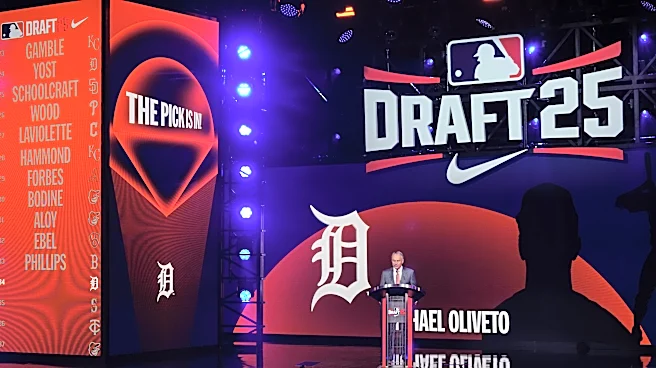



After three pretty successful drafts, the Detroit Tigers enter the 2026 edition of the amateur draft picking way down the board for the second straight year. It’s too early to go crazy over their last three first round picks, but so far Bryce Rainer, Jordan Yost, and Michael Oliveto look like one heck of a good group. That’s especially true considering that they’ve held the 11th and 24th overall picks the past two years rather than picking near the top of the draft. Oliveto was 34th overall last year as the Tigers used
their biannual competitive balance round A selection on the sweet swinging catcher from Long Island.
On the other hand, the heavy emphasis on overslot bonuses to prep pitchers has not gone well at all. Rapidly the Tigers farm system has found itself in the unfamiliar position of being stacked with position player talent, while the upper minors lack any high end pitching prospects. Most of the prep pitchers they’ve taken are still 20 years old or younger, and they certainly have talent, so things could turn drastically in the Tigers favor over the next few years on the pitching side. Still, part of the reason more conservative teams favor college pitching is because the heavily injury prone young pitchers tend to be winnowed out in college ball. We’ll have to wait and see if the high risk, high upside strategy ultimately pays off or not. What has paid off is the emphasis on taking athletic, up the middle position players with demonstrated plate discipine and contact ability, out of the prep ranks. No doub that will continue to be the foundation to their draft strategy with their top picks.
On Wednesday, MLB release the 2026 amateur draft bonus pools. The Pirates will lead the way with $19,130,700 to spend, picking fifth overall. The Chicago White Sox hold the first overall pick and the third biggest bonus pool at $17,592,100.
The top ten picks, with slot values for each pick, are listed below.
1. White Sox: $11,350,600
2. Rays: $10,507,000
3. Twins: $9,740,100
4. Giants: $8,988,400
5. Pirates: $8,336,500
6. Royals: $7,746,100
7. Orioles: $7,327,200
8. Athletics: $6,982,600
9. Braves: $6,675,300
10. Rockies: $6,393,100
The Detroit Tigers will pick 22nd overall, two slots higher than last year. However, this year their competitive balance pick will come in the B round following the normal second round of the draft. They’ll also be working with a bonus pool of just $9,165,100. Last year they had $10,990,800 to work with, mainly as a result of the higher CB round selection.
The slot values for the Tigers first three picks are as follows.
22. $4,082,700
61. $1,523,600
69. $1,254,200
In theory, the Tigers could burn all but $2,304,600 on those first three picks, leaving them with little enough to spread around on prep pitchers the way they have the past three drafts. That’s obviously not how they’ve done business to date, but this is going to be their toughest draft to date. Perhaps this is the year they actually do take a college player with their first pick on an underslot deal in order to be better able to spread money around to multiple prep players they like later on. Mixing in their usual selection of a few college pitchers and cheap, athletic speed players with some contact ability from smaller schools on minimum bonuses would allow them to round things out. John Peck, their 2023 seventh rounder, signed for $222,500, $72,500 over the minimum, as a fairly light hitting college shortstop out of Pepperdine, but has buit himself up to at least average pop to go along with good defensive ability, to cite a prime example of this type of pick.
We’ll get into the latest mock drafts from Baseball America, FanGraphs, and MLB Pipeline in the weeks ahead as the college season turns toward their own stretch drive in late April and the beginning of May.