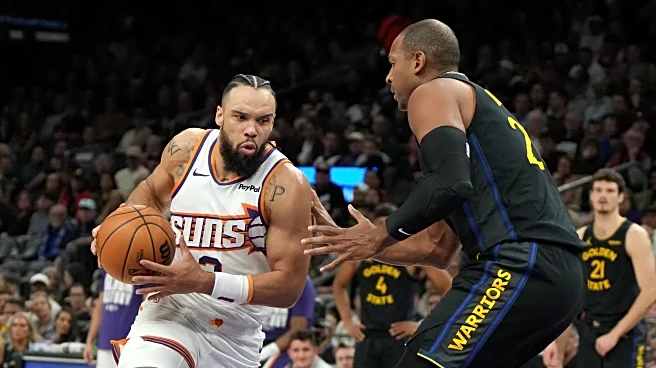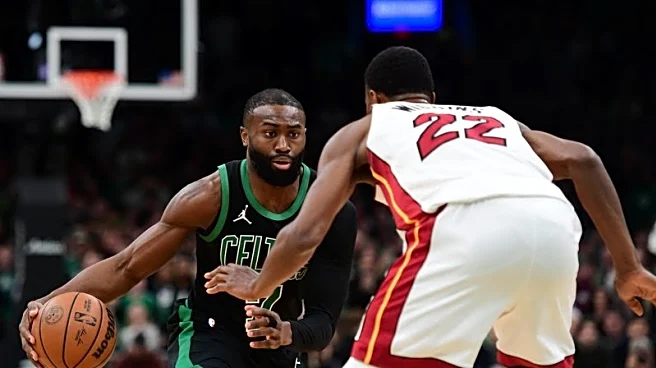

The Golden State Warriors are reeling after Jimmy Butler III suffered a season-ending injury in Monday night’s victory over the Miami Heat. Things had finally been coming together for the Dubs, who went
12-4 in the team’s last 16 games before Butler’s season was over. But where do they go from here?
If Golden State wants to try and salvage any chance at contention this season, they have to consider trading Butler prior to this year’s deadline on February 5. Sure, the Dubs could largely stand pat and fight for a play-in spot in hopes Butler returns to form next year, as GM Mike Dunleavy Jr. has suggested they’ll do. However, can they really risk that at this point in Steph Curry’s career?
The obvious name the Warriors will be tied to is Anthony Davis, who has an identical salary to Butler. However, it’s very difficult to envision a framework for a deal coming together. One could argue the Mavericks should swap Davis for Butler and a protected first-round pick, offloading Davis’ longer contract as they tank for the rest of the season, but they traded Luka Dončić for AD last season. They need a sexier return.
Dallas has been tied to Jonathan Kuminga in the past, but even if the Dubs brought back a solid role player like Naji Marshall, it’s hard to imagine them trading the three unprotected first-round picks it would probably take to get a deal across the finish line. And they would probably be right to say no.
The Brooklyn Nets and Utah Jazz are both clearly trying to tank this season with hopes of competing in 2026-27, hypothetically making Butler an appealing target for both front offices. Could Butler and the Warriors remaining picks finally bring Lauri Markkanen to the Warriors? Would the Nets trade both Michael Porter Jr. and Nic Claxton to the Warriors for a trio of first-round picks, Butler, and expiring contracts from the Lakers (with Jarred Vanderbilt heading to Golden State while Kuminga and Buddy Hield join Luka)?
The Warriors could go star hunting with Butler and/or Kuminga, looking to package picks alongside taking back long-term money. Marcus Thompson II of The Athletic suggested targeting a package of Ja Morant and Jaren Jackson Jr. It’s easy to see pairing Dejounte Murray with one or both of Zion Williamson and Trey Murphy III as another option. Would the Warriors trade three first-round picks, Butler, Kuminga, Hield, and Moses Moody for Williamson, Murray, and Murphy? Would the Pelicans consider it?
Any deals like that would likely be the final blockbuster move of the Curry era. Golden State would be tying up the team’s long-term payroll and most (if not all) of the team’s draft picks for the foreseeable future. The Warriors should definitely pursue these possibilities, but the odds of one coming available that appeals to both teams seems unlikely at the moment.
Golden State’s best available path could be using Butler and Kuminga (probably Hield as well) to acquire multiple legitimate upgrades with some flaws on sizable enough contracts that the Dubs can retain the team’s draft capital. No, the Warriors should not hoard picks for the sake of it, but if no one good enough comes available, acquiring players that can give them a fighting chance to be competitive for the rest of the season that could be movable in the offseason should be the priority.
The Portland Trail Blazers are worth keeping an eye on. They have Jerami Grant and Jrue Holiday, two veteran players who would fit on the Warriors. But they both make more than $30 million per season through the 2027-28, a year after Butler’s current deal expires, making future trades more complicated.
From a salary-matching perspective, the Warriors could trade Butler, Kuminga, and Hield to Portland for Holiday, Grant, and Robert Williams III. Golden State would be acquiring immediate help while the Blazers would clear more than $73.5 million off the team’s books in the 2027-28 season alongside added gambles on Kuminga and Butler that could have significant upside as well.
Holiday is among the best archetypes of two-way guards to pair with Curry. Williams is a solid role player center on an expiring contract. Grant is a microwave scoring big wing who could help replace some of Butler’s scoring.
The Warriors would have reason to argue that taking on Grant and Holiday’s long-term money would make the swap even without including any picks, but it’s unclear whether the Blazers are worried about that long-term money at the moment. They have never been among the teams heavily interested in Kuminga and have play-in aspirations of their own that would be severely hampered by a deal like this. It would probably take Golden State parting with at least one protected first-round pick to get this deal done.
There’s a case to be made that would be worth it, and it’s not a scenario the Warriors front office should rule out if it’s on the table, but there’s one team that simply makes far more sense.
Yes, I’m talking about the Sacramento Kings.
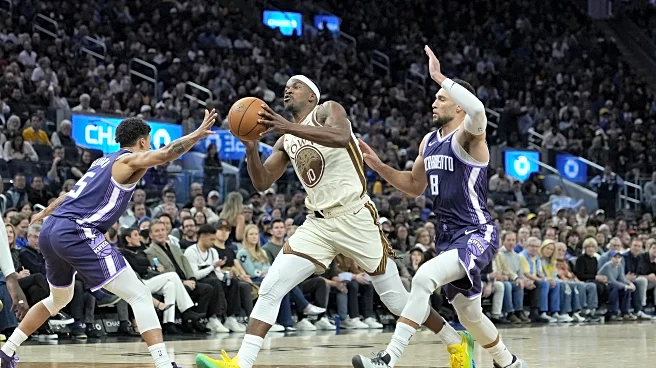
No team has more consistently pursued Kuminga than Sacramento. No team is more interested in offloading veterans in an effort to tank and open up playing time for younger players. And no other team has two solid veterans whose salaries could so seamlessly be traded for Butler and Kuminga (Zach LaVine and DeMar DeRozan).
Like Butler, LaVine’s contract runs through the 2026-27 season. While LaVine technically has a player option, it’s clear the former UCLA wing will not be pursuing free agency. DeRozan has a partially guaranteed contract next season, comparable to Kuminga’s team option.
Neither LaVine nor DeRozan are at Butler’s level as a second-option offensively, but they are clear upgrades over the Warriors previous third options. There’s a case to be made that a Warriors starting lineup of Curry, LaVine, DeRozan, Green, and Post would be more potent offensively than the team’s lineup prior to Butler’s injury.
DeRozan is averaging 19.0 points, 4.0 assists, and 3.3 rebounds per game this season on 50.8%/35.9%/87.4% shooting. His mid-range and isolation heavy approach has plenty of similarities to Butler, and it’s easy to see him slotting into a comparable role with the Warriors. LaVine, on the other hand, is capable of scoring at all three levels, averaging 19.8 points per game, and is a true knockdown three-point shooter (39.8% on 6.8 attempts per game this season).
Of course, serious questions would arise elsewhere.
Despite being a key contributor on every team he’s played on over his 12-year career, LaVine has played in just four playoff games. Defensive struggles and questions about his willingness to make winning plays have followed him for some time. In Sacramento’s losing situation, LaVine’s is posting an embarrassingly low 3.3 rebounds and 2.4 assists per 36 minutes, suggesting a lack of effort. DeRozan has similarly never been known for his defensive prowess, and is now 36 years old.
The Warriors would be banking on a couple of things if they were going to make a deep postseason run with LaVine and DeRozan. First, they’d be betting on both players stepping up in a winning environment. Curry would immediately become the best teammate either player has ever had by a significant margin.
Moreover, acquiring LaVine and DeRozan would allow head coach Steve Kerr to lessen De’Anthony Melton’s workload heading into the postseason and alleviate significant pressure on Brandin Podziemski and Moody to score. With Curry, LaVine, and DeRozan handling the lion’s share of offensive responsibility, Kerr would be able to challenge players like Draymond Green, Podziemski, Melton, Moody, Al Horford, Will Richard, and Gary Payton II to pick up the slack on the other end.
In an effort to create a roster spot for Pat Spencer, the Warriors would also likely hope to work a Buddy Hield for Dario Šarić swap into the trade. Golden State could give Šarić a brief audition, but he would more likely be waived. Swapping Hield for Šarić would save the Warriors $4 million in payroll this season and $3 million next year. Sacramento would likely try to buy Hield out if they could not swap him to a contender trying to add some wing shooting depth.
For Sacramento, LaVine and DeRozan have been on the trade block since Scott Perry was hired as the team’s general manager. DeRozan may be able to net a second-round pick or two at this year’s deadline, but LaVine’s deal has long been considered among the least team friendly in the league. Perhaps just as importantly, they are both blocking young wings like Keon Ellis and 2025 first-round pick Nique Clifford.
Perry has been pursuing Kuminga since last summer. Kuminga’s youth, upside, and team-friendly contract would be an excellent addition for Sacramento, particularly in a scenario where they are not forced to give up any valuable pieces.
Similarly, Butler’s injury actually aligns with the Kings current goals. The Kings currently have the fourth-worst record in the league, and clearly are hoping to get the best draft lottery odds possible in the stacked 2026 NBA Draft. They would be in a perfect position to let Butler rehab for the rest of the season and head into next season with him on an expiring contract.
A highly-motivated Butler could be a legitimate impact player in Sacramento next season and expedite the team’s rebuild, but could also simply rebuild enough value to be traded for more prospects and picks next season. If he fails to regain his form, then his deal will expire and leave the Kings in the same salary cap position following the 2026-27 season they will be in if they retain LaVine.
If the two sides broadly agreed that a Butler, Kuminga, and Hield for LaVine, DeRozan, and Šarić framework made sense, the conversation would move to draft picks. I imagine Perry and Warriors general manager Mike Dunleavy Jr.’s conversations would go something like this:
Perry: DeRozan and Šarić are an even swap for Kuminga and Hield, but I need at least one first-round pick to take Butler back for LaVine. There isn’t another team out there willing to give you a legitimate rotation piece for Butler without forcing a longer contract onto your books.
Dunleavy: We know you don’t want LaVine. You’re trying to tank this season anyway so replacing him with Butler makes it easier for you to secure a top pick and play young players. Both LaVine and Butler become expiring deals this offseason and Jimmy has an easier chance to recouping value down the line because he has actually been playing at an elite level when he plays. He’s going to be coming off an injury in a contract year. He’ll never be more motivated. It’s an even trade as is and YOU get all the upside. No one believes LaVine and DeRozan are ever going to be All-Star caliber players again while Kuminga has that upside and Butler was just playing at that level.
I could see a deal landing on either end, either including no draft picks at all, or Golden State parting with a protected future first, probably lottery protected in 2026. The Warriors do have one remaining tradeable second-round pick, and at the moment, I’d lean toward that pick alongside a future first-round pick swap emerging as the meeting point.
If they agreed on that, the Kings would then come away with some draft pick compensation alongside Kuminga and a flier on Butler post-ACL rehab while offloading three veterans who are clearly not in the front office’s long-term plans. Golden State, on the other hand, would turn three players currently outside of the rotation into two legitimate starters and some payroll relief while retaining the ability to trade three first-round picks in another deal down the line.
Trade prediction:
Warriors get: Zach LaVine, DeMar DeRozan, Dario Šarić
Kings get: Jimmy Butler III, Jonathan Kuminga, Buddy Hield, right to swap 2029 SAC 1st with 2029 GS 1st, 2030 GS 2nd
Would this make the Warriors clear Western Conference contenders? No. But that ship likely sailed with Butler’s season-ending injury. The question is can Golden State find a trade that gives them a fighting chance this year without sacrificing the team’s ability to build a contender around Curry next season and possibly the year after. This type of trade with the Kings would do exactly that.