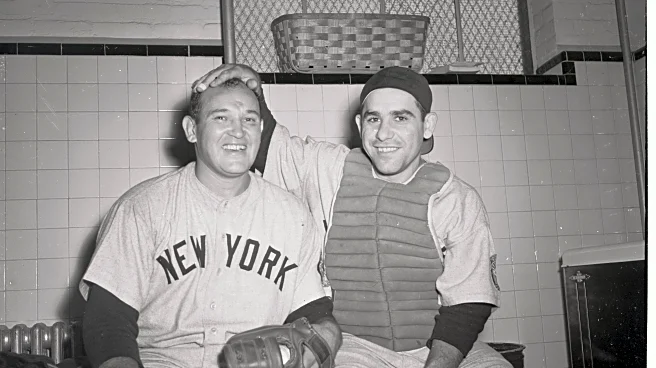




Allie Reynolds’ parents decided that he wouldn’t play organized baseball until after he left high school. Despite the late start to the game he wound up loving, he was good enough to make it to the big leagues with the Cleveland, and to pique the Yankees’ interest, as they sent Joe Gordon out to Ohio to acquire him in late 1946.
Cleveland needed an infielder, and the Yankees could definitely use a talented pitcher. Those circumstances resulted in an eight-year stint in the Bronx for Reynolds, who
was equally good starting a game or entering as a reliever.
Allie Pierce Reynolds
Born: February 10, 1917 (Bethany, OK)
Died: December 26, 1994 (Oklahoma City, OK)
Yankees Tenure: 1947-54
Reynolds was born in Bethany, Oklahoma, on February 10, 1917. He was 3/16-ths Creek Indian and, according to the Society of American Baseball Research (SABR), his parents lived by the Nazarene doctrine, staying away from movies and dances. Young Allie wasn’t allowed to play sports on Sundays.
His athletic ability eventually stood out, though, and he was very good at multiple disciplines, most notably baseball, softball, track, and football. He might have had a future in the latter, but coaches believed his build was too light.
Reynolds married his high school sweetheart, Dale Earlene Jones, in 1935, long before becoming a major leaguer. Oklahoma A&M gave Reynolds a track scholarship, and he shone there in the 100-yard dash, the 220-yard dash, and javelin throw while also playing football.
In 1937, he was spotted by Oklahoma A&M’s athletic director and baseball coach Henry Iba. Initially, he was asked to throw batting practice to the team, and after impressing everybody there, he joined the squad. In 1939, Cleveland signed Reynolds and gave him a $1,000 bonus. He encountered some control issues in Class-C, but it was all a learning experience for the young righty, who was 22 at the time.
He stayed in the minors until 1942 and made his debut in September as a reliever.
Despite some strong seasons in Cleveland — even making the All-Star team in 1945 — he couldn’t make the World Series there. His career took a turn for the better when he joined the Bombers, though, finishing 15th in the MVP race in 1947 with a 19-8 record and a 3.20 ERA.
That year, Reynolds won his first of six World Series titles, in addition to the ones he got in 1949, 1950, 1951, 1952, and 1953. He was stellar in the Fall Classic, compiling a 7-2 record and a 2.79 ERA in 15 appearances and 77.1 innings.

The 1951 campaign would be one of the best in Reynolds’ career. He won the 1951 Hickok Belt award as the top professional athlete in America, was third in the AL MVP race, won 17 games, threw two-hitters, and put up a 3.05 ERA. As hard to believe as it might sound, 1952 was even better. Reynolds won 20 games, had a 2.06 ERA (best in the AL), and also led the junior circuit with 160 punchouts. He was second in the race for the MVP Award.
Reynolds retired in 1954, the first year in which he didn’t win the Fall Classic since 1948. He went out in style, posting a 3.32 ERA in 157.1 frames, starting 18 games and entering as a reliever in another 18.
Reynolds was a member of some really strong Yankees rotations in the late ’40s and early ’50s, joined by the likes of Vic Raschi and Eddie Lopat. He managed to stand out, mainly because of his heart, ability and willingness to pitch hurt, and clutch pitching performances when it mattered most.
When all was said and done, he retired with six All-Star Games, six World Series rings, an ERA title, two strikeout crowns, two no-hitters (in the same season, tying a record), and a plaque at Monument Park. After his retirement, he was the president of the minor league American Association and a key cog in the organization of the Red Earth Native American cultural festival. He has a stadium named in his honor at Oklahoma State University.
Among the finest pitchers not to be inducted into the Baseball Hall of Fame, Reynolds is a true Yankees icon and one of their most important pitchers in a very productive stint in team history. Reynolds actually came very close to immortality when he fell just one vote short in the 2009 HoF cycle, when the man who was traded for him (Gordon) got in instead. Reynolds received eight votes in the Classic Baseball ERA balloting and needed nine or more. He got another shot on the 2022 ballot, falling six votes short in that crowded mix as well.
Some believe the right-hander was a borderline Hall of Famer, but even if Reynolds’ 182 career wins and 3.30 ERA are impressive, he fell a bit short of most standards considering the workloads of other arms in his era. Still, his place in Yankees’ history is undeniable.
See more of the “Yankees Birthday of the Day” series here.