
Are all losses considered equal? Of course not. A home loss to an unranked team carries more weight than a road loss against a top-10 opponent, not to mention the impact of Quadrant 1 versus Quadrant 4 defeats on tournament resumes. But here’s a deeper question: are losses treated differently based on the school’s conference affiliation and preseason ranking? For those who’ve followed my previous pieces, my skepticism toward preseason polls should come as no surprise. This week on Stats Corner, we are solely
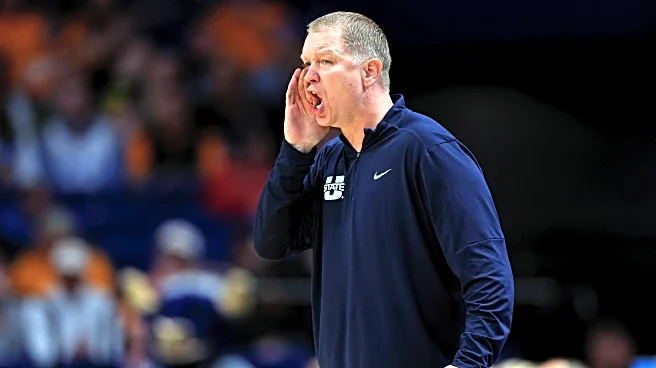
examining losses by ranked teams against unranked opponents to determine whether some programs face harsher penalties than others. And while this has been a topic I have toyed with in the past, yes, this analysis was prompted by Utah State’s loss to Grand Canyon, which sent the Aggies plummeting out of the top 25. The Data: Ranked Teams Losing to Unranked Opponents This season, there have been 28 instances where an AP Top 25 team fell to an unranked opponent. Here’s how the polls responded: Teams That Remained Ranked After Losses (19 cases) In 19 of those 28 matchups, the defeated team dropped in the rankings but stayed inside the Top 25: Week Team (Rank) Opponent Rank Drop 3 UCLA (12) Cal 4 spots 5 Florida (3) TCU 5 spots 6 Tennessee(18) Kansas, Syracuse 7 spots 7 Florida (3) Missouri 5 spots 9 Kansas (19) UCF 5 spots 10 UNC (25) SMU 5 spots 10 Louisville (11) Stanford 4 spots 10 Kansas (19) West Virginia 5 spots 11 Michigan (7) Wisconsin 2 spots 11 Arkansas (14) Auburn 2 spots 11 Alabama (15) Texas 5 spots 11 Georgia Ole Miss 3 spots 11 Tennessee(18) Florida 3 spots 12 Iowa State(16) Kansas, Cincinnati 7 spots 12 Vanderbilt Texas 5 spots 12 UNC (25) Stanford, Cal 8 spots Teams That Dropped Out of the Top 25 (9 cases) Nine ranked teams suffered losses that sent them out of the rankings entirely: Week Team (Rank) Opponent 5 UCLA (12) Cal 6 Indiana Kentucky 6 USC Washington 8 St. John’s Kentucky 11 SMU Clemson 11 UCF Oklahoma State 12 Utah State Grand Canyon 12 Tennessee(18) Kentucky 12 Seton Hall Butler
The Patterns: What the Numbers Reveal
Preseason Ranking Bias
The most striking divide is preseason status:
• Among teams that stayed ranked after a loss: 17 of 19 (89.4%) were ranked in the preseason Top 25
• Among teams that fell out of the rankings: Only 2 of 9 (22.2%) were preseason ranked teams
The two preseason-ranked teams that dropped out were #12 UCLA and #17 Tennessee.
Bottom line: If you entered the season ranked and lose to an unranked opponent, there’s an 88.2% chance you’ll remain ranked. If you weren’t preseason ranked? Only a 28.6% chance of staying in the Top 25.
Conference Affiliation Matters
Of the 19 teams that stayed ranked after losses, all 19 were from Power 4 (P4) conferences, and their opponents were also P4 schools.
Conversely, of the 9 teams knocked out of the rankings, 3 were from non-P4 conferences—and in all 3 cases, they were eliminated from the Top 25.
The Combined Effect
Here’s where the bias becomes undeniable:
• Ranked P4 team loses to unranked P4 team: 79.2% chance of staying ranked
• Non-P4 team loses to unranked P4 team: 0% chance of staying ranked
• Loss to any P4 opponent: 73.1% chance of staying ranked
• Loss to a non-P4 opponent: 100% chance of dropping out
The Takeaway
The data suggests a clear double standard in AP Poll voting. Preseason-ranked P4 programs receive a safety net that non-P4 teams and unranked programs simply don’t have. A bad week for the SEC might cost you a few spots (Tennessee (week 6) and Iowa State (week 12) losing two games one to unranked teams, but only dropping 7 spots each). A bad game for a Mountain West team? It could cost you your ranking entirely.
Is it intentional bias? Perhaps not, but it’s a pattern worth examining as Utah State, Seton Hall, St. John’s and similar programs continue to fight for respect on the national stage.
Conclusion and Analysis: The System Protects Its Own
The data doesn’t just suggest bias, it confirms it (some reading this will say “he just proved water is wet”, but you always need data to prove something). When you strip away the rhetoric about “body of work” and “resume building,” a stark reality emerges: college basketball polls operate on a two-tiered system where preseason pedigree and conference affiliation function as insurance policies against bad losses.
The 89.4% to 22.2% split in favor of preseason-ranked teams staying ranked is perhaps the most critical statistic of the entire analysis. It reveals that voters fundamentally struggle to reconcile their initial assessments with on-court reality. A preseason Top 25 team essentially carries a nine-game grace period—after all, 19 losses across the season still don’t justify removing a program that the voters “know” belongs. But for a team that fought its way into the rankings from the outside? One misstep, and you’re banished to the “others receiving votes” purgatory.
This creates a self-fulfilling prophecy that advantages the same programs year after year. Consider the mathematical reality: if you enter the season ranked, you can lose multiple times to unranked opponents and survive. If you don’t, you essentially have to be perfect. This structural disadvantage makes it exponentially harder for mid-major programs to crack, and stay in, the rankings. Utah State’s treatment against Grand Canyon wasn’t an outlier; it was the enforcement of a system designed to keep outsiders on the periphery.
The conference bias compounds this problem exponentially. The 0% survival rate for non-P4 teams losing to unranked P4 opponents tells you everything you need to know about how voters perceive strength of schedule. When a Big Ten team loses to an unranked SEC opponent, voters view it as an “acceptable” defeat between equals. When a Mountain West team does the same, it’s treated as a revelation that the team didn’t belong in the first place. This double-standard ensures that power conference teams control their own destiny in the polls, while mid-majors are at the mercy of voter perception, and their perception is consistently biased toward the power structure.
What’s particularly frustrating is that this bias operates independently of actual team quality. The numbers show that a non-P4 team losing to an unranked opponent, regardless of that opponent’s conference, is 100% likely to drop out of the Top 25. No matter how impressive the rest of their resume, no matter what metrics or NET rankings say, the voters default to removing the “anomaly” from the rankings. This isn’t about evaluating teams; it’s about maintaining the hierarchy.
The practical impact extends beyond the subjective matter of rankings. These polls influence NCAA tournament seeding, television exposure, recruiting narratives, and national perception. When the system systematically undervalues mid-major programs, it affects everything from where teams play in March to which high school prospects they can recruit. A player at Grand Canyon who beats Utah State should be able to celebrate the impact that victory will have on his team’s national standing. Instead, because of poll bias, that victory was effectively dismissed as a fluke rather than respected as a legitimate upset.
The irony is that college basketball has the most egalitarian postseason in major sports. The 68-team tournament gives mid-majors a chance to prove the polls wrong on the court every March. Yet the very system meant to measure regular-season achievement actively works to undermine those programs before they ever reach that stage.
Voters need to fundamentally reset how they evaluate mid-major programs. A loss shouldn’t be penalized more severely because a jersey doesn’t say “Duke,” “Kansas,” or “North Carolina” on it.
Utah State’s treatment this week wasn’t an isolated incident. It was the inevitable result of a system rigged to favor haves over have-nots. Until the voters are willing to confront their own biases, and the preseason polls that enable them, college basketball rankings will remain less about who deserves recognition and more about protecting the programs that have always had it.