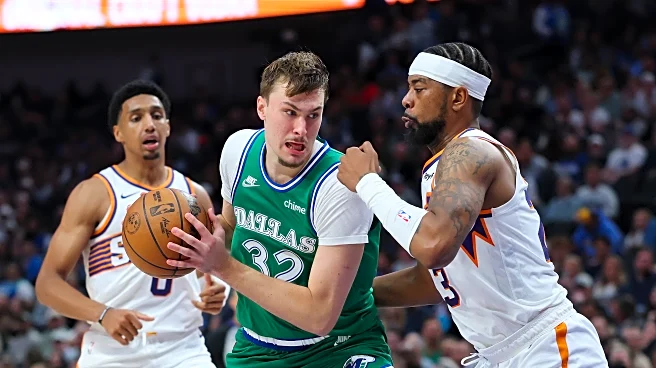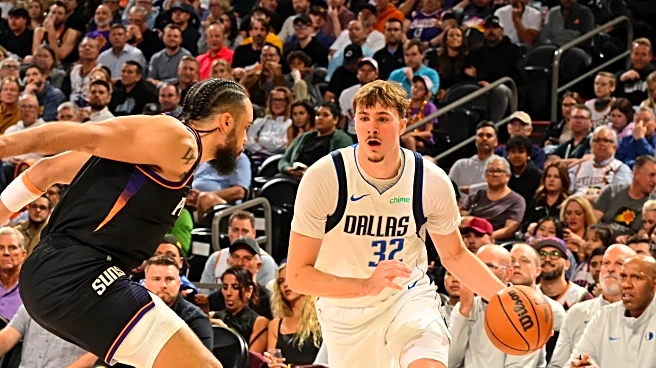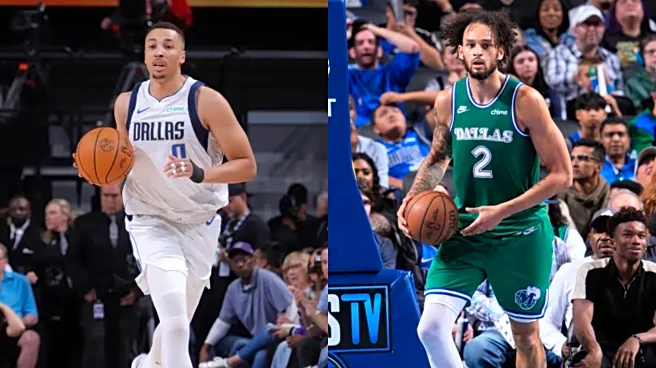


The Dallas Mavericks have reportedly been granted Disabled Player Exceptions for Dante Exum and Dereck Lively II. The team reportedly applied for this salary cap relief on Dec. 29, as the wheels start turning for all 30 NBA teams with the league’s Feb. 5 trade deadline approaching.
NBA insider Jake Fischer was first to report that the league had granted the Mavericks the exceptions. Lively’s season was cut short due to accumulating complications stemming from a right foot injury, after he played in just
seven games for the Mavericks this year. His season-ending surgery was announced on Dec. 10.
That’s seven games more than Exum suited up for this year, as his own season-ending surgery (on his right knee) was announced on Nov. 20. Exum started the season on the Mavericks’ injury report and was never able to log a single minute in the only season on his current $3.3-million contract. Remember, in order to sign Exum to that deal, which carries a salary cap hit of $2.2 million, former general manager Nico Harrison had to waive and stretch the contract for former Mavericks forward Olivier Maxence-Prosper, who will remain on the books for two more years after this season.
The Disabled Player Exceptions create salary cap room, not roster spots, for the Mavericks to operate under. The team is hard-capped right under the dreaded second apron in the NBA’s current salary cap system. Lively’s exception is worth roughly $2.6 million, and Exum’s is worth roughly $1.1 million. The actual wording of the DPE says that the team can sign a player to replace the disabled player (assuming there is already a roster spot available for the incoming player) for the lesser of half the taxpayer mid-level exception or the remainder of the disabled player’s pay this year. Since both Lively and Exum’s pay falls far below the roughly $12-million TPMLE, we’re using the remainder of their 2025-26 salary as the figure in this case.
This means that, if Dallas had one open roster spot, they could fill it using the Exum exception with a player making $1.1 million or less the rest of the season, provided his contract ended this year, either coming back in a trade or signed as a free agent. They could also choose to bring on a player whose expiring contract is worth up to $2.6 million with the Lively exception — but again, that assumes that the Mavericks had any open roster spots available. They do not.
It’s also important to note that the exceptions do not allow the team receiving them to go over the second salary cap apron. The Mavericks are currently just a little over a $1 million under that number as it stands. So, even by using the Lively exception, the team would only be able to use exactly as much of it as the room as they have under the second apron, or else be subjected to all the roster-building constraints that come from exceeding the apron.
In order to take advantage of this salary cap relief, someone would have to be waived. The most likely candidate, of course, is Exum. If the Mavericks want to take advantage of the combined $3.7 million of the salary cap relief provided by the two exceptions, two players would need to be waived. Lively simply isn’t a candidate to be waived at this point, but theoretically, the Mavs could open up two roster spots to be able to use both exceptions if they waive Exum and another player.
The limited bit of wiggle room these exceptions create is also not likely to be used to replace Exum by converting two-way rookie point guard Ryan Nembhard to a standard contract, as the team would likely want to sign Nembhard to a deal longer than just for the rest of this season. Remember, whoever fills the salary space created using one or the other DPE must come off the books after this year.
But let’s think about this in terms of deals to be made at the NBA Trade Deadline. If the Mavericks do indeed waive Exum, that creates one roster spot available to absorb an incoming player in such a trade. If the Mavs decide to use the Lively DPE, they would be able to accept one more incoming player than they send out in that deal and would be able to accept a little over $1 million more in incoming than outgoing salaries in that deal. Being hard-capped at the second apron is really holding the Mavericks back here.
Simply put: the relief the Mavericks get from these two DPEs … it’s not a ton of relief, but it could help Dallas get a deal done at the trade deadline. If either or both of the exceptions are to be used, that must happen before March 10, which falls in line with the Feb. 5 deadline to get deals done.