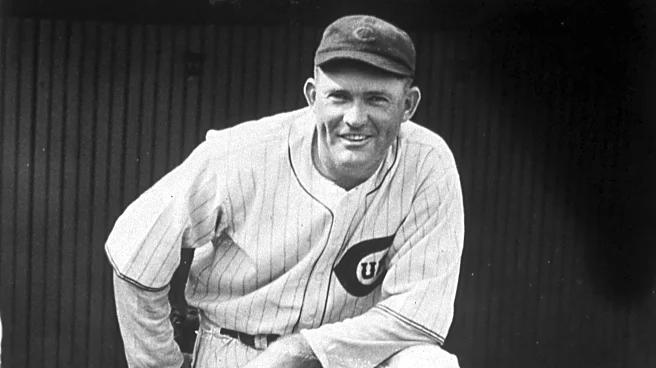


Rogers Hornsby was one of the greatest MLB players ever. Of this, there is no doubt nor question.
Rogers Hornsby was also one of the most disliked MLB players and managers ever — and there’s little doubt of that, too.
Hornsby played 12 outstanding years for the Cardinals from 1915-26 and won the NL MVP award in 1925. He’d have won more of those if the award had existed prior to that, and the 1925 award was pre-BBWAA. He had five seasons of 10 or more bWAR in St. Louis and his 12.1 bWAR season in 1924,
in which he batted .424/.507/.696, is one of the greatest MLB seasons ever.
He was also the Cardinals’ manager in 1925 and 1926, and per his SABR biography he received “very high praise” for his managing abilities.
Nevertheless, he wanted to renegotiate his contract, which had a year remaining, and Cardinals owner Sam Breadon got so frustrated with Hornsby that he traded him to the Giants. Hornsby lasted only one year there before being sent to the Braves and then, before the 1929 season, was traded to the Cubs for Bruce Cunningham, Percy Jones, Lou Legett, Freddie Maguire, Socks Seibold and $200,000. That was a tremendous sum of money in those days, roughly equivalent to $4 million today. The deal was made largely because the Braves were in financial trouble and needed the money badly.
Hornsby immediately paid dividends on the field. You’ve probably heard a lot about his 1929 MVP season in comparison to Pete Crow-Armstrong’s great 2026 season, and in 1929 Hornsby batted .380/.459/.679 with 39 home runs, a league-leading 156 runs and 409 total bases, which to this day ranks fourth in Cubs history.
That’s when things began to turn sour for Hornsby. He had a broken ankle in 1930 which limited him to just 42 games. The injury was one of the biggest reasons the Cubs didn’t repeat as NL champions in 1930, finishing just two games out of first place.
And then Cubs owner William Wrigley made a decision that was franchise-altering. From the SABR bio:
Cubs owner William Wrigley had become disenchanted with Joe McCarthy and announced with four games left in the season that Hornsby would take over as player-manager for 1931. Although there were rumors that Hornsby had undermined McCarthy and actively sought his job, the Rajah denied it, saying the two had parted as friends. Others, like teammates Gabby Hartnett and Charlie Grimm, were not convinced. Cubs president William Veeck, Sr. was so upset at Hornsby’s hiring that he resigned, only to come back when Wrigley promised he would never interfere again.
Veeck put up with what has been characterized as Hornsby’s “reign of terror” for about a season and a half before firing him on August 2, 1932. In the interim Hornsby had gotten cross-ways with just about everyone on the team, including stars like Gabby Hartnett, Hack Wilson, Kiki Cuyler, and Billy Herman. Hornsby was so disliked that when a firecracker in the stands went off during a lull in a game, Woody English, who actually liked the Rajah, remembered thinking that somebody must have just shot Hornsby.
Hornsby wound up as a manager again, with the St. Louis Browns, from 1933-37, but the Browns, bereft of talent, didn’t come close to first place. After that he managed in the minor leagues for a time, with the Browns again in 1952 and then the Reds later in 1952 and 1953.
He had also tried broadcasting briefly, announcing some Cubs games on TV in 1949. No video survives, but contemporary accounts weren’t kind to Hornsby as a broadcaster. Later in the 1950s, he served as a spring training instructor at Cubs camp in Mesa, Arizona. One day he was critiquing a group of Cubs prospects and had something negative to say about all of them, except for two, who he looked at and said, “You could play in the major leagues right now, and so could you,” pointing to the rookies. Those men were Ron Santo and Billy Williams — so Hornsby still did have a good hitters’ eye.
This paragraph from the SABR bio sums up Hornsby’s life and baseball career pretty well:
Like all men with superior athletic ability of one kind or another, Hornsby was far from perfect. He mostly made a mess of his personal life and his blunt, opinionated, outspoken, speak-your-mind-at-any-time approach to life kept him in turmoil and cost him any number of jobs. He was, not surprisingly given his Texas upbringing at the time, bigoted and anti-Semitic, although he had a number of Jewish friends. Although he always claimed that he was hurting no one but himself, his betting on the horses got him cross-ways with Commissioner Landis, who may have blackballed Hornsby for a number of years.
Hornsby died in Chicago of a stroke on January 5, 1963, aged 66. You are also probably familiar with his famous saying about baseball: “People ask me what I do in the winter when there’s no baseball. I stare out the window and wait for spring.”
Hornsby posted 16.1 bWAR with the Cubs. His career total of 127.4 bWAR ranks 12th all-time.