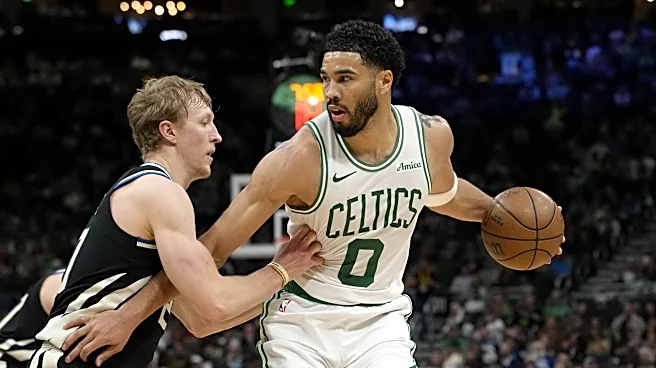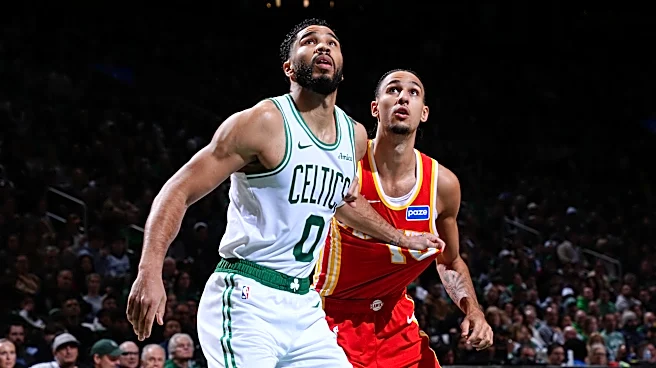

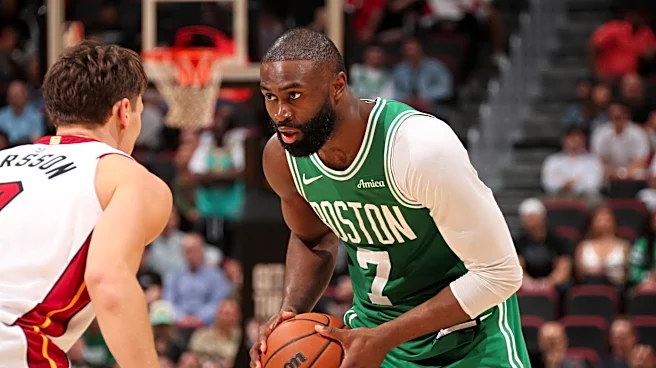
From the moment Tatum hit the court in his first game almost a month ago, one thing has stuck out to me: the guy has come back to the game with a nose for the ball that is truly remarkable.
It’s like we’ve got a Steve Austin Six Million Dollar Man thing going on here, because Tatum has, from the get-go, displayed a knack for grabbing rebounds that is truly remarkable, given his career numbers.
In 13 games, Tatum is averaging 9.9 rebounds, which is enough to lead the team by almost a full board (Neemias
Queta is second at 9 rebounds per game over the same time period).
What’s more impressive about that stat is that it’s significantly higher than his numbers from last season. Tatum’s shooting is down meaningfully from last season, as is his assist total (eFG% is down from .537 to .494, assists are 5.1, down from 6.0), but his rebounding has gone from 8.7 to 9.9 rips per game, with all of that increase coming on the defensive glass.
With a little bit of luck, Tatum could end the season averaging a double-double, something that he’s never done in his career.
Importantly, Tatum’s rebounds aren’t coming strictly at the expense of other players on the team.
Looking at advanced stats split before and after Tatum’s return, the Celtics have been rebounding the other team’s misses at a 75.4% clip since March 6th. Prior to that, the team’s defensive rebounding rate was just 70.4%. Defensive rebounds are up by more than 3 per game in real numbers.
Given that the Celtics score 119.4 points per 100 possessions, those extra three rebounds amount to an extra 3.6 points per game, and are partially responsible for a better than one point per 100 possession drop in opponent production against Boston.
Not surprisingly, Boston’s net rating per game has gone from +7.3 before Tatum’s return to +8.5 since, with no meaningful change in field goal percentage to indicate better offensive efficiency on that side of the ball.
Tatum is still very much a work in progress on the offensive side of the court, but he seems to be content to work into the flow of the game at that end, not trying to force himself back into game shape in a manner that works to the detriment of the team as a whole, but, on the other end of the court, he’s been the team’s number one rebounding option from the get-go.

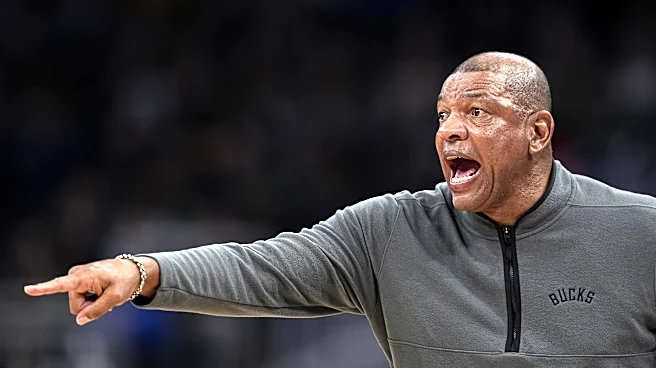
Doc Rivers into the Hall of Fame
I suppose this was, in some ways, a foregone conclusion.
The Basketball Hall of Fame seems to place a high value on longevity when it comes to coaches at all levels of the sport, and at this point in time, Doc is the only coach with more than 2,000 games under his belt that isn’t in the hall of fame. Heck, Bill Fitch is in the Basketball Hall of Fame with 2,050 games coached, and he’s got a losing record as a head coach.
But I think that time will not be kind to Doc’s reputation. To be sure, he’s got a pretty decent record, overall, 1192-863 as of this date, and it’s not out of the question that he could top Lenny Wilkens’ record for total games coached. Wilkens coached 2,487 games in his career, and Doc is sitting at 2,055 games. At the same time, Doc has morphed from a coach who could get the most out of his players to a guy who seems bent on blaming them for everything. There’s also the matter of the blown 3-1 playoff series.
The version of Doc that is coaching the Bucks these days seems a far cry from the “Ubuntu” Doc that led the Celtics to a title in 2008 and confidently hid $2,600 in the Staples Center locker room in 2010 to convince the team that they were going to make the Finals that year.
I kind of feel for the guy. It doesn’t seem like he enjoys coaching very much these days, and it makes me wonder why he keeps at it. Is he chasing Lenny Wilkens’ record? Does he not want to figure out life holds for him after he’s done coaching?

Another one bites the dust
The Lakers have shut Luka Doncic down for the rest of the season, meaning that he’s also going to miss the 65 game threshold for regular season awards.
Predictably, people are up in arms about this.
I stand by my observations from last week: There should be a declared minimum number of games played to qualify for awards that are quite literally based on the games one plays, and if that minimum cuts out a player due to injury, well, that’s just how these things work. If you want to get a regular season award, logic dictates that you participate in a significant number of regular season games.
Right now, you can take off every fifth game and still qualify for the MVP award. Lowering the threshold to 60 games would mean that you can take every fourth game off, which seems excessively lenient to me, and either abolishing the limit or lowering it further seems to be even less defensible.
And in Doncic’s case, he would’ve met the threshold if he had been less adept at incurring technical fouls.