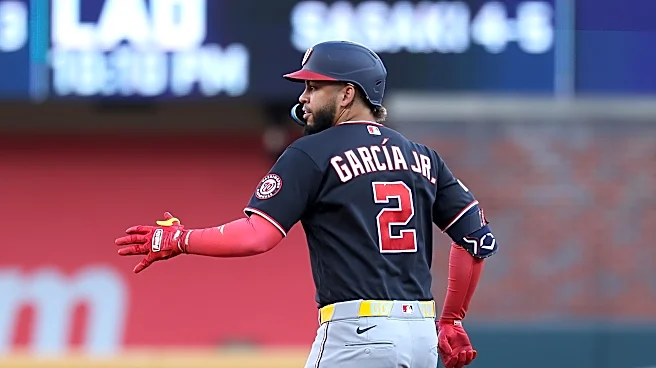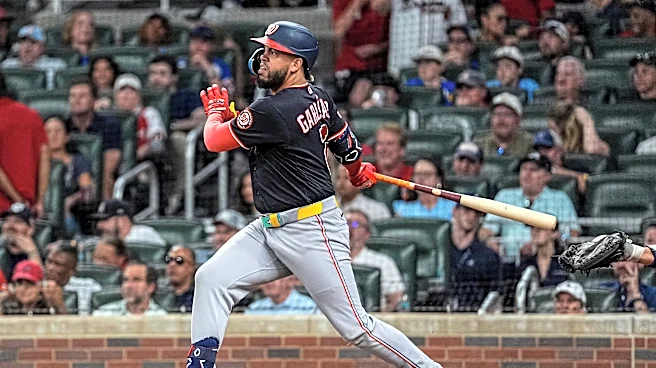




Once I returned to American soil on Saturday night, the Phillies started winning again. Now, they’ve been (theoretically) bolstered by a few trades, and are ready to make a run to the playoffs over the final two months of the season. On the other hand, their next opponent has raised the proverbial white flag on the 2026 season by trading away outfielder Luis Garcia, Jr.
Personally, if my team had a 26-year-old player experiencing a breakout season and still under control for another year, I’d try
to hold on to him. I might even go as far as to try to work out a contract extension with him. Instead, the Nats strategy seems to be constantly trying to turn one good player into multiple future good players.
It makes sense…to a point. The Nats have faith in their player development system, and based on recent results, they probably should. But at some point, don’t you have to actually commit to a core of players?
Opposition research: Jake Bird
One of the players – though far from the centerpiece of the deal – the Nats received in return for Garcia is reliever Jake Bird. Bird started his career in Colorado where he was regarded as a solid reliever, despite a somewhat elevated ERA (that’s to be expected pitching in Colorado). One year ago, the Yankees traded for Bird at the deadline, thinking he could help bolster their bullpen.
It didn’t work out that way.
Over three appearances with the Yankees, Bird gave up six earned runs in two innings and was quickly demoted to the minors for the rest of the season.
He started the season with the Yankees and picked up where he left off, giving up a lot of runs. He bounced between the majors and minors, and his last appearance with the Yankees might have been his worst yet: 0.1 innings, five earned runs.
Yankees fans were not exactly saddened to learn that he had been traded away:
I’m relieved the Phillies didn’t trade for him, because based on the bullpen management, he would have inevitably been placed in high leverage spots.
Remembering a guy who played for the Phillies and Nationals
Ben Revere played two and a half years for the Phillies and was generally fine. They acquired him from the Twins in exchange for Trevor May and Vance Worley and was installed as their new centerfielder. I hated that trade at the time. I thought the Phillies might pursue Justin Upton to play the outfield, and instead they traded for a guy with zero home runs in his first two full seasons.
Revere has some strengths: He had elite speed and racked up a lot of base hits. But he also had major weaknesses: He had almost no power and had an extremely bad arm. Defensively, his speed allowed him to cover a lot of ground, which was a necessity because he didn’t always take good routes to the ball.
In July 2015, the Phillies were going through a hard rebuild, and with a similar and (at the time) thought to be better player on hand in Odubel Herrera, the Phillies traded Revere to the Blue Jays. He was solid for the Jays, but they still traded him to the Nationals after the season.
For whatever reason, Revere absolutely tanked upon arriving in Washington. He suddenly lost his hit tool, batting just .217, and was worth negative one win above replacement. The Nats happily allowed him to leave as a free agent. After one poor season with the Angels, his major league career was done.
Hating on the Nationals
If the Nats want to go through a perpetual rebuild, I’m certainly not going to complain. They’ve already traded Garcia and Curtis Mead, and we’ll see what happens with their other young stars C.J. Abrams and James Wood (who slumped badly in the second half of 2025 and hasn’t played well since the All-Star Game this year).
Both of those guys were thought to be available last offseason, and presumably are off the trade block for the time being. Will the Nats commit to them, or will they trade them for prospects who might one day become All-Stars (Like C.J. Abrams or James Wood)?
Additional thought about the series
Luis Arraez has played good defense this season, but it has not been a historical strength. Presumably, Arraez stays at second, Bryson Stott moves to third, Alec Bohm goes to first, and Bryce Harper to the outfield. Maybe that works out, but it’s possible that the Phillies’ already poor defense gets even worse.
It also makes the top of the lineup even more lefthanded, although Arraez’s platoon splits are pretty even. On the plus side, it likely gives the Phillies a high-contact hitter to bat in front of cleanup hitter Kyle Schwarber. That’s what a lot of Phillies fans say they want. We’ll see how it works out in reality.