
It took me longer than a lot of Buckeye fans to get on the “Ohio State is going to repeat because almost everyone else is mediocre” train this season, not because I disagreed that most teams in the pool
were mediocre this year (aside from Indiana, I still feel that to be true), but because I was hyperfocused on—and hyper-critical of—the Buckeyes’ shortcomings. I did eventually get there somewhere around the win in Ann Arbor, but I spent most of New Year’s Day scrubbing off my clown makeup as a result.
Hindsight is twenty-twenty; we all know this to be true. But despite the defense looking like a new and improved model of last season’s exceptional group and a powerhouse wide receiver corps bolstered by Julian Sayin at quarterback, there were still areas for improvement in almost every game, sometimes glaring ones. So it was clear early on that despite having some of the most singularly talented people in college football on the roster and some of the most singularly talented coaches in college football on the sidelines, this was not a perfect team.
We can pick apart the losses to Indiana and Miami all we want (surely, there is much to mull over), but it won’t change the outcome of this season. Instead, I’m turning my attention toward what needs to change for 2026. If we’re hoping for a different outcome next season, there are three major non-negotiables the Buckeyes need to take care of.
Fix special teams
Special teams isn’t entirely to blame for the Cotton Bowl loss, but the unit is not innocent either. Jayden Fielding’s missed 49-yard field goal would have put the Buckeyes on the board right before halftime. It also would have meant a tie game following OSU’s second touchdown, early in the fourth quarter. While it’s anyone’s guess how that would have shaken out in the end, being tied is very different than being down, even by a field goal, from a momentum perspective.
Likewise, in the Indiana game, Fielding missed what should have been a chip shot—a 27-yard, fourth-quarter field goal that would have tied the game at 13-13, most likely pushing the game into overtime.
In fact, over the course of the season, two of Fielding’s four missed field goals were under 40 yards, and in 2024, he missed two additional kicks under 40 (both in that nightmarish loss to Michigan, a game the Buckeyes lost by just three points).
He has been inconsistent enough that when he lined up to take that 49-yarder, I texted my family, “They should have just gone long.” This is, I should note, an actively bad idea given the risk of being picked with a little time left on the clock, but what I was getting at was, “If we can’t rely on our kicker, why bother kicking? We needed points before half, and our better shot at doing that was to throw the ball.” Fielding should have been able to go out there and kick that ball. Sure, it’s a longer kick, but it was also in a dome where the weather was a non-factor.
And to be fair to Fielding, the special teams issues don’t start and stop with missed field goals this season. There were sloppy kick returns, sloppy punt returns, sloppy punts, turnovers, and the list goes on. Fielding is not alone in his inconsistency. The bigger issue is how little Ryan Day seems to be bothered about it.
Heading into 2026, Fielding has used up his eligibility, and the Buckeyes will need to replace him. Day has a responsibility to use this offseason to find someone who can consistently do the job, and while he’s at it, to fix the rest of the special teams issues as well, whether that’s via the transfer portal, new special teams coaches, or both.
Special teams might not be the bread and butter of a team like Ohio State, but it shouldn’t be a liability either. It’s an important part of any elite team’s strategy, sometimes even just as a clock management tool, and it’s one Day needs to address immediately if the Buckeyes want to get back to winning championships.
Inconsistency on the O-Line
When the offensive line was firing on all cylinders, boy, were they good. The win in Ann Arbor was a prime example of this, with the front five absolutely dominating all game, giving both the rushing and passing game room to breathe.
Still, this was not always the case this season. Even games with stellar offensive performances on paper, such as the 34-10 win over Purdue in early November, the offensive line looked iffy, with shaky blocking and blown assignments contributing to two sacks.
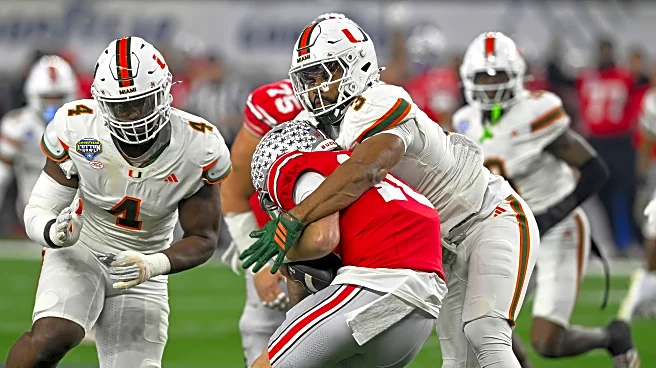
Similar issues continued against Indiana and Miami. Against both the Hoosiers and the Canes, the offensive line gave up five sacks—ten total in two games, compared to just six through the whole regular season.
Quarterback Julian Sayin largely managed to handle pressure well all season, maintaining composure impressive for any age, let alone a first-year starter. However, against Miami, he seemed rattled, uncharacteristically misfiring or often failing to get rid of the ball altogether behind poor pass protection.
Suffice it to say, had a less-talented quarterback and receiving corps been on the field this season, it’s quite possible OSU would have had more issues stemming from an inconsistent offensive line. It was also a factor in the Buckeyes’ inconsistent rushing this season. Heading into next year, Day and the coaching staff need to build out some depth in the offensive line, or it’s going to continue hampering an offense that otherwise has all the pieces to be the best in the country.
Make better use of the transfer portal
Largely, the solution for the two issues above and a whole host of other issues is to make better use of the transfer portal. The Buckeyes had some big wins following the 2024 National Championship, most prominently the addition of tight end Max Klare to the roster, but most of their eleven transfer portal additions were largely forgettable.
In some cases, like that of tackle Ethan Onianwa, who started at Rice University, the player wound up not being up to par. In others, like kicker Jackson Courville, the coaches never even gave him a shot, despite Fielding’s aforementioned issues. Courville is now back in the portal.
Day and his player evaluation staff cannot repeat these mistakes. They need to do a better job of truly identifying gaps in talent, finding the right guys (read: the best guys) for the job, and then, once we land them, giving them a shot to prove what they can do.
Whether you’re pro- or anti-transfer portal (I’m very pro), there’s no doubt it’s changing the coaching strategy at this level by giving the players more autonomy and choice. The Buckeyes are already seeing a mass exodus, less than a week after their Cotton Bowl loss. It’s up to Day to respond, and he should start by treating the portal as an asset to building the best team possible on all fronts, not just the showiest ones.