







By now, all Buffalo Bills fans know this — whether it be from visceral memories or from completed research they’ve read — the team’s defense flopped in playoff defeats during the Sean McDermott era.
As yet another reminder of those infamously disappointing defensive showings — in Buffalo’s eight playoff losses from 2017 through 2025, the opposition averaged a higher points-per-drive (3.83)… than the 2007 Patriots.
For an entire unit to make its opponents more efficient than the 16-0 (and ultimately
18-1) Tom Brady, Randy Moss, Wes Welker Patriots hints at drastic problems at every level.
Here, I want to focus on Buffalo’s pass rush and its presence as a core issue for the team even in the regular season over the past decade.
Related here — I’ve been on a mission to find advanced stats that track to winning the Super Bowl, because that is, of course, what the Bills have set in their sights on — and justifiably so.
For example, I discovered a few years ago that point differential is probably the best indicator of which team (or the cluster of teams) can win the Super Bowl in a given season. Check this out:
It’s currently my favorite statistical nugget pertaining to the NFL. Now, the below discovery is not nearly as straightforward, and it’s certainly not as predictive as regular-season point differential on the cusp of the playoffs.
In conducting research on the pass-rush units of recent Super Bowl winners, I found that said units either were incredibly deep or had an elite-level (like All-Pro caliber) defender on it.
Below are the amount of defenders the last 10 Super Bowl winners had who registered 20-plus pressures during the regular season. You will notice the trend right away.
2025 – Seahawks (7 players)
2024 – Eagles (7 players)
2023 – Chiefs (4 players but Chris Jones with 75 pressures)
2022 – Chiefs (5 players but Chris Jones with 77)
2021 – Rams (5 players but Aaron Donald with 86)
2020 – Buccaneers (5 players, Vita Vea had 16 in 5 games)
2019 – Chiefs (5 players but Chris Jones with 58)
2018 – Patriots (6 players)
2017 – Eagles (7 players)
2016 – Patriots (6 players)
The verdict over the past 10 years centers around an abundance of productive depth OR a superstar. In the case of the Chiefs and Rams, said superstar was an interior havoc wreaker. The average 20-plus pressure defenders for the last 10 Super Bowl winners is 5.7.
Of course, simply fielding seven defenders who ultimately register 20-plus pressures in the regular season is not magic — it won’t guarantee any team wins the Super Bowl.
But note the (albeit small) difference between those figures and the number of 20-plus pressure defenders the Bills had during the McDermott era from 2017 to 2025.
2025 – 4
2024 – 5
2023 – 5
2022 – 6
2021 – 6
2020 – 5
2019 – 6
2018 – 5
2017 – 4
That equates to an average of 5.1 players per season, which may not seem like a drastic disparity from the Super Bowl winners. In a sample size of 10, it’s noteworthy. And, heck, even if you don’t believe it is, it’s not as though the were Bills lightyears away from reaching a Super Bowl with McDermott as head coach, particularly from 2020 through last season.
The past two years, the losing Super Bowl team (Chiefs, Patriots) only had four 20-plus pressure defenders in the regular season before each of their respective runs to the big game. The two previous years featured the 49ers and their five 20-plus pressure defenders and Eagles with six such defenders being defeated in the Super Bowl.
Believe me, I understand how this may feel like a stretch. And it’s certainly a demonstration of correlation not necessarily implying causation.
However, Buffalo’s lack of pass rush is near of the top of the culprit list as to why the otherwise super-successful McDermott era didn’t even feature a Super Bowl appearance.
Here are the top pressure generators (and their regular-season pressure numbers) during the McDermott era, and I only included those who hit at least 50 pressures:
- 2025 Greg Rousseau (54 pressures)
- 2024 Greg Rousseau (63)
- 2023 Ed Oliver (65)
- 2020 Jerry Hughes (54)
- 2018 Jerry Hughes (74!)
Of course, it’s mostly been in the playoffs when the typically reliable McDermott defenses failed, and those downturns in production were typified by relative lackluster performances from the pass-rushing units.
In those eight playoff losses, the Bills generated a pressure on just 31.5% of the opposing quarterbacks’ dropbacks. Is that low? For context, that is ever so slightly below the pressure rate of the Chicago Bears pass rush in 2025, which was the 25th-best in football.
Frankly, a pressure rate under 32% in the playoffs is simply not good enough.
The easiest, quick-fix to this problem for the Bills — or any team for that matter — is to find an All-Pro caliber player in the front seven (or a tremendously productive blitzing cornerback or linebacker). Matt Milano is Buffalo’s last defensive front seven All-Pro. In that All-Pro season of 2022, he set a career high in pressures with 19.
The more challenging way to field what appears to be a Super Bowl caliber pass-rush unit is by loading up on talent. This is what the Bills have mostly done — and what most teams attempt to do.
Sure, the defensive front seven production over the past decade has not matched Brandon Beane’s pass-rush investments in it.
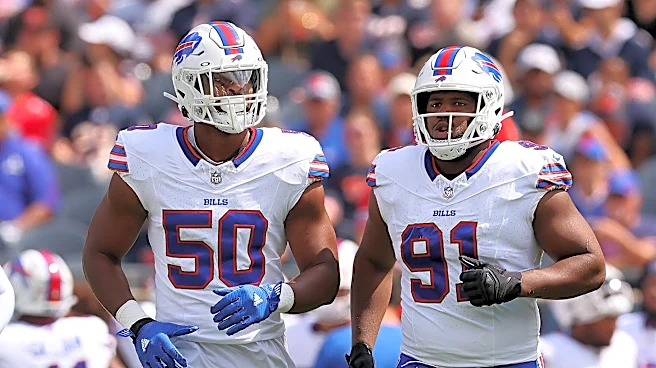
But now, with Bradley Chubb, second-round pick T.J. Parker, Greg Rousseau entering his prime, Ed Oliver close to being 100% healthy, a potentially healthier than expected Michael Hoecht, and plenty of newcomers on the interior, the Bills have their deepest pass-rushing group since Von Miller’s first season in Buffalo in 2022.
Some would say, the defensive front is clearly better than it was a season ago. I agree with that sentiment.
The Bills didn’t swing for the fences with a trade to acquire Myles Garrett or Maxx Crosby. They didn’t pony up big money for Trey Hendrickson.
Therefore what they should be/seemingly are aiming for is a defensive front that comes at opposing quarterbacks in waves and has as many as seven rushers who can register more than 20 pressures in the regular season.
Because that formula has worked well for teams that’ve recently hoisted the Lombardi Trophy in February.